Why Ganesha Worship Feels “Secret” in Japan: The Hidden World of Kangiten
Introduction
You walk into a Japanese temple expecting incense, bells, and quiet prayers.
Then you hear a rumor that stops you: “Ganesha is here… but you’re not allowed to see him.”
Not a replica. Not a tourist trinket.
A real, living object of worship—kept behind closed doors, sometimes inside a small shrine cabinet, revealed only on rare days (or not at all). That “hidden” detail is exactly why the devotion can feel mysterious.
If you’ve ever wondered why Ganesha worship is a secret in Japan—and why the statue is hidden—the answer is both simpler and more meaningful than most people expect.
The Japanese Ganesha Has a Different Name
In Japan, Ganesha is most commonly known as Kangiten (also associated with the title Shōten/Shōden). In many sources, he’s described as the Japanese Buddhist form of Ganesha/Vinayaka, adapted into Japan’s esoteric Buddhist traditions.
That’s the first “twist” for many Indian readers: this isn’t presented as “Hinduism in Japan” in the everyday sense. It’s Buddhist devotion that absorbed and transformed many deities over centuries, especially within esoteric lineages.
So when people say “Japan worships Ganesha,” what they often mean is:
- A Buddhist temple venerates Kangiten as a powerful god of bliss, success, and obstacle-related outcomes.
- The iconography and rituals follow Japanese Buddhist rules and taboos.
- And the “hidden statue” practice comes from Japanese religious culture—not from modern secrecy.
What “Hidden Statues” Mean in Japan
Japan has a long tradition of hibutsu—Buddhist icons concealed from public view.
These are not “forbidden idols.” They’re sacred images kept inside shrines or behind curtains/doors, sometimes revealed only during special ceremonies.
Why hide something holy?
Because in some Japanese religious thinking, concealment can emphasize:
- Potency (the icon is not ordinary)
- Purity (protected from everyday “pollution”)
- Ritual correctness (only certain rites, people, and times apply)
So when you hear “the statue is hidden,” it’s often less scandal and more: this image is treated as dangerously sacred.
Why Kangiten Statues Are Often Kept Hidden
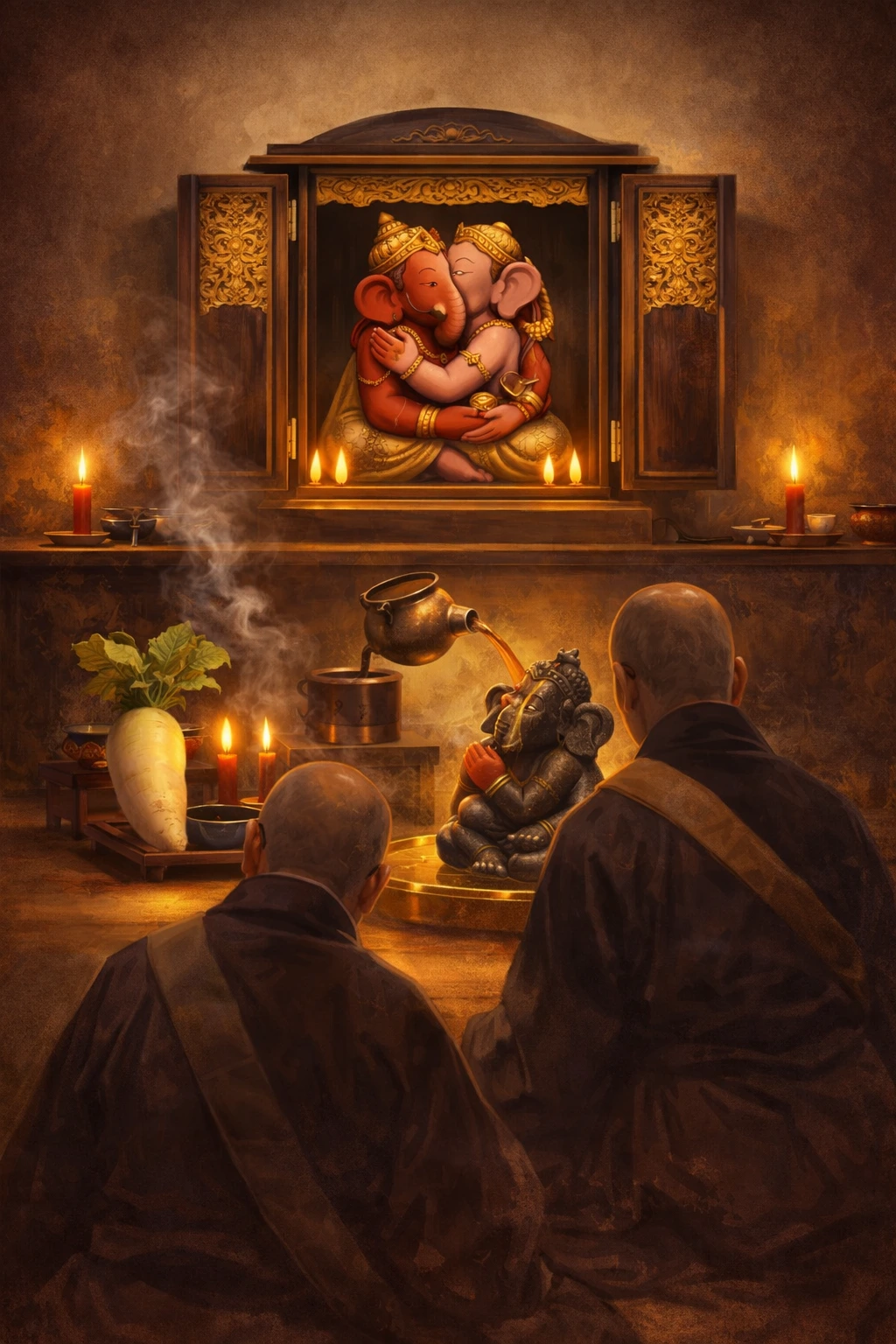
Kangiten is a special case even within “hidden icon” culture. Multiple sources note that many images of Shōten/Kangiten are kept inside miniature shrines (zushi) and are not shown publicly, with rites performed privately by qualified practitioners.
In plain language, there are three overlapping reasons.
Reason 1 — Esoteric rites are designed to be private
Kangiten devotion is tied to esoteric ritual practice. A famous example is the Oil Bath (Yokuyu) rite, which is described as highly sacred and typically restricted—performed out of public view.
When the ritual itself is private, the icon often becomes private too.
Reason 2 — “Too powerful to casually handle”
Many traditions around Kangiten emphasize his extreme efficacy—a deity who “works” quickly but must be approached with strict rules. Some summaries explicitly state that images can be considered too sacred to be seen, and that improper handling is discouraged.
Whether a modern reader believes this literally or symbolically, the outcome is the same:
temples keep the icon protected and ritually controlled.
Reason 3 — The dual embracing form makes people misread it
This is the part that fuels the “secret” rumor the most.
Kangiten is very often shown not as a single figure, but as a male-female pair with elephant heads embracing—the form known as Dual-bodied / Embracing Kangiten (Sōshin Kangiten).
Because the image can carry erotic symbolism, some temples treat it as something that should not be casually displayed, photographed, or gossiped about—especially in contexts shaped by social modesty.
A museum description even states that Kangiten images are often “secret images” (hibutsu) and not shown publicly because of their strong erotic meaning.
The Embracing Form: Sōshin Kangiten
If you only know the Indian Ganesha, the embracing icon can feel shocking at first glance.
But within tantric/esoteric symbolism, embrace is not automatically “pornographic.” It can point to ideas like:
- Union
- Harmony
- Balance of forces
- Prosperity and household success
That’s why many popular references connect Kangiten devotion with practical blessings—especially outcomes tied to fortune and personal life.
Travel and culture sources describe rare places where an “embracing” effigy is publicly visible—precisely because most are not.
Offerings and Rituals That Surprise Indians
Two things come up again and again in modern descriptions of Kangiten worship: daikon radish and specialized rites.
Daikon radish offerings
Multiple sources mention daikon radishes as a recognizable offering motif in certain Kangiten/Shōten contexts.
For Indian readers, this is delightful because it reframes “Ganesha loves sweets” into a local Japanese vocabulary of symbolic foods—without changing the emotional heart of devotion.
The Oil-Bath (Yokuyu) ritual
The Oil Bath rite (Yokuyu) is frequently described as a major Kangiten practice: warm oil is poured ritually over an image in a tightly regulated ceremony.
Whether you interpret this as literal “initiation,” symbolic purification, or temple heritage, it helps explain why:
- images may be small/metal for ritual handling,
- the rite is not performed casually,
- and the icon is not treated like a public display object.
Where People Encounter Kangiten Today
If you’re looking for real-world anchors (not just theory), several well-known sites appear across reputable explainers.
Matsuchiyama Shoden (Tokyo)
This temple is widely associated online with Shōten/Kangiten devotion and daikon offerings, and its official English page highlights Yokuyu (oil-bathing) as a major ritual practice.
Menuma Shōdenzan Kangi-in (Saitama)
Some descriptions of Kangiten tradition note that a key exception to “never displayed” exists—where a main icon is put on public display intermittently (go-kaichō).
Why some places show the icon publicly
Not all temples follow identical rules. Some emphasize:
- public devotion and festivals,
- heritage tourism,
- or specific historical customs that allow periodic viewing.
That variation is exactly why it’s risky to claim “Japan hides Ganesha” as a universal rule. The more accurate statement is:
Many Kangiten icons are treated as hidden sacred images, but practices differ by temple and lineage.
Conclusion: What the “Secret” Really Means
So why does Ganesha worship feel “secret” in Japan?
Because Kangiten devotion sits at the intersection of three things:
- Japan’s tradition of hibutsu (hidden sacred icons),
- esoteric ritual privacy (like the oil-bath rite), and
- a widely used icon—the embracing Sōshin Kangiten—that outsiders can easily misinterpret.
When you put those together, a closed shrine door starts to look like a conspiracy.
But more often, it’s the opposite: a sign that the temple believes this image is alive with meaning—and deserves careful handling, not casual viewing.