Why Are Hindu Gods Compared to Aliens? The Hidden Story Behind the Theory
Introduction
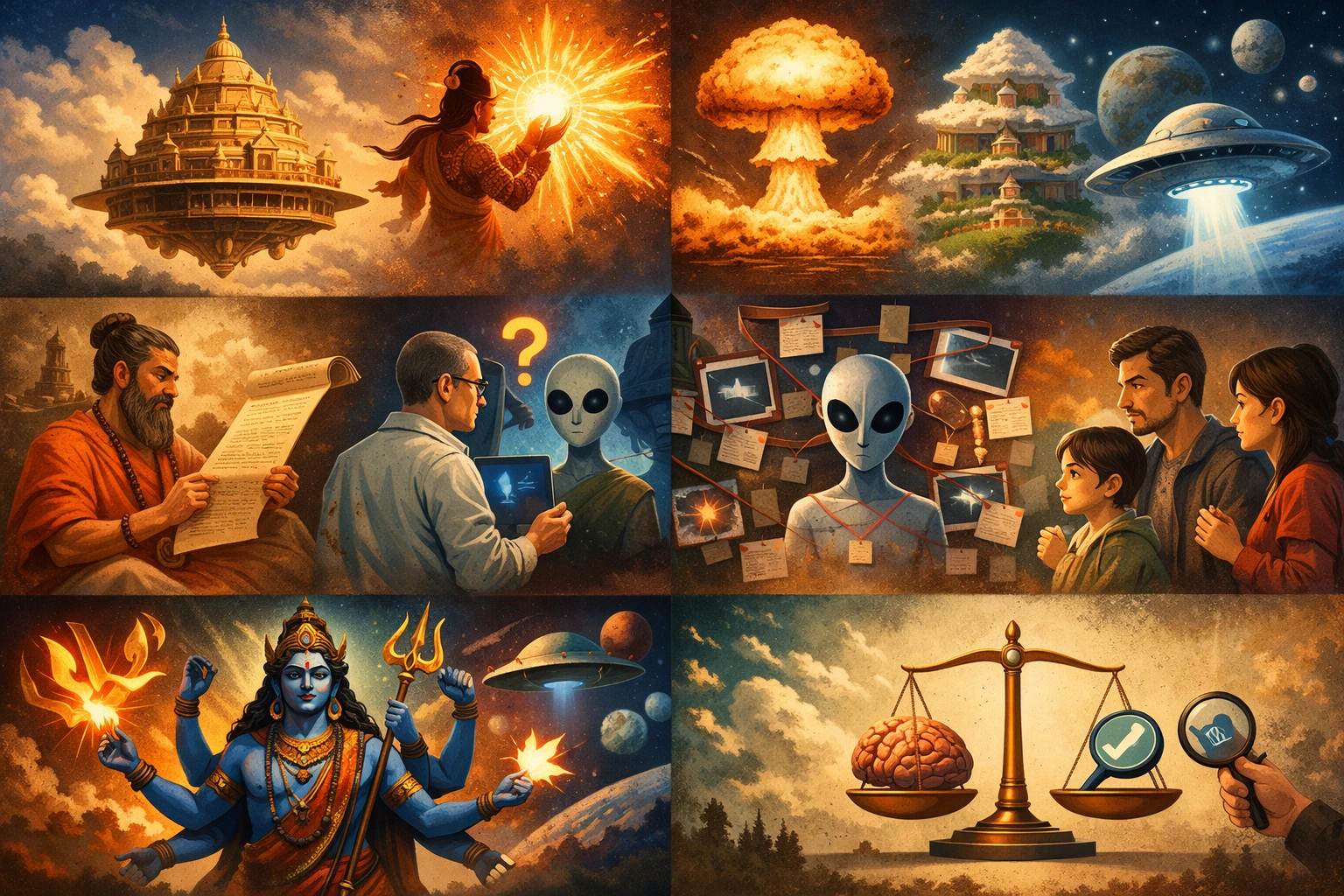
You’re reading an ancient story. A “vehicle” moves through the sky. A weapon shines like a thousand suns. A being appears blue, multi-armed, and impossibly powerful.
Here’s the twist: the strangest part isn’t the story—it’s what we do next.
Because in the modern mind, there’s a shortcut that feels almost irresistible: if it sounds like advanced technology, it must be aliens.
This is why Hindu gods are often compared to aliens: not because Hinduism “needs” UFOs, but because ancient symbolism + epic scale + modern sci-fi language creates a perfect illusion. Let’s unpack the real reasons the comparison keeps showing up—without mocking anyone’s faith, and without swallowing viral claims whole.
The “Alien Gods” idea in one sentence
The “Hindu gods aliens” theory usually says: ancient people saw advanced beings or tech, misunderstood it, and called it divine.
It’s compelling because it flatters the modern brain:
- “I’m being scientific.”
- “I’m decoding a hidden truth.”
- “I’m reading between the lines.”
But there’s a catch: epics and sacred stories aren’t instruction manuals. They are meaning-machines—built to carry philosophy, ethics, devotion, and awe.
So when we treat poetic language like a technical report, we can make almost anything sound like a UFO file.
Vimanas: mythic sky-vehicles, not UFO schematics
If you’ve ever Googled “Hindu gods aliens,” you’ve likely met the word vimana within minutes.
What a “vimana” is in epics and later retellings
In Hindu literature, vimanas are described as flying palaces or chariots—a way of expressing divine movement, cosmic scale, and majesty. Some stories describe famous vehicles like the Pushpaka vimana, linked with royal power and mythic travel.
To a modern reader raised on spacecraft, “flying palace” can sound like:
- a ship,
- a cockpit,
- a hovering craft.
To a traditional reader, it can also read as:
- a symbol of sovereignty,
- a sign of divine favor,
- a narrative device (how else do you move characters across vast, mythic distances?).
The common misunderstanding: treating poetry like a blueprint
Epic storytelling uses:
- exaggeration (to highlight stakes),
- luminous imagery (to create awe),
- metaphors (to compress meaning).
That’s why comparisons like “vimana = UFO” spread so quickly: they’re easy, visual, and exciting.
But “sounds like” isn’t the same as “is.”
The modern text problem: Vaimānika Shāstra and why scholars flag it
A big online driver of “ancient Indian aircraft” claims is a text called the Vymānika (Vaimānika) Shāstra. The issue: researchers have argued it’s modern-era, and an engineering critique from the Indian Institute of Science (1974) concluded the aircraft described are not feasible as real flying machines.
That doesn’t erase the beauty of mythic vimanas in epics—but it does mean we should be careful when a modern document is presented as proof of ancient aerospace engineering.
Brahmastra and the “ancient nukes” comparison
Another reason “Hindu gods aliens” content goes viral is the claim that Hindu epics describe weapons like nuclear bombs—often centered on Brahmastra.
How metaphor and scale work in epic storytelling
In epic traditions worldwide, the most powerful weapon is described in world-ending language because it represents:
- absolute power,
- moral consequence,
- the danger of pride,
- the need for restraint.
So when a story says a weapon blazed like the sun, modern readers may jump to radiation and blast waves.
But ancient authors also used “sunlike” language for:
- enlightenment,
- divine presence,
- overwhelming force in a moral sense.
What to ask before believing a viral quote
Before accepting “Brahmastra = nukes,” try this quick filter:
- Is the quote shown with an exact text reference (book, section, verse)?
- Is it from a primary translation, or a meme graphic?
- Does it interpret imagery as literal hardware without explaining symbolism?
You can keep the wonder and keep your standards.
Hindu cosmology and “many worlds”
A subtler fuel for the “alien gods” theory is Hindu cosmology—which includes layered worlds, vast time cycles, and many realms of existence.
Lokas, layered universes, and symbolic geography
Reputable references describe Hindu cosmology as an elaborate, multi-layered structure—often presented as many divisions or regions of the universe (lokas), with mythic geography expressing philosophical ideas about order, duty, and the nature of reality.
To a modern sci-fi fan, “many worlds” can sound like:
- exoplanets,
- dimensions,
- multiverses,
- alien civilizations.
The difference between “many realms” and “extraterrestrial visitors”
Here’s the key distinction:
- Cosmology answers: What is reality like? How is existence structured?
- Alien visitation claims: Physical beings traveled here from another planet.
The first can be philosophical, symbolic, spiritual, and mythic.
The second is a historical/scientific claim that requires physical evidence.
That’s why Hindu cosmology can inspire cosmic curiosity—without automatically implying UFOs.
Why gods look “otherworldly” in art
Let’s be honest: sometimes the alien comparison starts with a picture.
Blue skin. Multiple arms. A third eye.
It looks “non-human,” so people assume: non-human = extraterrestrial.
But Hindu iconography is a visual language.
Multiple arms as meaning (power, omnipresence, many skills)
Multiple arms commonly communicate:
- many abilities at once,
- divine reach beyond human limits,
- simultaneous protection and blessing.
It’s not “biology.” It’s symbolism.
Blue skin, third eyes, and visual symbolism
Colors and features do work, too:
- blue can signal vastness (sky, ocean), divinity, or transcendence,
- a third eye can signal insight and transformation—seeing beyond surface reality.
When you read the art as “literal anatomy,” it becomes alien.
When you read it as “meaning,” it becomes a visual philosophy.
Why Ancient Astronaut Theory keeps returning
The phrase ancient astronaut is basically a story template:
- Find an ancient description that sounds impressive.
- Translate it into modern tech language.
- Conclude: “It must have been aliens.”
A simple pattern: technology + distance + time = “aliens”
The farther back a story is, the easier it is to project mystery onto it.
And the more poetic a text is, the easier it is to reinterpret:
- chariot → craft
- thunderbolt → energy weapon
- celestial beings → extraterrestrials
How pop culture amplifies it
TV episodes, YouTube explainers, and short clips reward:
- big claims,
- dramatic visuals,
- confident narration.
It’s entertainment first, scholarship second. (And it can still be fun—as long as we remember which is which.)
A respectful way to discuss this around faith and family
If you’re a parent or educator, this topic can get sensitive fast.
Try framing it like this:
- “Some people interpret myths through sci-fi.”
- “Others read them spiritually and symbolically.”
- “Let’s separate what the text says from what we imagine.”
That keeps curiosity alive without turning a living tradition into a conspiracy prop.
A balanced take: keep wonder, lose false certainty
You don’t have to choose between:
- “It’s all aliens,” and
- “It’s all nonsense.”
A smarter middle path is:
- myth as meaning, and
- curiosity with evidence standards.
Critical thinking checklist (fast, friendly, usable)
When you see a “Hindu gods aliens” claim, ask:
- Source check: Is it from a reputable reference or a viral montage?
- Text check: Does it cite a specific verse/section, or just vibes?
- Genre check: Is it epic poetry, theology, folklore, or modern fiction?
- Category check: Symbolic cosmology vs physical visitation—are they being mixed?
- Evidence check: What proof exists beyond interpretation?
That’s not “debunking.” That’s reading well.