The Transformation of Medusa: The Hidden Story Behind the Monster
Introduction
There’s a strange secret hiding inside the Medusa myth: the “monster” isn’t always the beginning of the story. Sometimes, she’s the ending.
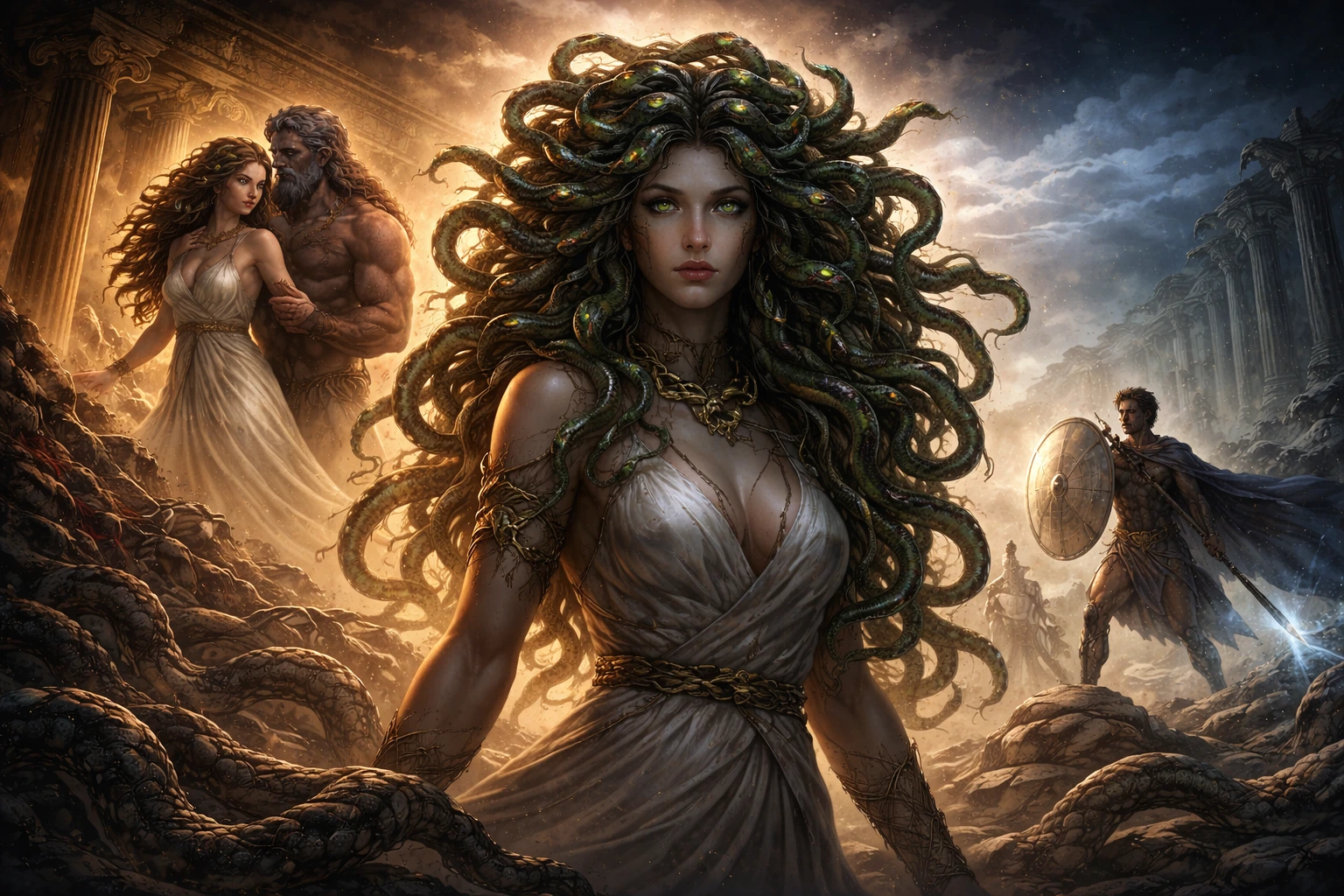
In many retellings, Medusa appears fully formed—snakes hissing, eyes deadly, fear guaranteed. But look closer and the Medusa transformation starts to feel less like a horror scene… and more like a warning about power, blame, and what happens when someone else controls your narrative.
Who Was Medusa Before the Snakes?
To understand the Medusa myth, it helps to know one simple truth:
Greek mythology isn’t a single book. It’s a library.
That’s why Medusa’s “origin” changes depending on which ancient voice you’re listening to—and which later storyteller reshaped the tale.
The “Gorgon from the start” tradition
In older strands of the tradition, Medusa is a Gorgon—one of three sisters—already monstrous in nature. She’s famous for a gaze that petrifies and for being the only mortal among the trio, which makes her vulnerable to a hero’s blade. Encyclopaedia Britannica keeps this core profile front and center: Medusa is a Gorgon, deadly to behold, and slain by Perseus.
This version is crisp and mythic: monster exists → hero must defeat her.
The “beautiful mortal” tradition (and why it’s so popular)
But later storytelling leans hard into another angle: Medusa as a beautiful woman before her fall—often emphasizing her hair, her radiance, and her life as a priestess.
That version grips people because it flips the emotional stakes. Suddenly, the Medusa transformation isn’t just an event. It’s a tragedy.
And tragedies make us ask uncomfortable questions: Who gets punished? Who gets protected? Who gets remembered as the villain?
What Really Happened in Athena’s Temple?
This is where the Athena curse debate begins.
Many modern tellings say Medusa was violated by Poseidon (or Neptune, in Roman naming) inside Athena’s temple, and Athena responds by transforming Medusa—snakes for hair, a petrifying gaze, exile by consequence. Britannica summarizes this well in its “why was Medusa cursed?” explanation.
But it’s worth noting something students rarely hear:
Different eras told this scene differently.
Some traditions emphasize desecration of a sacred space. Some make it an “affair.” Some frame it as assault. And some older depictions don’t focus on a temple incident at all.
That doesn’t mean “anything goes.” It means myths are cultural mirrors: they reflect the values, anxieties, and politics of the people retelling them.
What later sources say (and what they don’t)
Roman-era retellings—especially the influence of Ovid’s Metamorphoses—helped popularize the “beautiful Medusa punished afterward” framing. Modern museum and academic explainers often point out how the story evolves across time and representation.
Why myths often blame the vulnerable
Even if you keep the story at a high level, the emotional engine is clear:
- Medusa is harmed.
- Someone powerful caused it.
- Medusa pays the price.
That pattern appears across myths worldwide, not because ancient audiences were “the same as us,” but because myth often dramatizes how societies handle power—sometimes brutally.
Why Did Athena Curse Medusa? Three Interpretations
If the Medusa myth feels unfair, you’re not imagining it. That tension is why the story has survived.
Here are three common interpretations readers encounter—each changes how you read the Medusa transformation.
1) Desecration of the temple
In this reading, Athena reacts to the violation of sacred space. Medusa becomes the visible symbol of what happened, carrying the stain of desecration even if she didn’t choose it.
This interpretation explains the “why her?” logic in myth terms—but it doesn’t make it feel just.
2) Power dynamics among gods
Athena and Poseidon are not equals in every telling, and gods in myth frequently avoid punishing other gods the way they punish mortals.
So the story can be read as divine politics: the mortal becomes the easiest target.
3) “Protection” that still feels like punishment
Some modern readers argue the curse is a twisted kind of protection: the petrifying gaze ensures no one can ever approach Medusa again without consequence.
But protection that isolates you, frightens others away, and turns your body into a warning sign still has a cost.
And that cost—loneliness—becomes part of what makes Medusa compelling.
Life as a Gorgon
After the Medusa transformation, the story often shifts from society to solitude.
You’ll see recurring images across retellings:
- Snake hair that replaces once-admired beauty.
- A petrifying gaze that makes connection impossible.
- A reputation that grows faster than the truth.
In the Gorgon story, “monster” becomes a label that does real work:
- It justifies fear.
- It invites conquest.
- It turns complex pain into a simple target.
If the world calls you a monster long enough, myths suggest, the world eventually comes looking for a hero to slay you.
Perseus and the Death of Medusa
Here is the turning point most people remember: Perseus and Medusa.
Perseus is tasked with bringing back Medusa’s head. He receives divine help and uses a reflective shield so he can approach without meeting her eyes—one of the most iconic details in the Medusa myth.
The mirrored shield strategy
The shield matters because it’s not just a tool—it’s symbolism.
Perseus defeats Medusa indirectly, through reflection. He cannot look at her directly and survive.
That detail raises a quiet question: if the gaze is dangerous, is it because Medusa is evil… or because her gaze reveals something others can’t face?
Pegasus and Chrysaor
In many tellings, when Medusa is killed, Pegasus (the winged horse) and Chrysaor are born from her blood—often described as children linked to Poseidon. Britannica Kids includes this as a simple summary point that’s surprisingly powerful: even in death, Medusa becomes the source of something extraordinary.
At the end of the Perseus Medusa arc, her head remains potent. Perseus uses it as a weapon, and the image becomes protective in later symbolism, including Athena’s aegis in many retellings.
Themes That Keep Medusa Relevant
The Medusa myth isn’t popular because it’s tidy. It’s popular because it’s emotionally loud.
Beauty as danger
Medusa’s beauty is treated like a magnet—something that attracts power, envy, and entitlement.
The uncomfortable implication is that beauty becomes a risk not because it’s “bad,” but because others feel licensed to take.
Misplaced blame and injustice
The Athena curse debate is essentially a debate about blame:
- Was Medusa punished for what she did?
- Or for what happened to her?
Readers keep returning to Medusa because her story echoes a familiar human experience: being defined by an event you didn’t control.
Transformation as tragedy—and as survival
The Medusa transformation is horrifying. But it’s also a survival story in the weird logic of myth.
Once she is a Gorgon, she is no longer approachable. No one can harm her without consequence.
And that’s the sharp paradox at the center of the Gorgon story: the thing that protects her also isolates her.
Medusa in Art and Modern Culture
Medusa is not only a myth figure; she’s a visual icon.
The Metropolitan Museum of Art describes how Medusa’s image shifts across time—from more monstrous forms to increasingly human and feminine depictions, especially from the classical period onward.
That change matters because art shows what a culture is willing to imagine:
- A monster mask used to ward off evil.
- A tragic woman used to explore fear, desire, and power.
- A symbol reclaimed in modern contexts as protection and defiance.
Modern Medusa often appears as:
- A warning about injustice.
- A figure of resilience.
- A challenge to easy hero-villain storytelling.
Not because the ancients intended that exact message, but because the myth has enough tension to carry new meanings.
How to Talk About Medusa (Parents, Students, Educators)
The Medusa myth is a great teaching story because it’s layered. Here are ways to approach it without turning it into either “pure horror” or “pure empowerment.”
For parents: pick an age-appropriate version
- Younger kids: Focus on the adventure structure (Perseus’ quest, clever tools, consequences of looking). Use the “monster” framing gently.
- Teens: Introduce the idea that myths have versions—and ask what changes and why.
- Older teens: Discuss blame, power, and how stories treat victims.
For students: compare versions like a detective
Try questions like:
- What details stay the same across tellings (snakes, gaze, Perseus)?
- What details shift (beauty, temple incident, Athena’s motive)?
- What does each version seem to teach?
For educators: turn controversy into critical thinking
Discussion prompts:
- “Is Medusa a monster, a victim, or both?”
- “What makes a story ‘canonical’ if myths change?”
- “How does the hero story look if we center Medusa instead?”
The goal isn’t to force one interpretation. It’s to show students how narratives shape empathy.
Conclusion
The secret inside the Medusa myth is that it doesn’t stop at “monster.”
It asks why some people get remembered as threats when they were first hurt. It asks why power is so often protected by turning someone else into the warning sign. And it asks what happens when survival comes packaged as a curse.
If you only see the snakes, you miss the story.