The Rainbow Serpent Myth: How Fuxi and Nuwa Created Humanity (and Order)
Introduction
Something strange happens in the oldest stories: the world ends… and the gods don’t panic.
They build.
In one Chinese mythology tradition, two serpent-bodied siblings stand in the quiet after catastrophe and decide the next chapter of humanity won’t happen by accident. It will be shaped—by hand, by mud, and by rules that turn survival into society.
This is the creation myth of Fuxi and Nuwa—a tale that doesn’t just explain where people came from, but how people learned to live together.
Why This “Rainbow Serpent” Myth Still Feels Alive
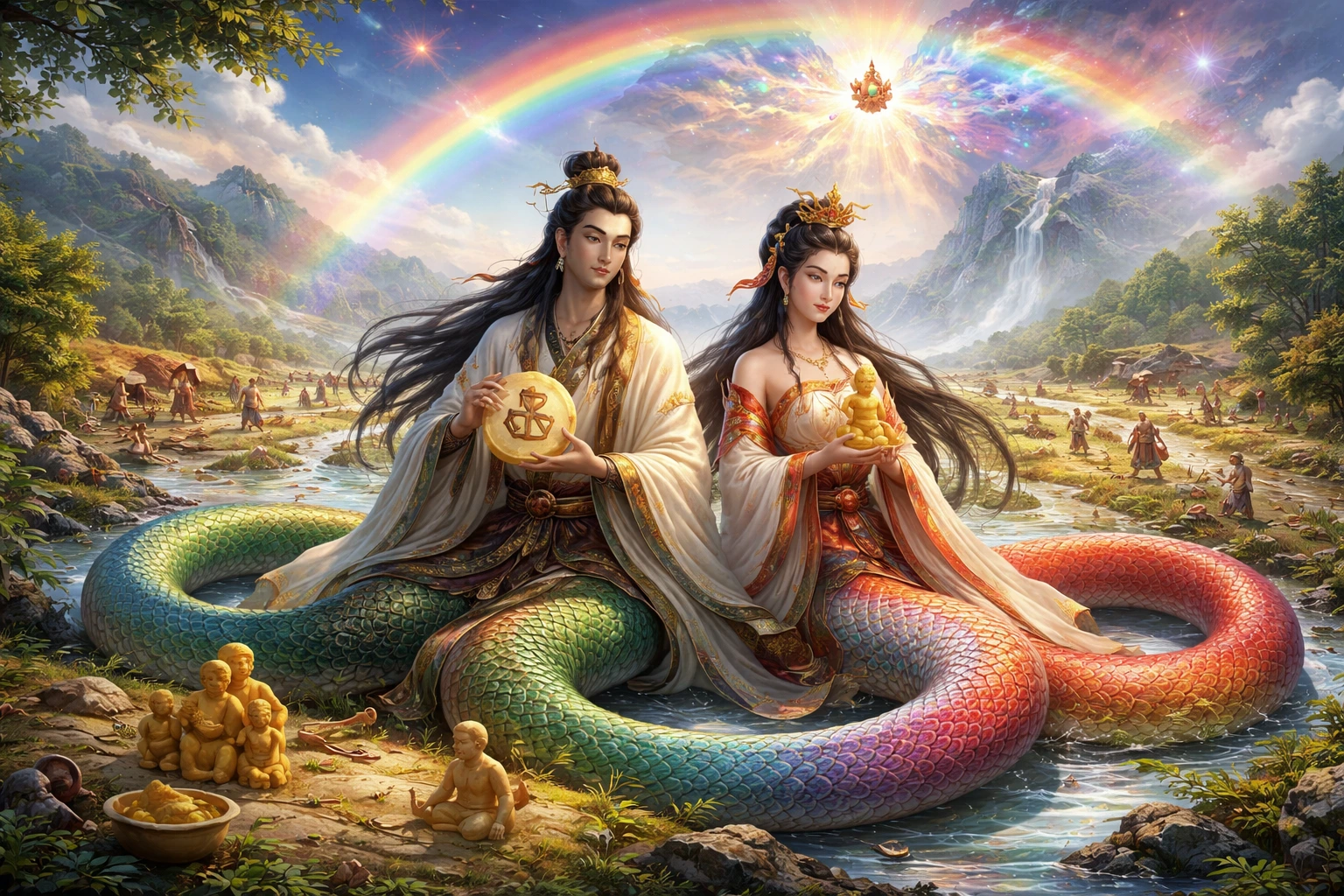
In Chinese mythology, Fuxi and Nuwa are often shown with human torsos and serpent bodies—sometimes their tails even intertwine. That image isn’t random decoration. It’s a visual shortcut for a big idea: human life is braided into nature, earth, and sky.
What “serpent-bodied” gods symbolize in Chinese mythology
Snakes shed skin. They move between water and land. They can look ancient and newborn at the same time. So when Fuxi and Nuwa appear as human-serpent beings, the myth is quietly saying: humanity belongs to cycles—seasons, floods, growth, renewal.
A quick note on why myths have multiple versions
If you’ve heard different details—siblings vs spouses, clay vs cord vs flood—it doesn’t mean one is “wrong.” Myths travel. Regions retell them. Dynasties reshape them. The core stays: Fuxi and Nuwa are linked to the beginning of humans and the beginning of order.
Who Are Fuxi and Nuwa?
In many versions, Fuxi and Nuwa are described as foundational ancestors—sometimes “Father of Humanity” and “Mother of Humanity” in spirit, even when the text uses different titles.
Father of Humanity vs Mother of Humanity (roles and titles)
- Fuxi is commonly treated as a culture hero: he brings skills, tools, and social structures.
- Nuwa is strongly associated with creating humans—and later, repairing the world when it breaks.
Siblings, partners, or both? How to read the variations
Some traditions describe them as siblings; others describe them as a married pair. Britannica even notes Nuwa (Nu Gua) as wife or sister of Fu Xi in different tellings.
A helpful way to read this: ancient societies used myth to explain how “family” and “community” began. In that context, Fuxi and Nuwa symbolize the first partnership that makes civilization possible—however the story frames the relationship.
The Creation of Humanity (The Clay, the Cord, and the Flood)
Here’s the part most people remember: Nuwa makes humans from earth.
But the myth has a twist: it also explains why people are different, why society has layers, and why creation sometimes shifts from careful craft to messy efficiency.
Nuwa’s yellow clay humans (handmade vs “mass-made”)
In a well-known version, Nuwa molds people from yellow earth or yellow clay. Then she gives them life.
But creating each person by hand is slow—so another version adds a “mass production” method: she drags a cord or string through mud, creating many humans at once.
If that detail feels oddly practical for a creation myth, that’s the point. This isn’t just a magical origin story. It’s a story about scale: how a world goes from empty to populated.
The flood-survivor version: repopulating a reset world
UNESCO highlights a foundation-myth framing where Fuxi and Nuwa are the only survivors of a great flood and are charged with repopulating the world—often by creating clay figures and bringing them to life.
This flood element matters because it shifts the tone:
- The world isn’t born perfect.
- The world is rebuilt after loss.
- Creation is an act of responsibility.
What these versions explain about society and diversity
Why include both “handmade” and “mud-made” humans? Some later interpretations treat it as a mythic explanation for social difference—why status exists, why people have varied origins. Wikipedia’s Nuwa entry summarizes these variants and their social readings.
Whether or not you accept that message today, the storytelling goal is clear: Fuxi and Nuwa don’t just create bodies—they create a human world, with complexity included.
The Skills That Turn “People” Into a “Community”
If the story ended at “humans exist,” it would be simple.
But Chinese mythology often asks a deeper question: How do humans stop being helpless?
That’s where Fuxi and Nuwa become teachers.
Fishing, hunting, and nets (survival with rules)
Fuxi is repeatedly credited as a bringer of practical knowledge—teaching people how to fish and hunt, including the idea of nets. Britannica’s discussions of Fu Xi emphasize this “teaching humanity” role.
This isn’t just about food. It’s about learning the boundary between taking from nature and living with it.
Farming and domestication (stability and seasons)
In the broader “culture hero” tradition, Fuxi is also linked to domesticating animals and shaping early subsistence practices.
The hidden message: once humans can plan for tomorrow, they can build homes, store grain, and protect children. Civilization begins when life stops being one long emergency.
Marriage and family rituals (social harmony)
Both Britannica and other reference traditions connect Nuwa and Fu Xi to norms around marriage and conduct—mythic explanations for why families become formal institutions.
In other words: Fuxi and Nuwa don’t only populate the world. They help organize it.
Nuwa Repairs the Sky (The Myth After the Myth)
Just when the world feels stable, another disaster hits.
And Nuwa doesn’t create something new—she repairs what already exists.
Five-colored stones and cosmic repair
A major Nuwa myth says she patches the sky using five-colored stones after a catastrophe damages the heavens. This “mending the heavens” story is one of her defining legends.
Even in a short summary, the symbolism is powerful:
- The world can break.
- Repair is sacred work.
- Protection is part of creation.
Why “mending heaven” matters as a cultural idea
In a lot of stories, heroes win by defeating enemies.
In this one, Nuwa wins by doing something quieter: restoring balance.
That’s why the myth lasts. It treats care, rebuilding, and responsibility as heroic.
Fuxi, the Bagua, and Cosmic Patterns
Now for the part that often gets reduced to a trivia sentence: “Fuxi made the eight trigrams.”
But that line hides a worldview.
The eight trigrams in plain language
The bagua (eight trigrams) are symbols used to describe patterns of change—often discussed alongside the I Ching tradition. Britannica describes Fu Xi as connected to revealing or making known the bagua and teaching symbolic systems.
You don’t need to study divination to get the myth’s meaning:
- Life changes.
- Nature has rhythms.
- Humans can learn to read patterns instead of fearing chaos.
Mythic “patterns” as a way to make sense of life
In the story logic of Chinese mythology, Fuxi and Nuwa create humanity, then help humanity understand the world—how it shifts, repeats, and transforms.
Creation is not only an origin.
Creation is a lesson plan.
Lessons for Parents, Students, and Educators
Here’s how to make the Fuxi and Nuwa creation myth useful beyond “a cool story.”
Parents: discussion starters (kindness, balance, nature)
Try questions like:
- “Why do you think the gods look part human and part serpent?”
- “What does it mean to rebuild after a flood?”
- “Which is harder—creating something new or fixing something broken?”
Keep it gentle. If your child asks about the sibling/partner versions, you can say: “Different places told the story differently, but they always worked together to help humans.”
Students: compare versions in 5 minutes
Make a quick chart:
- Humans made from yellow clay (careful, individual).
- Humans made with cord/string in mud (fast, many at once).
- Humans made after a great flood (repopulation).
Then ask: what does each version explain about people or society?
Educators: a mini-activity (symbol + story mapping)
Have learners match each myth element to a theme:
- Serpent bodies → nature + renewal
- Clay → shaping identity
- Flood → reset and resilience
- Sky repair → restoration and responsibility
- Eight trigrams → patterns and change
This turns the creation myth into a toolkit for reading symbolism.
Conclusion
The secret at the heart of Fuxi and Nuwa is that they don’t just “make humans.”
They make:
- a world after disaster,
- a society after loneliness,
- and meaning after chaos.
That’s why the rainbow-serpent image lingers: humanity is not separate from nature. It’s braided into it—mud, water, sky, and story all together.