The Mysterious Tale of Yurei: Japan’s Haunting Spirits (Explained)
Introduction
There’s a hidden rule in Japanese ghost stories that most movies never say out loud.
A yurei doesn’t appear just to scare you.
It appears because something in the world is out of place—a betrayal that never got answered, a grief that never softened, a goodbye that never happened.
And until that imbalance is corrected, the yurei stays.
The secret rule of yurei
Yurei (幽霊) are often translated as “Japanese ghosts,” but the folklore logic is a little sharper than that.
A yurei is typically a human spirit that can’t settle after death because something is still burning—rage, sorrow, jealousy, devotion, regret. In story terms, that emotion becomes a tether.
That’s why yurei aren’t usually random.
They’re specific.
- Specific to a person (the betrayer, the witness, the one who “should’ve known”).
- Specific to a place (a home, a road, a well, a room).
- Specific to a moment (the night of the crime, the anniversary, the hour that repeats).
And here’s a helpful comparison many readers look for:
Yurei vs yokai (quick lens):
- Yurei = “a someone” (a human spirit with a past).
- Yokai = “a something” (a creature, phenomenon, or eerie presence).
That distinction is one reason yurei stories feel emotionally heavy. You’re not just being chased by a monster.
You’re being chased by a story that refuses to end.
What yurei look like and why
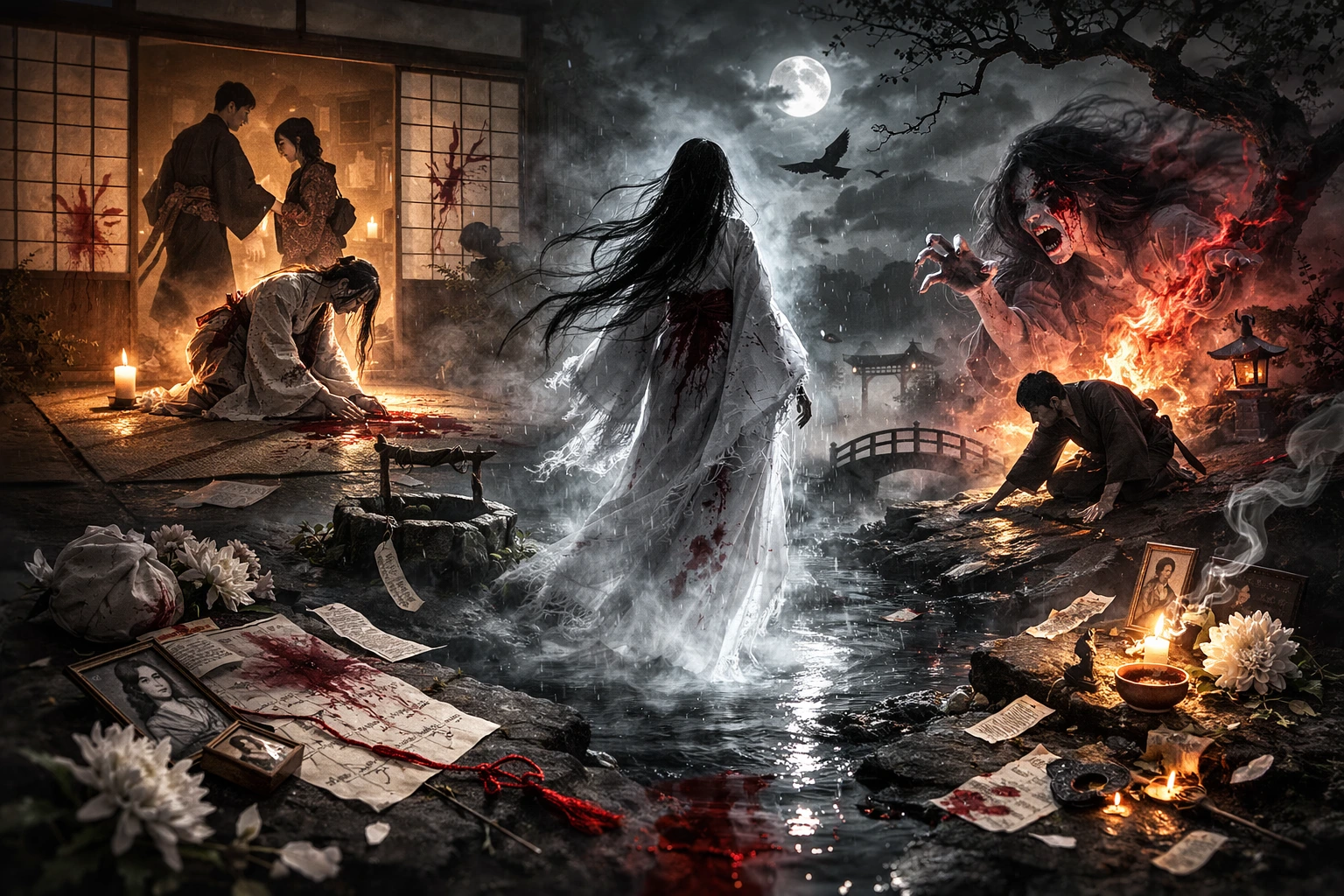
Even if you’ve never studied Japanese folklore, you probably recognize the classic yurei image:
- White clothing
- Long black hair
- A floating presence that seems… slightly unfinished
That look didn’t come out of nowhere. It’s tied to how death, purity, and remembrance show up in older traditions.
White burial clothing and ritual purity
Many depictions dress yurei in white because white is strongly associated with ritual purity and funerary customs. The “ghost outfit” is often connected to burial clothing, which makes the image feel less like a costume—and more like a reminder.
So when a yurei appears in white, the story is quietly signaling: this is not a playful haunting. This is the dead, unresolved.
Hair, face, floating—why it stuck
Long, loose hair is part practical stage language and part symbolism. In older performance and visual art traditions, disheveled hair reads as a break from normal social order.
The floating effect—sometimes shown as missing feet or legs—works like a visual shortcut: not fully of this world.
Symbols you’ll see around yurei
Depending on the tale, you might see:
- Paper charms (often called ofuda) used for protection or sealing.
- A triangular head cloth (often shown in art and theater).
- Strange lights or flames hovering nearby in illustrations.
Not every story uses all of these, but they’re part of the shared “visual vocabulary” that yurei stories built over time.
The yurei types you’ll hear most
Once you start reading, you’ll notice yurei isn’t just one category. It’s more like a family of story patterns.
Here are the ones that show up again and again.
Onryo: the vengeful yurei
If yurei are the umbrella, onryo are the thunderstorm.
An onryo is a yurei driven by a grudge—often created by betrayal, cruelty, injustice, or humiliation. Onryo stories warn that some harms don’t disappear just because time passes.
They echo.
Ubume and other tragic returners
Some yurei tales center less on revenge and more on unfinished care—like the spirit of a mother who died too soon, or someone who can’t stop worrying about a loved one.
These stories can be eerie, but they’re also tender.
They ask: What emotions are so strong they outlive the body?
Place-bound ghosts
Many Japanese ghost stories bind yurei to a location: a well, a house, a tunnel, a bridge.
It’s not just for atmosphere.
It turns geography into memory. The place becomes a kind of “scar” the living keep walking past.
Oiwa and Yotsuya Kaidan
If you’ve ever searched yurei, you’ve likely seen one story rise to the top: Yotsuya Kaidan, the tale most associated with Oiwa.
Different versions exist, but the core pattern is unforgettable:
- A woman is wronged.
- She suffers.
- She dies unjustly.
- Her spirit returns—no longer limited by the rules that failed her in life.
AP’s modern overview frames Yotsuya Kaidan as a classic “betrayal and vengeful haunting” tale that has been retold across theater and film.
Why does this one stick?
Because it isn’t only about fear.
It’s about power.
In life, Oiwa is trapped in a world where betrayal can go unpunished. In death, the rules flip. The haunting becomes a reckoning.
And that’s the secret engine of many onryo stories: the supernatural isn’t random—it’s moral pressure.
What it means to “encounter” a yurei
In a lot of modern horror, a ghost is basically a jump scare with a backstory.
In yurei folklore logic, “encountering” the spirit is often a sign that the living have stepped into someone else’s unresolved narrative.
Curses and misfortune (story logic, not “game rules”)
Many tales describe yurei bringing misfortune—illness, accidents, spiraling bad luck—until the truth is faced or the emotional knot is undone.
Think of it like this:
A yurei isn’t always trying to “win.”
A yurei is trying to finish.
Not all yurei are evil
Some yurei haunt out of loneliness.
Some appear to protect.
Some simply repeat their sorrow like a song stuck on loop.
That’s part of the fascination: yurei stories make fear and sympathy exist in the same room.
Rituals, remembrance, and release
Here’s where yurei stories get surprisingly gentle.
Many traditions emphasize that careful rites, prayers, and remembrance help the dead settle. When those practices are missing—or when death is sudden and violent—the story imagines a spirit that can’t find its way.
Obon as a cultural bridge
Obon is often described as a time when families honor ancestors and welcome their spirits with offerings and visits. In other words, it’s remembrance with structure—grief given a calendar and a language.
If yurei stories are about “unfinished endings,” then remembrance practices are one way cultures try to finish well.
Yurei in modern pop culture
If you’ve seen J-horror, you already know how yurei imagery travels.
The long hair.
The white clothing.
The slow, wrong-angle movement that feels more like grief than aggression.
Modern storytelling didn’t invent yurei—it amplified the icon.
And newer media keeps evolving it. Even modern games and culture features discuss yurei as distinctly human-centered spirits, contrasted with broader supernatural “things.”
So why does yurei still work globally?
Because the core fear is universal:
- being wronged and never believed,
- losing someone mid-sentence,
- realizing the past is not finished with you.
A yurei is a ghost shaped like an emotion.
That translates.
A guide for parents, students, and educators
Yurei stories can be spooky, but they can also be an incredible doorway into culture, storytelling, and emotional literacy—if you frame them well.
For parents: keep it curious, not cruel
If your child is fascinated by Japanese ghosts, try this approach:
- Emphasize that yurei stories often teach lessons about kindness, honesty, and consequences.
- Ask: “What happened to make the spirit so sad or angry?”
- Focus on resolution: “What would help this story end peacefully?”
Conversation prompts (gentle):
- “What do you think ‘unfinished business’ means?”
- “How could people have treated the character differently?”
- “Do you think the ghost is angry, or hurt, or both?”
For students: quick study notes
Use this mini cheat-sheet:
- Yurei: human spirits that linger due to strong emotion.
- Onryo: vengeful yurei, often tied to betrayal/injustice.
- Yotsuya Kaidan: famous story featuring Oiwa, a classic onryo figure.
- Visual shorthand: white burial clothing associated with purity/funerary custom.
Compare/contrast idea:
Write 5 lines on how a Western ghost story resolves vs how a yurei tale resolves. Which one depends more on “closure”?
For educators: a simple mini-activity
Activity (15–20 minutes): “The Emotion Map of a Yurei”
- Pick a short summary of a yurei tale (Oiwa works).
- Students list emotions in order: betrayal → fear → anger → regret → consequence.
- Discuss: “If the living had acted differently earlier, would the haunting still happen?”
Reflection question:
-
“What does the story suggest about justice when society fails?”
This keeps the focus on narrative and culture, not gore.
Conclusion
The strangest secret of yurei stories is that the ghost is rarely the main horror.
The horror is the human moment that created it:
- the betrayal that no one stopped,
- the grief that didn’t get witnessed,
- the injustice that got shrugged away.
A yurei is what happens when a story refuses to be forgotten.
And that’s why, centuries later, the chill still works.