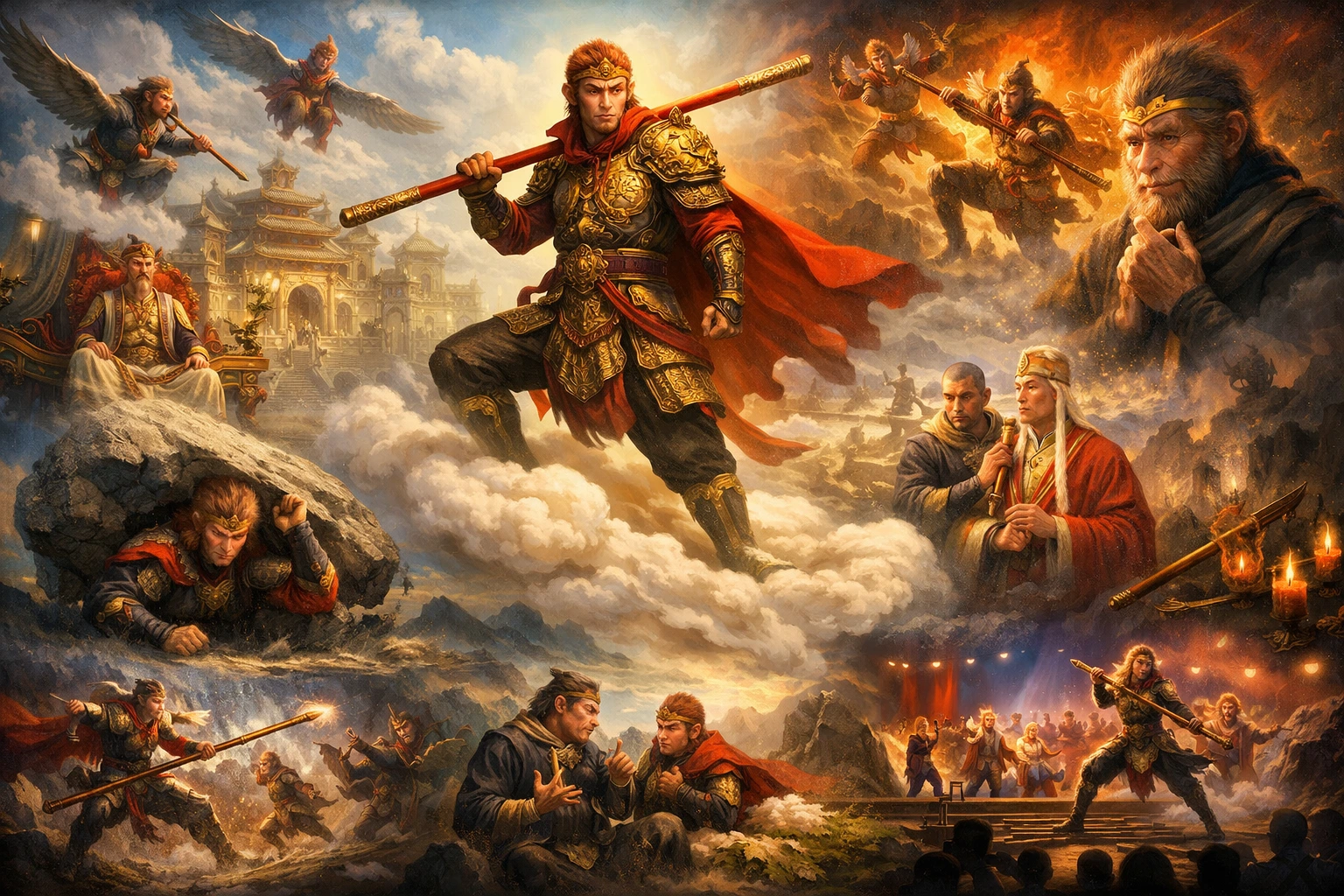
Introduction
There’s a reason Sun Wukong feels weirdly familiar even if you’ve never read a page of Journey to the West.
He shows up like a glitch in the cultural matrix: a laughing rebel with a staff, a cloud, and an attitude problem—appearing in films, games, anime, and now even major Western opera stages.
The secret is that the Monkey King isn’t just a character.
He’s a storytelling “master key” that unlocks action, comedy, meaning, and transformation—at the same time.
Who Is Sun Wukong, Really?
Sun Wukong—better known as the Monkey King—is one of the central figures in Journey to the West, a classic Chinese novel that first appeared in print in the late 1500s.
But the story doesn’t begin as “a monkey goes on a quest.”
It begins as: a wild force is born into a world that wants order.
The stone-born origin and why it matters
In the traditional origin, Sun Wukong is born from a magical stone.
That’s already a warning sign: he doesn’t come from family lines, rules, or institutions.
He comes from the universe itself.
In myth terms, that makes him a pressure system—something nature “creates” when a culture needs to ask hard questions.
The “rebel vs. Heaven” conflict in one minute
Once Sun Wukong gains supernatural abilities, he runs into the celestial power structure: the Jade Emperor’s Heaven.
And Sun Wukong does what he always does:
- He refuses to accept a small role.
- He mocks the system’s fake prestige.
- He fights the bureaucracy like it’s a personal enemy.
This isn’t random chaos. It’s satire with fireworks.
Heaven in Journey to the West often behaves like a rigid office: titles, ranks, punishments, and politics.
Sun Wukong is what happens when someone refuses to “stay in their lane.”
The redemption arc people forget
Most modern retellings keep the rebellion and the cool powers.
But the full story has a second half: discipline.
After Sun Wukong’s revolt, he’s punished—famously trapped under a mountain for 500 years—until a new path opens: protecting the monk Xuanzang (Tang Sanzang) on a pilgrimage for sacred texts.
That’s why the Monkey King lasts.
He isn’t only a rebel fantasy.
He’s also a transformation story: wildness learning direction.
Sun Wukong’s Powers (And What They Symbolize)
Yes—Sun Wukong is entertaining because he’s overpowered.
But what makes him sticky is that his powers are also metaphors.
72 transformations and identity
The famous “72 transformations” let Sun Wukong shapeshift—changing forms to survive, trick enemies, or break rules.
On the surface: it’s fun action.
Underneath: it’s about identity.
Sun Wukong asks a question that modern audiences still live with:
How many versions of yourself can you become—and still be you?
That’s why the Monkey King fits modern storytelling so well. He’s built for reinvention.
Ruyi Jingu Bang and “control vs. chaos”
Sun Wukong’s weapon is iconic: the Ruyi Jingu Bang, a staff that can grow or shrink at will.
That’s not just a cool prop.
It’s the perfect symbol for him:
- Too big? He overwhelms everyone.
- Too small? He hides it away, waiting for the right moment.
Sun Wukong’s whole journey is about learning scale—how much force to use, and when.
Immortality quests and fear of limits
Sun Wukong’s obsession with immortality is one of his defining motives.
It’s easy to read as ego.
But it also reads as a fear almost everyone recognizes:
What if the rules of life are unfair—and nobody will explain them?
In that sense, the Monkey King is relatable even when he’s outrageous.
He’s not only power-hungry.
He’s limit-hating.
Why the Monkey King Works in Every Era
If Sun Wukong were only “strong,” he’d be forgettable.
What makes Sun Wukong everywhere is that he solves storytelling problems.
Trickster logic: humor + disruption
Sun Wukong is a trickster.
That matters because tricksters do something heroes often can’t: they reveal hypocrisy.
They expose the difference between “what the system says” and “what the system does.”
That’s why the Monkey King can be hilarious and meaningful at the same time—an ingredient modern audiences still crave.
Heaven as bureaucracy satire
In many retellings, people treat Heaven like a distant fantasy realm.
But Journey to the West often frames it like an over-managed institution.
Positions, punishments, promotions, paperwork energy.
Sun Wukong’s rebellion isn’t only against gods.
It’s against the idea that status is more important than merit—a theme that translates instantly into modern life.
The emotional switch: arrogance → discipline
Here’s the pivot that makes Sun Wukong more than a meme:
He changes.
Not quickly. Not politely. But decisively.
He begins as a hurricane.
He becomes a protector.
This is the part that resonates across ages:
- Kids enjoy the spectacle.
- Teens relate to rebellion.
- Adults recognize the cost of uncontrolled pride.
- Everyone understands growth.
That’s why Sun Wukong doesn’t age out.
He levels up.
Sun Wukong in Pop Culture
Modern audiences often meet Sun Wukong backwards.
They see the Monkey King’s image first, then discover the original story later.
And that’s exactly how a myth survives.
Adaptations across film, TV, stage
There are countless retellings and adaptations—so many that even list resources exist just to track them.
What changes from version to version is usually tone:
- Sometimes Sun Wukong is a loud prankster.
- Sometimes he’s a righteous warrior.
- Sometimes he’s a troubled antihero.
- Sometimes he’s wise—almost parental.
Yet the core stays recognizable: staff, swagger, and a refusal to bow easily.
Even major Western arts institutions are actively adapting the Monkey King today, which shows how global the symbol has become.
Gaming’s boost: Black Myth: Wukong and search spikes
If you’ve noticed Sun Wukong “suddenly everywhere,” games are a big reason.
Reuters covered Black Myth: Wukong as a cultural moment—both for its popularity and its role in exporting Chinese mythology to global players.
National Geographic also points to the game as a fresh doorway for new audiences to discover Sun Wukong’s older story.
And that’s the pattern:
A modern medium revives an ancient myth.
Then people go searching for the original.
How reinterpretations change him (and why it works)
Modern pop culture often sandpapers myths into simple heroes.
Sun Wukong resists that.
He can be read in multiple ways without breaking:
- Hero: defender of the vulnerable on the journey.
- Antihero: chaos with a conscience.
- Mentor: a battle-tested guide figure.
- Symbol: of resistance, resilience, and self-mastery.
That flexibility is exactly why creators keep returning to him.
Sun Wukong is less like a single character…
…and more like a powerful template.
A Reader’s Guide for Parents, Students, and Educators
Sun Wukong isn’t just “content.” He’s a conversation starter.
Here’s how to make the Monkey King meaningful for real readers.
Parents: what kids notice first (and how to talk about it)
Kids often latch onto:
- the staff
- the transformations
- the jokes
- the fights
You can gently steer toward themes without making it heavy:
- Fairness: Why does Sun Wukong hate being given a “small” role?
- Consequences: What happens when power doesn’t have boundaries?
- Growth: How does he change when he protects someone else?
A simple framing works:
“Sun Wukong learns that strength isn’t the same as wisdom.”
Students: a quick study frame that actually helps
If you’re reading Journey to the West in any form, use this three-part lens:
- Desire: Sun Wukong wants freedom, status, and immortality.
- Conflict: The Heaven order (Jade Emperor) demands hierarchy.
- Change: The journey forces discipline and responsibility.
That’s the spine. Everything else—demons, disguises, battles—is the pressure that reveals character.
Educators: discussion prompts + cultural respect tips
A few classroom-friendly prompts:
- “Is Sun Wukong more hero or more trickster—and why?”
- “What does Heaven represent: religion, government, or social order?”
- “Why do stories keep remaking him in new genres?”
- “Which modern characters feel ‘Monkey King-like’ in your culture?”
Respect tip that helps:
Avoid flattening Chinese mythology into “exotic magic.” Instead, treat it like any mythic system: symbolic, layered, and tied to history and values. National Geographic’s framing of Xuanzang’s real pilgrimage can help ground that discussion.
Conclusion
Sun Wukong is everywhere because he carries three stories at once:
- the thrill of rebellion,
- the comedy of a trickster,
- and the hard-earned shape of self-mastery.
That mix is rare.
And it’s why the Monkey King keeps returning—whenever a culture needs a character who can punch the sky… and still learn humility.