The Jade Emperor: The Hidden Bureaucrat King of Chinese Heaven
Introduction
There’s a secret hiding in plain sight across Chinese mythology: the “most powerful god” often isn’t the loudest, flashiest, or most magical.
He’s the one with the ledger.
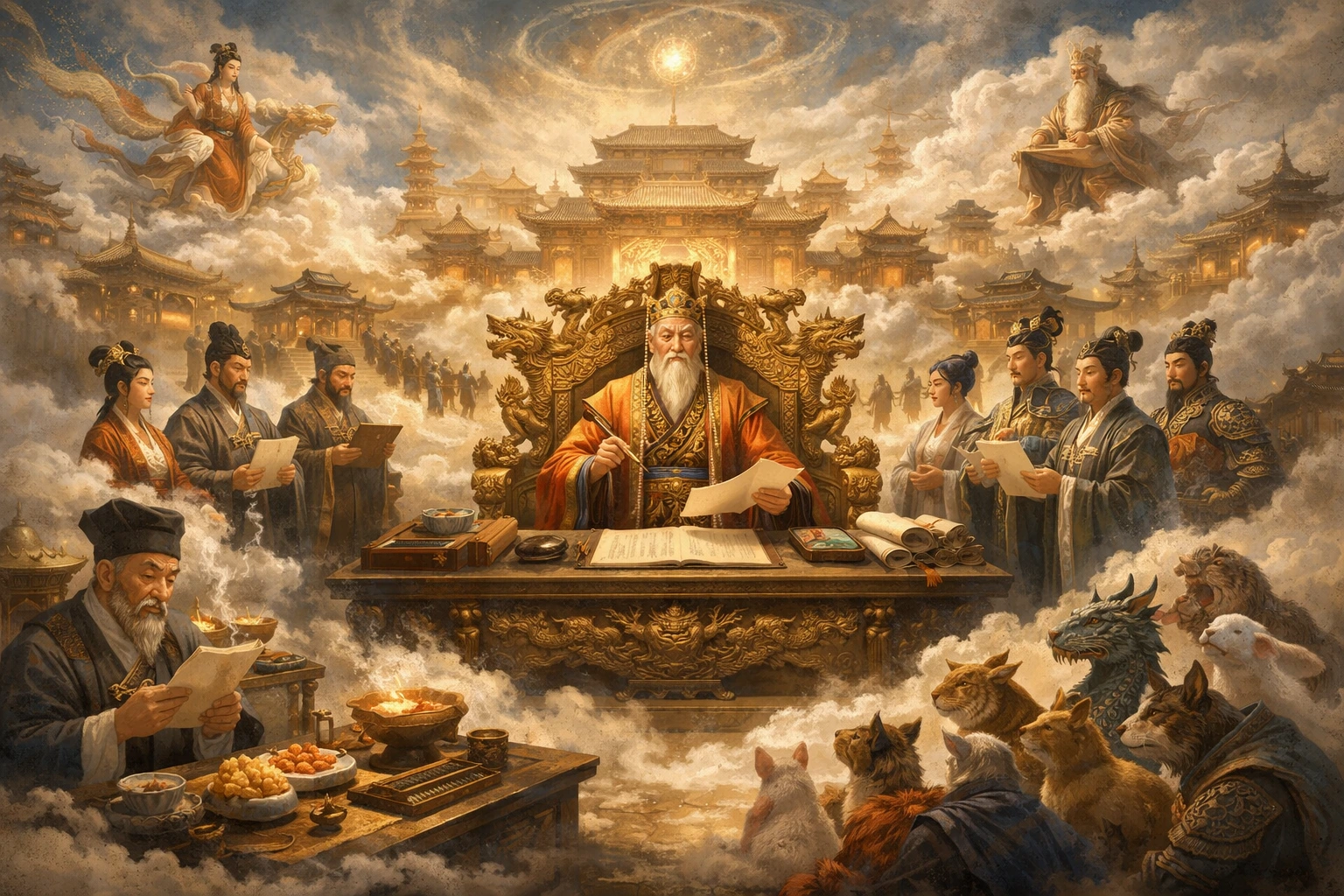
The Jade Emperor—also called Yu Huang or Yudi—is famous for ruling Heaven. But the real reason he matters is stranger than most people expect: in many stories and traditions, he’s important because he runs Heaven like an imperial government, with officials, reports, promotions, and punishments.
If you’ve ever wondered why one deity can feel “above” countless gods and spirits, you’re about to see the hidden structure behind the myths.
Who Is the Jade Emperor (Yu Huang / Yudi)?
The Jade Emperor is widely described as the ruler of Heaven in Chinese folk religion and many mythic traditions. He presides over a heavenly court, surrounded by ministers and officials—almost like a mirror of historical Chinese imperial government.
You’ll often see his name written in different ways:
- Yu Huang (玉皇) — a common short form meaning “Jade Sovereign”
- Yudi — another common name/title used in religious contexts
- Heavenly Grandfather / Tiangong — a popular devotional address in some communities
Names and titles (why “Jade Emperor” is an office)
One helpful way to understand him: “Jade Emperor” can function like a job title—the “Emperor of Heaven”—not merely a personal name. Several references describe him as a ruler whose role is modeled after the earthly emperor, overseeing a divine bureaucracy.
That’s why different stories can disagree about his “origin” while still treating the position as supreme.
Where he “sits” in the cosmic order
Many modern explainers place the Jade Emperor at the top of Heaven’s administration. At the same time, Taoist theology can present higher, more abstract cosmic principles above him (depending on the school and text).
So if you hear:
- “He’s the highest god,” and
- “He’s not the absolute highest principle,”
…both can make sense, because they’re coming from different lenses (folk religion vs theological cosmology).
Why Is He Called the Most Important Chinese God?
When people call the Jade Emperor “the most important,” they usually mean something very specific:
He’s the one who governs the system.
Not every tradition says he created the universe. But many traditions say he runs the cosmic administration—and that makes him feel unmatched in authority.
Heaven as a government (celestial bureaucracy)
A major theme across credible educational sources is that Heaven is imagined as an imperial-style bureaucracy: ranks of gods, assigned duties, and official authority flowing from the top.
In that picture, the Jade Emperor is important because he:
- presides over the court of gods,
- authorizes appointments and titles,
- receives reports about conduct and merit,
- represents “order” rather than chaos.
The power of appointment, records, and rewards
Think of the Jade Emperor like a cosmic head of state: even powerful gods can have a “department,” but he represents the seat of governance.
This is also why some stories focus less on his battles and more on:
- virtue
- responsibility
- judgment
- balance
His power is often the power of legitimacy—who is recognized, who is promoted, and which actions have consequences.
Jade Emperor in Taoism vs Chinese Folk Religion
If your goal is to write or study Chinese mythology without confusion, this section is the key.
The Jade Emperor appears in:
- Chinese folk religion (community practice, festivals, household customs)
- Taoism/Daoism (organized religious traditions and theology)
- Popular mythology (stories told for meaning, morals, and entertainment)
These overlap, but they are not identical.
How Taoist theology situates him
In Taoist contexts, the Jade Emperor is often described with formal reverence and is sometimes connected to a larger celestial hierarchy. Some explanations place him as an important heavenly ruler while also acknowledging higher primordial principles in Taoist cosmology.
How folk stories make him feel “closest” to daily life
Folk religion tends to make the Jade Emperor feel nearer to ordinary life because he’s connected to:
- household morality,
- yearly judgment,
- festivals,
- community temple rites.
That practical closeness—“He sees what we do, and it matters”—is one reason he becomes “most important” in everyday storytelling.
The Most Popular Stories About the Jade Emperor
Many online retellings share a “rise” story: the Jade Emperor begins as a virtuous being, cultivates wisdom through long practice, and becomes worthy of supreme authority.
Different versions vary wildly in details and timescales, but the moral theme stays steady:
Leadership is earned through virtue and discipline, not just raw power.
The cultivation-and-virtue rise (Golden Immortality themes)
In popular myth cycles, the Jade Emperor’s “promotion” comes after extraordinary trials and cultivation. These stories are less about historical biography and more about teaching a worldview:
- goodness should be rewarded,
- patience and self-mastery matter,
- the cosmic order values merit.
The zodiac selection story (why it’s told, what it teaches)
Another famous myth involves the Chinese zodiac: animals are summoned, tested, or arranged to determine the order of the years.
You’ll find many versions of this tale, but the “Jade Emperor” role is consistent: he functions as the organizer of time and order—choosing a system people can live by.
For students, this is a great pattern to notice:
-
The Jade Emperor appears most often where myths explain structure (time, ranks, duties), not just spectacle.
Jade Emperor and Chinese New Year
This is where the Jade Emperor stops being “just a myth character” and becomes a living idea in culture.
Many traditions describe a yearly process of moral accounting connected to Chinese New Year, involving the Kitchen God (Zao Jun).
The Kitchen God’s report and “sweetening” customs
In a widely repeated folk belief, the Kitchen God returns to Heaven before the New Year to report the household’s behavior to the Jade Emperor. The Jade Emperor then rewards or punishes based on that report.
That’s why you’ll hear about customs like offering sweets—symbolically encouraging a “sweet report” or positive words.
What the tradition is trying to teach
Whether or not someone takes the story literally, its lesson is clear:
- actions have consequences,
- private behavior matters,
- community harmony is valuable,
- the year is a chance to reset.
This is also a strong educator moment: you can frame it as mythology functioning like a moral calendar—timing stories to teach values at meaningful moments.
Festivals and Worship (Including His Birthday)
A major celebration linked to the Jade Emperor is his birthday, commonly described as falling on the ninth day of the first lunar month.
Ninth day of the first lunar month
In many communities, people visit temples, burn incense, and present offerings—treating the Jade Emperor as the highest heavenly authority for blessings and protection.
What temple rituals typically include
While details vary by region and tradition, common elements often include:
- incense and candles,
- food offerings,
- formal bows/prostrations,
- prayers for health, safety, and good fortune.
The key idea is less “magic” and more relationship: a respectful appeal to cosmic order, much like petitioning an emperor in a symbolic universe.
What to Remember (Parents, Students, Educators)
If you only remember one thing, make it this:
The Jade Emperor is “most important” in many stories because he represents the system that holds the divine world together.
A simple study summary
- Jade Emperor (Yu Huang / Yudi) = ruler of Heaven in many traditions.
- He’s modeled after an imperial ruler: Heaven has officials and departments.
- In Chinese New Year folklore, the Kitchen God reports to him about households.
- The “most important” label often means administrative authority, not necessarily “creator of everything.”
Mini glossary
- Jade Emperor: Heavenly emperor figure; supreme ruler in many folk depictions.
- Yu Huang / Yudi: Common names/titles used for the same deity/office.
- Celestial bureaucracy: Heaven imagined like a government with ranks and officials.
- Zao Jun (Kitchen God): Household deity who reports yearly conduct to the Jade Emperor.
Conclusion
The Jade Emperor isn’t “most important” because he throws the biggest thunderbolt.
He’s “most important” because he sits at the top of a vast, story-powered idea: order.
In Chinese mythology, order means roles, responsibilities, moral consequences, and a universe that can be understood—even if it’s full of gods. And when you read the Jade Emperor through that lens, his throne stops being just a fantasy palace.
It becomes a symbol: the belief that the world, somehow, can be governed by meaning.