The Hidden Origin of Egypt’s Gods: From Nun’s Ocean to the First Pharaoh Question
Introduction
If you imagine ancient Egypt beginning with sand, pyramids, and blazing sun—here’s the twist: in many Egyptian stories, it begins with water. Not the Nile. Not rain. An endless, silent ocean called Nun—a place so empty it still somehow contained every possibility.
Before we name a single god, one question shadows everything: If the gods ruled first, who was the first Pharaoh—really?
If you like mythology that hides philosophy inside family drama, you’ll want the next part.
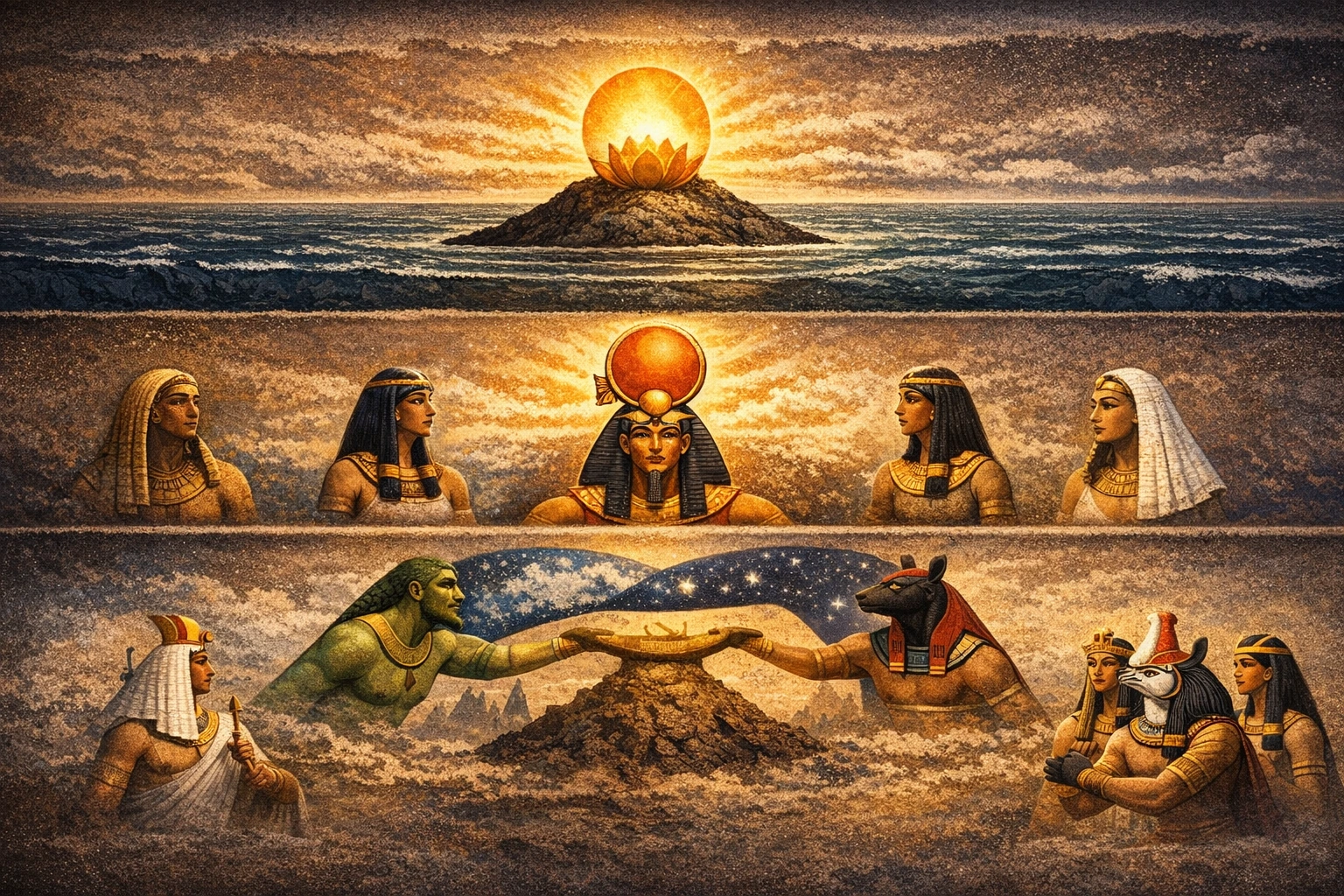
The secret Egypt starts with water
In many Egyptian creation traditions, Nun (or Nu) is the primeval ocean—chaos, potential, and “not-yet-formed” reality.
This matters because Egyptians didn’t think creation was “making something from nothing.”
They imagined creation as order rising out of chaos.
Nun/Nu: the ocean-before-everything
Nun isn’t a villain. It’s more like raw material—unshaped life.
And then something happens that feels small, but changes the universe:
Why “first land” matters: the benben mound
A mound rises from Nun—often called the benben.
It’s the first stable ground, the first “place” where order can stand.
If you’ve ever watched floodwater recede and reveal land again, you can see why this image stuck for thousands of years.
The first sunrise: lotus, benben, and the creator
Once the mound exists, Egyptian stories often place a symbol beside it: a lotus opening.
When it blooms, the newborn sun appears—bringing light, time, and the first rhythm of days.
Atum, Ra, or Atum-Ra (and why texts vary)
Here’s where modern readers get confused fast: some versions emphasize Atum, others Ra, and many blend them as Atum-Ra.
That isn’t “contradiction” so much as regional theology. Different cities supported different sacred explanations, but shared core motifs.
In the Heliopolitan tradition, Atum is “self-created,” rising on the mound and beginning the chain of life.
Ra, meanwhile, becomes the solar face of creative power—the force that makes the world visible and alive.
Shu and Tefnut: air + moisture become the first “space”
From the creator come two foundational forces:
- Shu: air (space, breath, separation)
- Tefnut: moisture (wetness, humidity, balance)
They aren’t just “characters.” They’re building blocks.
And in some stories, humans appear from the creator’s tears of joy when the divine family returns safely—an image repeated across Egyptian storytelling.
The Egyptian Ennead: the universe as a family tree
Egyptian mythology loves what feels like a family saga—but it’s also a cosmic blueprint.
The Heliopolitan chain is famously summarized as the Ennead—nine major deities tied to creation and kingship.
Geb and Nut: earth and sky
Shu and Tefnut produce:
- Geb: earth
- Nut: sky
In art and story, Nut arches above, Geb lies below, and Shu holds them apart—creating the space where life can happen.
This “separation” theme is huge: life exists because forces are balanced, not blended.
Osiris, Isis, Set, Nephthys: the cosmic “four”
Geb and Nut’s children form the core drama:
- Osiris (fertility, rightful rule, renewal)
- Isis (magic, motherhood, protection)
- Set (disruption, storms, wild force—often “chaos”)
- Nephthys (protection, liminal spaces, mourning roles)
Even when you find different versions, this quartet is the emotional engine of the Osiris myth tradition.
The Osiris story: death, love, and the afterlife
If the Egyptian creation myth is about the world beginning, the Osiris myth is about what happens when power breaks the rules.
Osiris is often presented as a primeval king who represents order—what Egyptians called maat (cosmic and social rightness).
Set represents what disrupts that order.
Why Set kills Osiris (and why motives differ)
Modern retellings often lock Set into one motive: jealousy.
But Egyptian sources preserve multiple motives, and later writers add others. Some versions even include conflict over Nephthys.
That variability is the point: Set is the force that breaks stability, whatever the trigger.
Isis’s search, the body, and the afterlife logic
After Osiris is killed, Isis searches—sometimes with Nephthys—recovering and restoring the body with the help of other gods such as Anubis and Thoth in many accounts.
This is where the myth stops being “just drama” and becomes theology:
- The restored body explains mummification as sacred repair.
- Osiris becomes lord of the dead, explaining afterlife hope.
- The story teaches that life isn’t erased—it’s transformed.
And that’s the deeper sting: Set can disrupt the world, but cannot permanently cancel it.
Want more stories where myth hides a logic puzzle inside the plot?
Read more here: Navora Press
Horus vs Set: why Pharaohs inherit the throne
Osiris’s son, Horus, becomes the living claim to rightful kingship.
But the struggle isn’t always portrayed as a simple “battle to the death.”
Not just a fight—often a divine court case
Many traditions frame the Horus–Set conflict as judgment before an assembly of gods, debating legitimacy and inheritance.
That detail matters because it shows Egyptian thinking:
Power should be recognized as lawful order, not just force.
What “maat” is, and why kingship depends on it
Maat isn’t only “morality.” It’s the stability of the cosmos.
So Pharaohs weren’t just rulers. They were expected to uphold maat on earth—making the country function like the gods intended.
That’s why later Egyptian ideology loves the phrase “Horus on earth”: the king is the living representative of divine order.
Conclusion
Egypt’s creation story doesn’t begin with pyramids or kings—it begins with Nun’s endless waters, where the benben mound rises and a solar creator (often Atum/Ra) brings order into being. From there, the Egyptian Ennead turns the universe into a family tree, and the Osiris myth turns that family into a lesson about power, death, restoration, and legitimacy.
So, who was the first Pharaoh?
- Mythically: the first “ruler” is the creator god (Ra/Atum) as the divine king of the cosmos.
- Historically: the earliest widely cited candidate for the first pharaoh of a unified Egypt is Narmer (often linked with the later name “Menes”).
That split—myth for meaning, history for chronology—lets you enjoy the drama without losing the truth.