The Hidden Chain Reaction Behind Samudra Manthan: Durvasa’s Curse, Indra’s Pride, and the Ocean of Milk
Introduction
Something tiny falls to the ground.
Not a weapon. Not a thunderbolt. Not even a crown.
Just a garland—soft petals, a brief fragrance… and one careless moment.
And yet, that single drop in the story’s river becomes a flood that shakes heaven itself—pushing gods into defeat, forcing enemies into teamwork, and triggering Samudra Manthan, the legendary churning of the Ocean of Milk.
The “Small” Insult That Sparked a Cosmic Crisis
Picture Indra, king of the devas, riding Airavata—his majestic elephant mount—surrounded by power, praise, and the comfort of being on top.
Now introduce Sage Durvasa: brilliant, intense, and famously quick to anger in many retellings. In versions found in the Puranic tradition, Durvasa offers Indra a special garland—treated as more than decoration, almost like a sacred blessing tied to “Sri,” meaning fortune and prosperity.
Here’s the crucial moment: Indra doesn’t treat it like something living with meaning. He places it on Airavata instead. The elephant—irritated (some versions mention bees drawn to the scent)—throws it down. The garland is trampled.
In everyday life, this looks like nothing.
In mythology, symbols are never “just symbols.”
Durvasa sees arrogance. Not only in Indra’s action, but in the attitude behind it: “I’m too important to handle this myself.”
And then the heavens pay the price.
Durvasa’s Curse: What Exactly Was Lost?
Durvasa’s curse is often summarized as: the devas lose strength, energy, and fortune—the very qualities that keep cosmic order stable.
That matters because gods in these stories aren’t “invincible by default.” Their power is connected to dharma, discipline, and divine favor.
So what changes after the curse?
- The devas grow weaker and more vulnerable.
- Their rivals—the asuras—gain the upper hand.
- The balance tips. Heaven can be threatened.
Some retellings even connect the loss of fortune to Lakshmi’s withdrawal—an image that makes the lesson sharper: disrespect prosperity, and prosperity doesn’t stick around.
For students, the chain is simple to remember:
Disrespect → Curse → Weakness → Defeat → Desperation → Samudra Manthan
Vishnu’s Strategy: Why the Gods Needed Their Enemies
When the devas realize they can’t “muscle their way back” into power, they approach Vishnu for guidance.
And Vishnu’s solution is clever, but uncomfortable:
To regain what they lost, they must obtain amrita, the nectar of immortality, by performing Samudra Manthan—the churning of the Ocean of Milk.
But there’s a problem.
Churning an ocean is not a weekend project. Even gods can’t do it alone—especially weakened gods.
So Vishnu advises the unthinkable: work with the asuras.
This is the story’s first big twist. The conflict doesn’t vanish. It gets postponed.
Both sides cooperate… while secretly planning to win.
That makes Samudra Manthan more than mythic spectacle. It becomes a tale about teamwork under tension—when nobody fully trusts anybody, yet the job still must get done.
How Samudra Manthan Works
If Samudra Manthan ever felt confusing, here’s the clean structure.
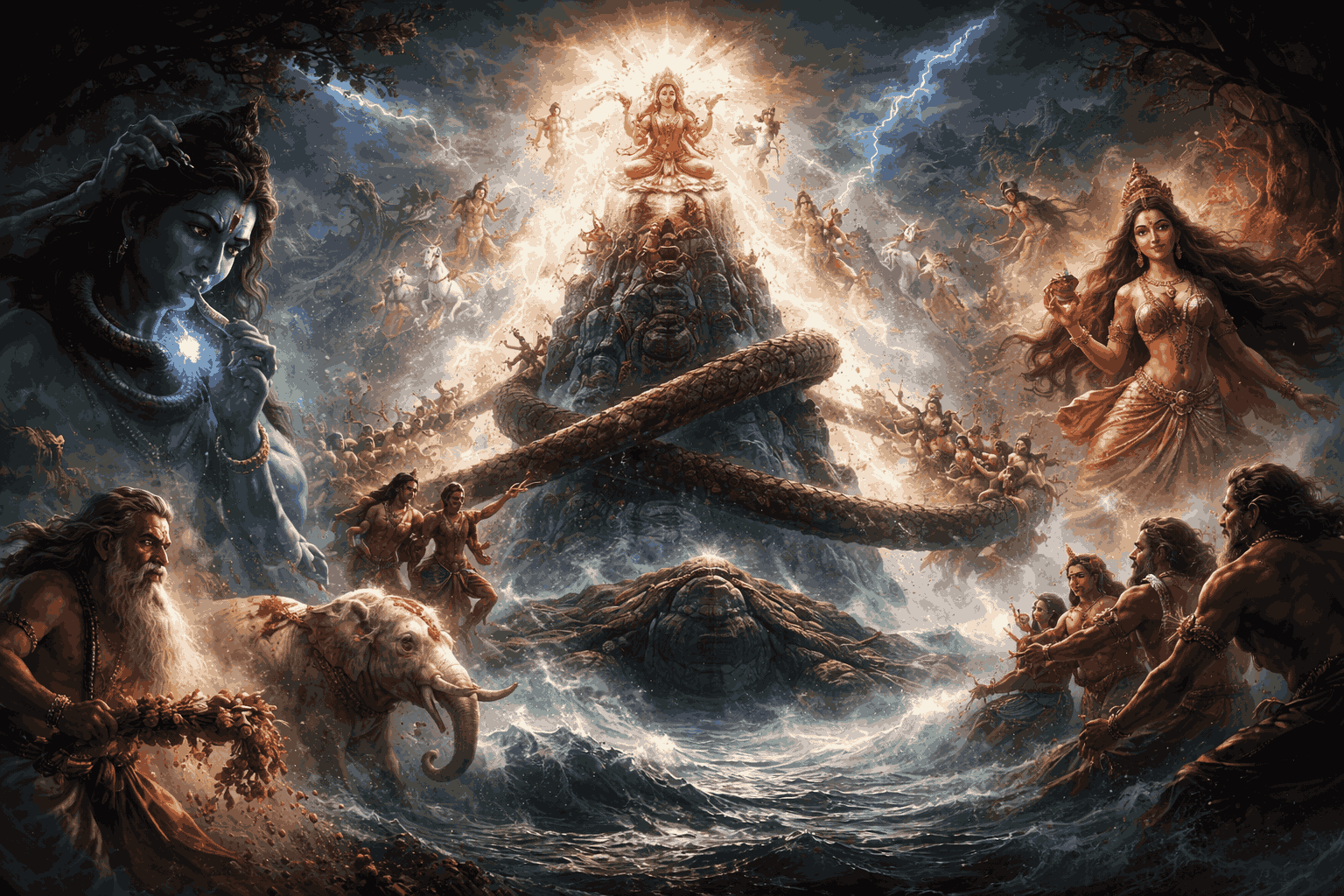
1) Mount Mandara becomes the churning rod
The devas and asuras uproot Mount Mandara to use it like a giant churn stick.
2) Vasuki becomes the rope
They use Vasuki, the great serpent, as the rope wrapped around the mountain.
3) Kurma avatar stabilizes the impossible
When the mountain sinks, Vishnu appears as Kurma (tortoise) to support it—turning chaos into a stable system.
4) Pull, pull, pull… and the ocean yields
The devas pull on one side, the asuras on the other, and the ocean is churned—bringing hidden things to the surface.
Even the “which side held the head” detail can vary by retelling, but the larger point remains: tension creates transformation.
Poison First: Halahala and Shiva as Neelkantha
Here’s the part many people don’t expect when they first hear Samudra Manthan:
Before the nectar, before the treasures, before the victory…
poison appears.
The lethal poison halahala emerges, threatening to destroy creation.
This moment flips the story’s mood. It’s not “yay, teamwork!” anymore. It’s: we might all be doomed.
And this is where Shiva steps in.
Shiva consumes the poison (or contains it), holding it in his throat so it won’t spread—earning the name Neelkantha, the blue-throated one.
If you’re teaching this (or reading it with children), this is the most memorable pattern:
When you churn life to get something great, the toxins come up first.
Sahapedia’s interpretive lens highlights exactly this kind of “inner churning” symbolism—poison as what must be faced and handled, not ignored.
Treasures of the Ocean of Milk
After the crisis of halahala, the churning continues—and the Ocean of Milk begins releasing wonders.
Different traditions list different “treasures,” but many popular tellings include items and beings that become symbols in their own right—such as Lakshmi (prosperity), the celestial horse Uccaihshravas, and Dhanvantari (divine physician) bearing the nectar.
Instead of memorizing a long catalog, use a “meaning map”:
-
Lakshmi emerges
→ prosperity returns; order begins to restore.
-
Divine gifts emerge
→ creation is shown as abundant, but not automatically “owned.”
-
Dhanvantari emerges with amrita
→ the goal finally surfaces: renewal and strength.
This is also where the original insult becomes clearer.
A garland linked to fortune was disrespected.
So the story takes the devas on a long journey to earn fortune back—through humility, strategy, and hard work.
Amrita and Mohini: The Final Twist
Finally, amrita appears—the nectar of immortality.
And predictably, cooperation collapses.
The asuras want the amrita for themselves. A struggle erupts.
So Vishnu uses a second strategy: he takes the form of Mohini, an enchanting figure who distracts the asuras and distributes the nectar to the devas instead.
This part raises the question students often ask:
“Isn’t that unfair?”
A useful way to discuss it is to stay inside the logic of the myth:
- The devas are framed as guardians of cosmic order (dharma).
- The asuras are framed as threats to that order.
- The nectar in the wrong hands means imbalance becomes permanent.
So Mohini’s “deception” functions as a story device: the cosmos cannot afford an immortal chaos.
Whether a reader agrees or disagrees is part of the myth’s power—it invites debate, not just belief.
What This Myth Teaches
For students
-
Cause-and-effect storytelling:
one act of pride can create a chain reaction.
-
Sequence clarity:
curse → weakness → alliance → churning → poison → nectar → restoration.
-
Big theme: the greatest rewards often arrive late—and never alone.
For parents
-
Use the garland moment as a gentle conversation:
-
“How do we treat gifts?”
-
“How do we show respect without fear?”
-
-
Keep it age-appropriate:
-
Younger kids: focus on kindness and humility.
-
Older kids: explore consequences, trust, and moral ambiguity.
-
For educators
-
Teach Samudra Manthan as a systems story:
-
Inputs: teamwork, tension, effort
-
Outputs: poison first, then value
-
-
Pair the myth with discussion prompts:
-
“Why do stories place poison before nectar?”
-
“Is Mohini’s act justice, strategy, or both?”
-
-
Add a symbolism lens when appropriate:
-
Interpretations often connect the churning to inner struggle and transformation.
-
And always return to the hidden secret of the tale:
The ocean was never the real problem.
The real problem was pride.
Conclusion
Samudra Manthan isn’t just a dramatic myth about gods and demons pulling a snake around a mountain. It’s a carefully built chain reaction: Durvasa’s curse exposes vulnerability, vulnerability forces alliance, alliance triggers churning, churning releases poison, poison demands sacrifice, and only then does the nectar appear.
And the quiet warning beneath it all is unforgettable:
Treat blessings lightly, and you may spend a lifetime trying to earn them back.