The Gita Verse in an Egyptian Pyramid: Hidden Truth or Viral Myth?
Introduction
There’s a strange little “secret” that keeps resurfacing online: someone claims a Bhagavad Gita verse was found carved inside an Egyptian pyramid.
Not a symbol. Not a loose reference.
An actual verse—on stone—deep inside a structure that’s thousands of years older than most written traditions we casually talk about today.
So… did it happen?
Or is this one of those stories that feels ancient and powerful because it sounds ancient and powerful?
The claim that sparked the mystery
The story usually goes like this:
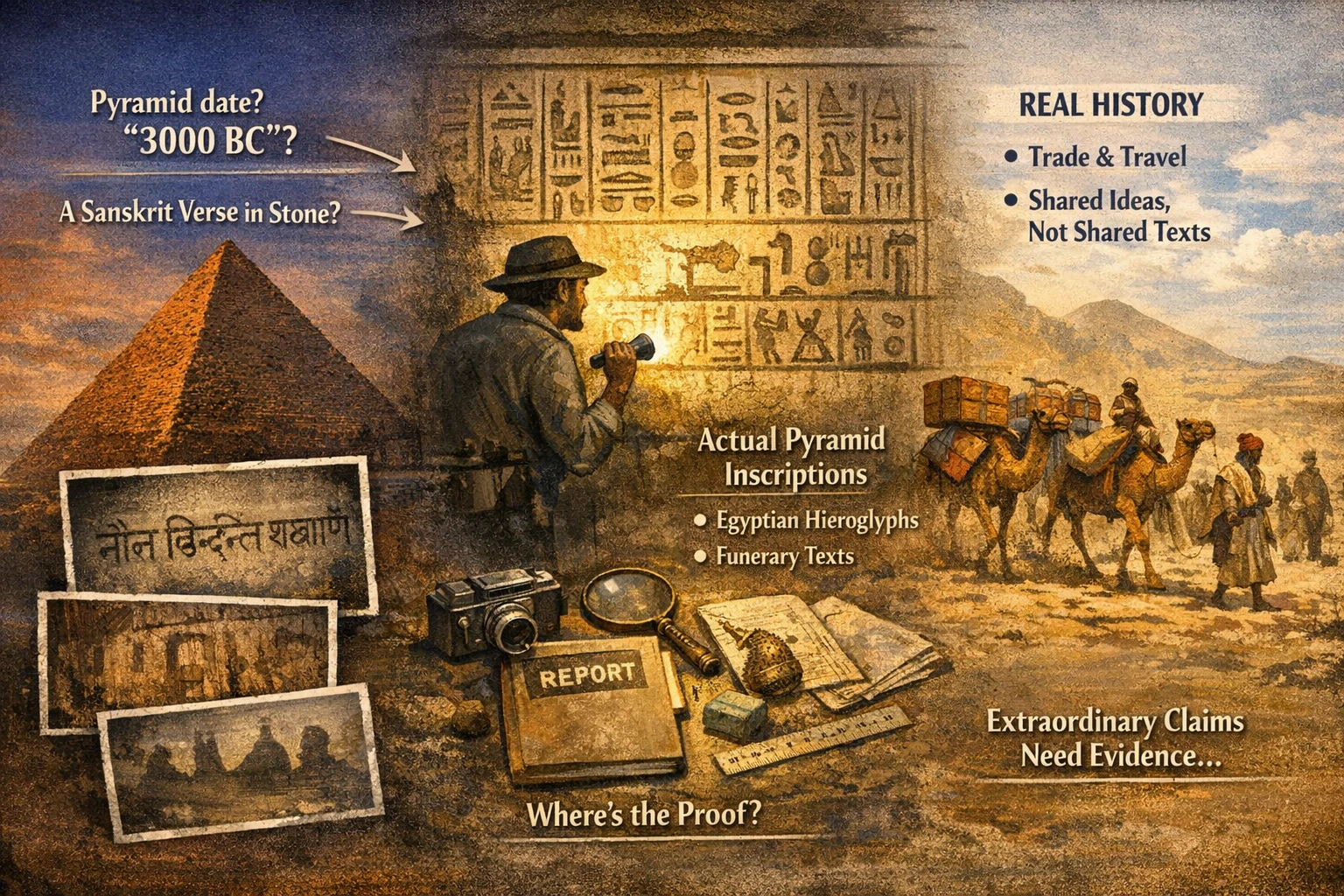
A pyramid—often vaguely dated to “3000 BC”—contains an inscription that matches a Bhagavad Gita shloka. The most quoted lines are from Chapter 2, Verse 23, the famous teaching that the soul cannot be destroyed by weapons, fire, water, or wind.
It’s an emotionally satisfying idea. If the “Gita pyramid” story were true, it would feel like proof that civilizations we treat as separate were once closely linked—maybe even sharing sacred knowledge.
What people say was “found”
Most versions of the claim repeat the same core ingredients:
- a Sanskrit verse,
- a very early pyramid date,
- and an implication that this proves deep India–Egypt overlap.
But when you look for the basics—clear photos of the exact inscription, the pyramid name, an artifact catalog entry, an excavation report, or an academic publication—those details tend to vanish. The story stays strong; the documentation stays thin.
Why the claim feels believable at first glance
Two reasons:
-
Both traditions talk about the afterlife.
Egyptian mortuary texts focus on what happens after death. The Bhagavad Gita also addresses the immortal self. It’s easy to leap from “similar ideas” to “shared text.” -
Pyramids already feel like they hold secrets.
If someone says, “There’s a hidden Sanskrit verse inside,” your brain wants it to be true—even if your skeptical side is whispering, “Wait… where’s the evidence?”
What’s actually written inside Egyptian pyramids
Here’s the grounding fact that changes the whole discussion:
Many royal pyramids do contain inscriptions—but they are ancient Egyptian funerary texts, carved in hieroglyphs, not Sanskrit.
Pyramid Texts—what they are and where they appear
The best-known set of inscriptions is called the Pyramid Texts: prayers, hymns, and spells intended to protect the dead king (and sometimes queens) and help them in the afterlife. Britannica describes these texts as being inscribed on the walls of inner chambers and notes the pyramid of Unas as the earliest known example.
This matters because it tells us what “inscriptions in pyramids” usually means in Egyptology:
- Egyptian language
- Egyptian script
- Egyptian religious content
- specific pyramids and dynasties (not a generic “3000 BC” claim)
Why Giza’s big pyramids aren’t the inscription example people expect
Another detail that surprises many readers: the massive pyramids at Giza (Khufu, Khafre, Menkaure) are not the classic “text-covered” pyramids people imagine. The major tradition of large internal inscriptions is associated with later Old Kingdom pyramids such as Unas at Saqqara, where the Pyramid Texts appear.
So if someone says, “The Great Pyramid has a Gita verse carved inside,” that’s immediately a claim that collides with what mainstream references say about where inscriptions commonly appear.
Would a Sanskrit Gita verse in a pyramid be possible?
Let’s be fair: “unlikely” isn’t the same as “impossible.”
Human history includes long-distance trade, migration, and cross-cultural exchange.
But an inscription claim is not a vibe. It’s a verifiable artifact question.
The provenance problem: what would we need to believe it?
For the “Gita pyramid” claim to be credible, we’d expect at least some of the following:
- The exact pyramid name and chamber location
- High-resolution photographs of the inscription in situ
- A museum catalog number if it’s removed
- A published epigraphic study (specialists documenting the script and text)
- A clear dating method (material context, stratigraphy, paleography, etc.)
This is normal in archaeology. Extraordinary claims require ordinary paperwork—because that’s how artifacts become part of accepted history.
When those anchors aren’t present, the story stays in the realm of internet folklore.
Script and language: what Egyptologists would expect to see
If an inscription is truly ancient Egyptian, it typically appears in hieroglyphic form consistent with the period’s language and conventions.
A Sanskrit verse—especially recognizable as a Bhagavad Gita verse—would raise immediate questions:
- Which script is it written in?
- Who translated it, and when?
- How was it dated to the pyramid’s original construction rather than a later visitor carving?
Without solid answers, the simplest explanation tends to win: the claim is either misattributed, modern, or unsupported.
India–Egypt connections that are real
Here’s the part many viral posts skip: you don’t need a carved Gita verse in a pyramid to appreciate how connected the ancient world could be.
Trade and cultural exchange: what historians can support
Egypt was not isolated. Nor was the Indian subcontinent.
Across long time spans, trade networks connected Africa, the Near East, and South Asia. Ideas, goods, and stories traveled. That’s a reasonable baseline—and it’s genuinely fascinating.
But trade and contact are different from saying:
-
“This specific book was present in this specific pyramid at this specific date.”
Similar themes vs “same origin” claims
Two cultures can independently develop similar answers to big human questions:
- What happens after death?
- Is the self eternal?
- How do we live well?
Similarity can be meaningful without requiring a single source. It can point to shared human experience more than shared authorship.
Common “proofs” online—quick fact-checks
This is where many posts try to “stack” supportive-sounding claims. Let’s sort a few of the most repeated ones.
“Egypt comes from Ajax/Ajapati”
This one collapses quickly under basic etymology.
A standard reference explanation traces “Egypt” through Greek and Latin forms back to an Egyptian term connected with the temple/house of the ka of Ptah at Memphis (often rendered as something like Hwt-ka-Ptah).
That doesn’t prove anything about India–Egypt contact either way—but it does show why “name similarity” arguments are risky. They often start with a conclusion and work backward.
Ra/Ravi, Horus/Hari, Ramesses/Rama: similarity isn’t evidence
It’s tempting to line up syllables across languages and declare a match.
But languages can produce similar sounds by coincidence. To argue real borrowing, you’d want:
- documented contact in the right period,
- a plausible route for transmission,
- and linguistic evidence showing systematic change, not one-off resemblance.
Otherwise, it’s pattern-matching—fun, but fragile.
Shulba Sutra and pyramid engineering
Ancient engineering achievements often lead to “someone must have taught them” stories.
The safer approach is:
- admire the math and planning,
- look at what texts, tools, and architectural evolution are documented,
- and avoid assuming a single outside source just because the result is impressive.
Why these stories persist
The “Gita pyramid” story survives because it offers three things humans love:
- Mystery (a hidden carving in a hidden chamber)
- Meaning (two civilizations connected by a sacred message)
- Identity (a feeling that history validates what we value today)
None of that makes it true.
But it does make it powerful.
A 60-second checklist for students, parents, and educators
Use this the next time a viral ancient-history claim appears:
- Where is it? Name the site, chamber, artifact ID.
- Who documented it? Museum, university, excavation team.
- What’s the medium? Photo, scan, published translation, peer-reviewed source.
- How is it dated? Context, stratigraphy, script analysis, material testing.
- Does a neutral reference mention it? Encyclopedias, museums, academic books.
If the answers are vague, treat the claim as a story—not a source.
Conclusion
So—does the Bhagavad Gita appear carved inside an Egyptian pyramid?
What we can say with confidence is this: Egyptian pyramids with inscriptions are best known for the Pyramid Texts—ancient Egyptian mortuary writings carved in hieroglyphs.
The viral “Gita pyramid” claim circulates widely online, but it rarely arrives with the kind of provenance that archaeology depends on: precise location, documented photographs, catalog records, and formal publication.
And that’s the real lesson.
Wonder is good. Curiosity is good. Cross-cultural study is great.
But when a story claims, “This exact verse was inscribed here, at this date,” it should be able to survive a simple question: