The Gigantomachy: The Hidden Rule That Let the Gods Defend Olympus
Introduction
Something about the Olympian gods has always felt… unbeatable.
Thunder. Wisdom. Sea-storms. Divine fire.
So here’s the twist most retellings rush past: in the Gigantomachy, the gods weren’t allowed to win on their own.
They could fight. They could wound. They could hold the line.
But without one fragile, mortal ingredient, Olympus was doomed.
What Is the Gigantomachy (and Why It’s Not the Titanomachy)
The Gigantomachy (often called the “War of Giants”) is the mythic war between the Olympian gods and the Giants (Gigantes) in Greek mythology.
It’s easy to mix it up with the Titanomachy, because both are “gods vs huge ancient enemies.”
But here’s the clean separation:
- Titans are an older divine generation (think: the family before Zeus’ rule).
- Giants are earth-born challengers who rise later, as a violent backlash against Olympus.
If you remember one thing: the Titanomachy is about who rules the cosmos. The Gigantomachy is about whether that rule can survive a primal uprising.
Where the Giants Came From
In many accounts, the Giants are tied to Gaia (Earth)—not just as a parent, but as a force of nature pushing back.
One influential version describes Gaia producing the Giants out of anger over earlier defeats and imprisonments, and the Giants erupt into the world ready to assault the sky itself.
That “earth-born” vibe matters.
These aren’t polished, palace-dwelling opponents. They represent something older, rougher, and harder to negotiate with.
Gaia, Uranus, and the “earth-born” idea
Many tellings connect the Giants to Gaia and Uranus (Sky), making the conflict feel like Earth’s children rising up toward Heaven.
Why ancient sources disagree on details
Greek myths weren’t a single book. They were a living library—poets, playwrights, local cults, vase painters, and later mythographers all shaping the story.
That’s why you’ll see variations in:
- where the battle happens (Phlegra/Pallene and beyond),
- which gods face which Giants,
- and how “monstrous” the Giants look in art over time.
The Prophecy That Changes Everything
Now to the hidden rule.
A major tradition states the Giants could not be defeated by the gods alone. A mortal had to join the fight, or the Giants would remain effectively unkillable.
This is the hinge of the whole Gigantomachy.
Why the Olympian gods need a mortal
On the surface, it’s a neat plot device: “bring in a hero for the final blow.”
Underneath, it’s a statement about how Greek myth sees power:
- Gods embody cosmic forces.
- Mortals embody risk, choice, and consequences.
- A victory that reshapes the world demands both.
What the rule reveals about Greek hero culture
The Gigantomachy is one of the clearest examples of a recurring pattern:
The gods may set the stage, but heroes make history.
And that’s why one name becomes unavoidable.
Heracles.
The Battle for Olympus (A Reader-Friendly Retelling)
The Gigantomachy isn’t a polite war with neat lines.
It’s chaos as a weapon.
Giants surge toward the divine order like a landslide deciding it hates the mountain.
The opening chaos: mountains, fire, and brute force
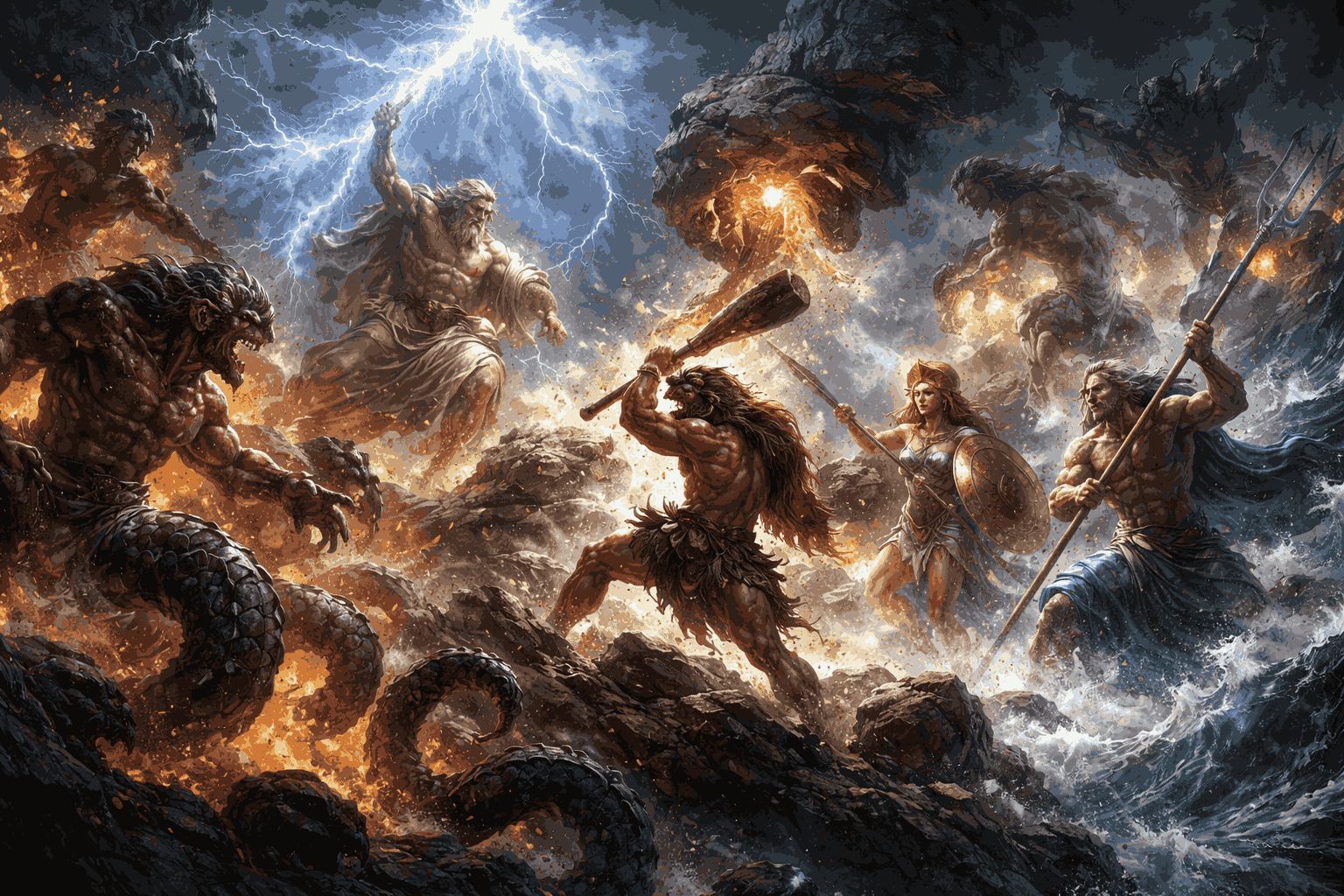
Some versions describe the Giants hurling massive rocks and blazing trees toward the heavens, turning nature itself into artillery.
Picture what that means in myth-language:
Not just “big enemies,” but the world’s raw materials rebelling.
Signature moves: Zeus, Athena, Poseidon (and friends)
This is where the Olympians look like Olympians.
- Zeus fights as the sky’s authority—lightning as judgment and control.
- Athena fights as strategy made flesh: planning, precision, and psychological advantage.
- Poseidon belongs in a myth where the earth shakes—sea and stone answering his will.
Different sources trade details, but the pattern stays stable: brute force meets divine coordination.
And still… it’s not enough.
Not until the mortal rule is satisfied.
Heracles’ turning-point moments (Alcyoneus, Porphyrion)
Heracles (Hercules) arrives as the “human key” that unlocks the Giants’ defeat.
One famous example involves Alcyoneus, sometimes described as especially hard to kill due to conditions tied to place or power. Many modern retellings highlight how Heracles changes the terms—by removing advantages and finishing the fight on workable ground.
Another recurring centerpiece is Porphyrion, often painted as a major threat whose aggression pulls multiple gods into the same crisis moment—then Heracles ends it with the kind of finality only the prophecy allows.
Even if names shift between versions, the structure is consistent:
- Gods fight and weaken the Giants.
- Heracles delivers the mortal “closing blow.”
- Olympus becomes secure—because divine might and human agency finally align.
Meaning and Symbolism
The Gigantomachy lasts because it’s not only spectacle.
It’s a story that thinks.
Order vs chaos (and why that theme keeps returning)
Many interpreters read the Gigantomachy as a mythic diagram:
- Olympus = order, law, civic structure, measured power.
- Giants = chaos, excess, earth-force, instability.
This is one reason Greek communities loved the theme in public art: it’s a victory story that says, “Our world has a right to exist.”
Hubris, authority, and the cost of rebellion
Another enduring thread is hubris—the overreach that ignores limits.
The Giants aren’t simply evil for sport. They’re what happens when power detaches from proportion.
And the myth is uncomfortably honest: rebellion can be understandable, but it can also become destructive when it turns into total domination.
That’s why the Gigantomachy can feel modern.
It asks: when the world is unstable, do you rebuild order—or try to replace it with force?
Gigantomachy in Art and Culture
If you want to see how seriously Greeks and later cultures took this myth, look at where it shows up: on monuments.
What to notice in the Pergamon Altar frieze
One of the most famous visual retellings appears on the Pergamon Altar, whose Gigantomachy frieze turns the war into a sweeping, cinematic stone narrative.
When you look at Gigantomachy art, watch for:
- gods shown with their signature attributes (Athena’s martial composure, Artemis’ bow),
- Giants becoming increasingly “other,” sometimes serpent-legged in later tradition, signaling a shift toward the monstrous over time.
Why cities loved this myth on temples and monuments
The public message is clear: “We stand for order.”
That’s why the Gigantomachy was an irresistible metaphor for:
- civilization vs barbarism,
- state stability vs invasion,
- lawful power vs violent upheaval.
In other words, it’s not just myth decoration.
It’s myth as political language.
What the Gigantomachy Still Teaches Us
A myth survives when it keeps offering usable insight.
The Gigantomachy offers plenty.
Strategy beats strength
The Giants have raw power.
The Olympians have coordination, specialized roles, and timing.
That combination—the right tool at the right moment—is why they hold the line long enough for the prophecy to be fulfilled.
The surprising power of alliances
The most human lesson in the Gigantomachy is also the most ironic:
Even gods need help.
Or, more precisely: even the most powerful systems fail without cooperation across “levels.”
Olympus doesn’t win by being solitary.
It wins by being a coalition.
And Heracles becomes the bridge between the mortal world and the divine—proof that greatness is often shared, not owned.