The Four Dragon Kings: The Hidden Guardians Behind China’s Water Myths
Introduction
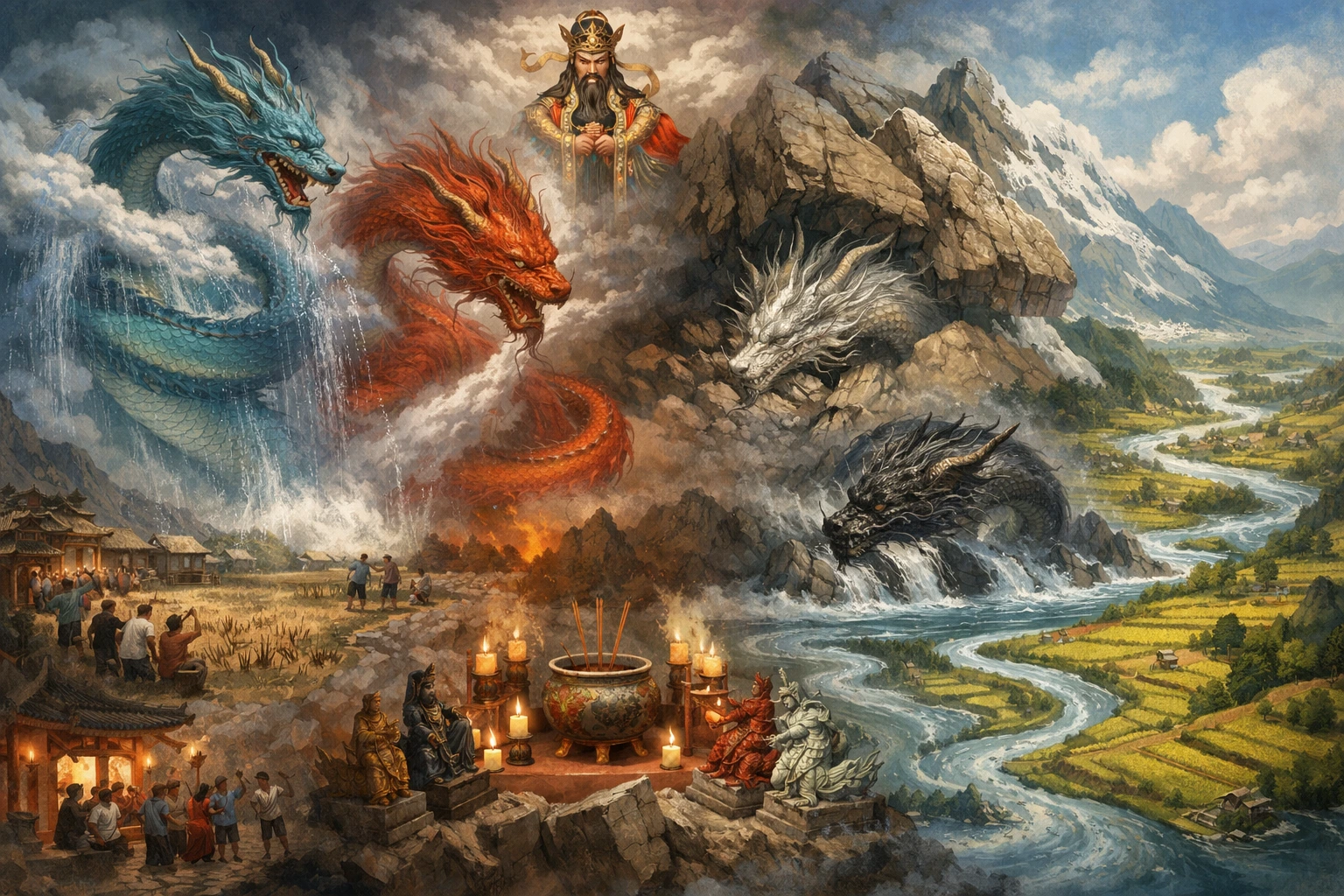
Something strange happens in the most famous Four Dragon Kings legend: the heroes do the “wrong” thing… and the world thanks them for it.
They break a heavenly rule.
They anger the Jade Emperor.
They get buried under mountains.
And yet, in many versions, they still “win”—because people live.
That twist is exactly why the Four Dragon Kings have survived for centuries in Chinese mythology: they aren’t just powerful. They’re useful—guardians of water, rain, and balance.
A secret in plain sight: why these dragons weren’t “monsters”
In a lot of Western stories, dragons guard gold, burn towns, and represent chaos.
In many Chinese stories, dragons do the opposite.
They guard water. They bring rain. They represent luck, strength, and harmony with nature. That’s why the Dragon King tradition is so tied to weather and survival—especially farming communities that needed reliable rain.
Chinese dragons vs. Western dragons (water, luck, balance)
Chinese dragons are often described as benevolent forces that help regulate nature. That doesn’t mean they’re always gentle—but their power is usually connected to protecting life, not destroying it.
If you’re reading this as a parent or educator, this difference is a gift:
- It helps kids see how cultures create different symbols for the same creature.
- It opens a conversation about how environment shapes mythology (farming + rivers = water guardians).
What “Dragon King” (Longwang) really means
“Dragon King” (Longwang) is a title used for water and weather deities across Chinese folk belief and mythology—linked to rain, seas, rivers, and storms.
Within that big umbrella, one of the most famous groupings is the Dragon Kings of the Four Seas—also called the Sihai Longwang—who rule the waters of the four cardinal directions.
That’s where the Four Dragon Kings step in.
Meet the Four Dragon Kings (Sihai Longwang)
The Four Dragon Kings are typically named as:
- Ao Guang — Dragon King of the East Sea
- Ao Qin — Dragon King of the South Sea
- Ao Run — Dragon King of the West Sea
- Ao Shun — Dragon King of the North Sea
They’re often presented as a set because together they “cover” the boundaries of the world—at least symbolically—through the Four Seas framework.
Ao Guang — East Sea
Ao Guang is one of the best-known Dragon Kings, appearing in major classics like Journey to the West and Fengshen Yanyi (Investiture of the Gods).
In many retellings, he’s portrayed as powerful, proud, and intensely connected to storms and rain—perfect traits for a guardian of the East Sea.
Ao Qin — South Sea
Ao Qin is linked to the South Sea and the southern direction in the Four Seas tradition.
In some modern explainers, the South Sea Dragon King is associated with the forces that shape weather—wind, rain, and seasonal change—because southern waters mean trade, travel, and typhoon paths.
Ao Run — West Sea
Ao Run is the Dragon King of the West Sea, and some traditions connect him with inland western waters as well.
What matters for readers: “West Sea” isn’t always a literal ocean in every telling. It’s also a mythic way to describe the western boundary waters that influence life.
Ao Shun — North Sea
Ao Shun is the Dragon King of the North Sea, tied to colder northern waters and the idea of nature’s harder edges—ice, winter, and deep currents.
Together, these four names form the most common “who’s who” list for the Four Dragon Kings in popular retellings.
The drought legend: the day they broke heaven’s rules
Here’s the legend that keeps showing up whenever people talk about the Four Dragon Kings:
A drought hits.
People beg for rain.
Heaven doesn’t answer.
And the Four Dragon Kings decide they can’t wait.
The crisis: drought, hunger, silence from above
In the story, the land dries up. Crops fail. Rivers shrink. Families suffer.
People pray to the Jade Emperor, ruler of Heaven in many Chinese mythic frameworks, asking him to send rain. In the legend, he ignores the pleas—either distracted, unconcerned, or slow to act (depending on the version).
The bold choice: stealing water to make rain
This is the moral pivot.
The Four Dragon Kings do something dangerously compassionate:
- They draw water from the seas.
- They rise into the sky.
- They release it as rain.
In other words, they act without permission—because waiting would cost lives.
This is why the Four Dragon Kings resonate as “guardians,” not just rulers: their power is tied to service.
The punishment: the Mountain God and the four mountains
When the Jade Emperor learns what happened, he’s furious.
The punishment is dramatic: the Mountain God is ordered to imprison the dragons beneath four mountains.
The imagery is unforgettable—massive, immovable stone pressing down on living water-power.
And here’s the twist: the story doesn’t frame the dragons as “criminals.” It frames them as protectors who chose consequences.
The “rivers” ending (why some versions say they became rivers)
Some widely shared versions end with an extra layer of meaning: even trapped, the dragons refuse to stop helping.
They transform into rivers—flowing across the land to keep nourishing people forever.
That “rivers” ending matters because your original blog frames them as guardians of China’s rivers. In the broader tradition, you’ll see both:
- Four Seas Dragon Kings (cosmic guardians of directional waters)
- Four Dragons become rivers (a moral folktale explaining why major rivers exist)
For Navora readers, you can treat this as a feature, not a problem: myths come in families of versions, and each version teaches something slightly different.
What the Four Dragon Kings symbolize in Chinese culture
The Four Dragon Kings aren’t only characters. They’re a cultural shorthand for what water represents:
- Life, because rain grows food.
- Power, because floods can destroy.
- Responsibility, because controlling water means protecting people.
Rain, farming, and survival
It’s easy to forget how high-stakes rainfall once was.
Before modern infrastructure, too little rain could mean famine. Too much could mean catastrophe. A mythic system that places water under the care of guardians makes emotional sense—especially in communities living near rivers and coasts.
Temples, prayers, and rainmaking traditions
Dragon Kings weren’t only “storybook” figures. Across Chinese tradition, people worshipped Dragon Kings as rain and water protectors, praying for relief during droughts and safety during floods.
That’s one reason “Dragon King” images appear in temples and folk religious contexts: they represent a relationship with nature—asking, thanking, and seeking balance rather than domination.
Why the Four Dragon Kings still matter now
The Four Dragon Kings story still lands today because it’s about a problem humans never outgrew:
How do we use power responsibly when lives are at stake?
For parents: conversation starters about responsibility and compassion
Try these discussion questions after you read the legend together:
- If you were one of the Four Dragon Kings, would you break the rule to help?
- Is it ever right to disobey authority to prevent harm?
- What makes a “guardian” different from a “boss”?
Kid-friendly takeaway: the Four Dragon Kings are strong, but the story praises them for being kind.
For students: themes—authority, ethics, and nature
The drought legend is basically an ethics case study:
- Authority vs. duty (the Jade Emperor’s order vs. people suffering)
- Consequences vs. conscience (punishment doesn’t erase moral purpose)
- Human-nature dependence (water as a shared lifeline)
If you’re writing an essay, you can frame the Four Dragon Kings as symbols of “moral action under pressure.”
For educators: a quick mini-lesson idea
A simple 25–35 minute lesson flow:
- Read a short retelling of the drought story.
- Build a four-column chart: Ao Guang / Ao Qin / Ao Run / Ao Shun.
- Discuss: Why might “Four Seas” be symbolic rather than strictly geographic?
- Compare dragon symbolism across cultures (one similarity, two differences).
- Exit ticket: “What would you do if you had the dragons’ power?”
Conclusion
The Four Dragon Kings endure because they solve an ancient fear with an ancient hope: that someone—some guardian—will protect the water that protects us.
Whether you picture them as the Dragon Kings of the Four Seas or as dragons who became rivers, the heart of the story stays the same: power is most meaningful when it shows up for the vulnerable.