The Eight Immortals Explained: The Hidden Meaning Behind China’s Most Mysterious Legends
Introduction
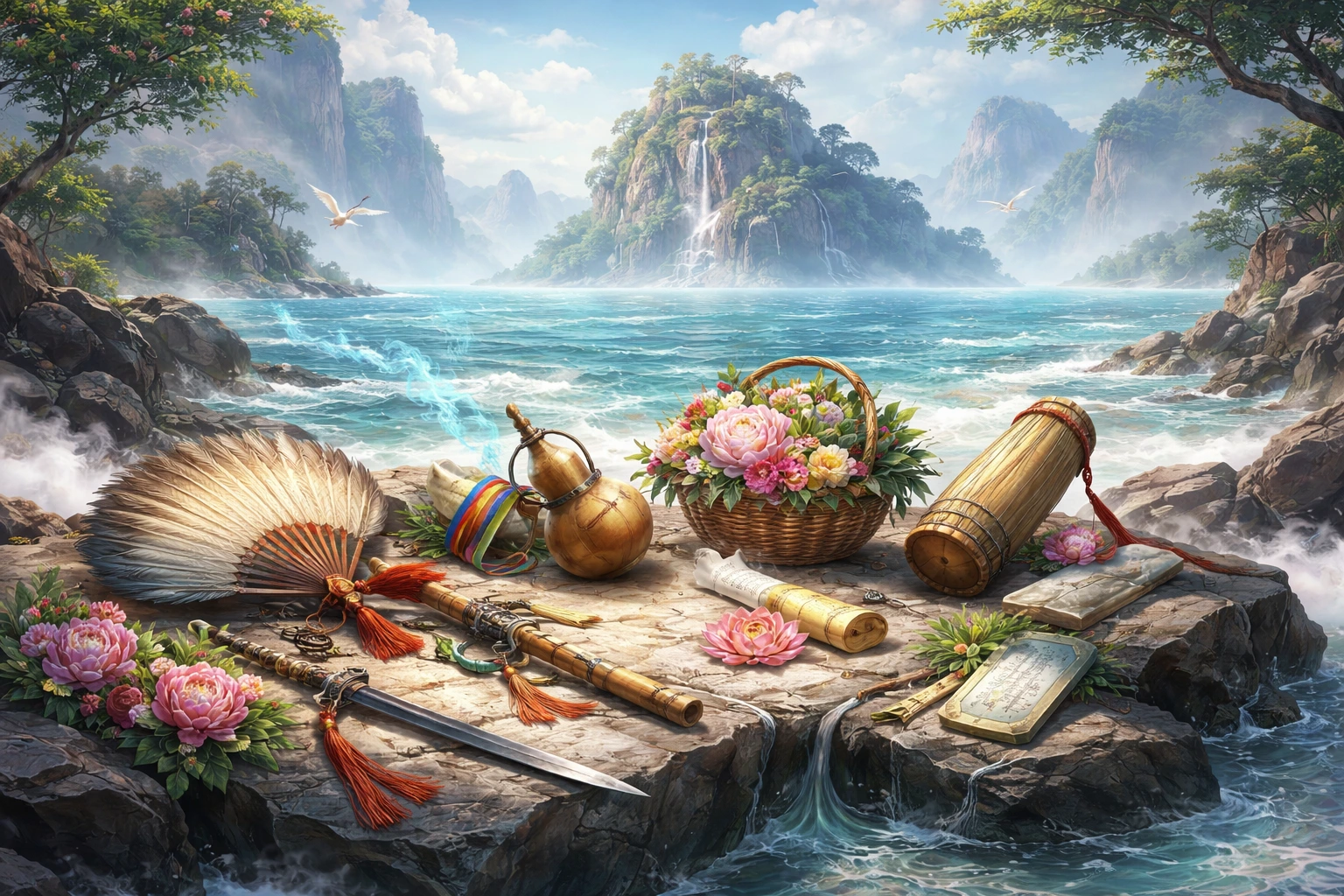
There’s a strange pattern in Chinese art: sometimes you don’t see the Eight Immortals at all.
Instead, you see a fan, a sword, a gourd, a lotus—objects arranged like clues at a crime scene. No faces. No names. Just symbols.
And somehow, people still know exactly who’s “there.”
If you’ve ever felt like the Eight Immortals (Bāxiān / 八仙) are less like characters and more like a riddle, you’re not imagining it. Their legend wasn’t designed to be solved once. It was designed to be retold—each time revealing a new meaning.
A Mystery That Refuses to Stay Solved
The Eight Immortals are famous for miracles—crossing seas, defeating monsters, healing the sick.
But their biggest “power” might be simpler: they refuse to sit still as one clean, official story.
That’s because the Eight Immortals aren’t just eight characters. They’re a collection of ideas—about personality, virtue, luck, aging, creativity, and what it means to outgrow ordinary life.
Many popular explanations describe them as a blend of historical, mythical, and religious storytelling, with the group often presented as living in the mythic landscape of Mount Penglai.
So if you’re searching for one “true origin,” the legend plays a trick on you: it offers eight.
Who Are the Eight Immortals (Bāxiān / 八仙)?
The Eight Immortals (Bāxiān) are a beloved group of Daoist immortals who appear across folk religion, literature, theater, and art. They’re often portrayed as dramatically different types of people—different ages, social classes, and temperaments—standing side by side.
A widely repeated cultural reading is that the Eight Immortals represent “every type of person,” which helps explain why they show up everywhere: the story has room for everyone.
Here’s the group you’ll most commonly see:
- Zhongli Quan — often linked to alchemy and transformation; typically shown with a fan.
- Zhang Guolao — an eccentric elder, associated with longevity and strange wisdom.
- Lü Dongbin — scholar-swordsman energy; often treated as a leader figure in later tradition.
- Cao Guojiu — courtly and refined, connected to imperial life.
- Li Tieguai — the “iron crutch” immortal, famous for healing associations.
- Lan Caihe — famously ambiguous and playful; often tied to spontaneity and youth.
- He Xiangu — the best-known female figure of the group in popular tradition.
- Han Xiangzi — the musician, associated with artistry and inspiration.
If you’re a student: the easiest way to remember them isn’t by memorizing biographies. It’s by learning their icons—because traditional art often identifies them through objects.
Where Did Their Story Come From? (And Why It’s Complicated)
Readers often ask: “When did the Eight Immortals begin?”
The honest answer: the individuals have older stories, and the group identity solidified over time.
PBS notes that stories circulated for generations before being recorded and that the group became combined as “BaXian” in later tradition.
This kind of myth-building is common:
- First, people tell stories about fascinating figures.
- Then, later audiences bundle them into a set.
- Finally, art and theater “lock in” the lineup because the visuals are memorable.
That’s why different sources may disagree on details, but still recognize the same eight.
If you’re looking for a practical takeaway: treat the Eight Immortals like a playlist, not a single album. Different dynasties and regions “remixed” them for different audiences.
“Eight Immortals Cross the Sea”: The One Story Everyone Knows
If the Eight Immortals have a greatest hit, it’s this: they cross the sea using their individual powers instead of a boat.
PBS frames the crossing as one of their most popular adventures, often linked to traveling to visit Xi Wangmu (the Queen Mother of the West) for a banquet celebrating her peaches.
The plot in one minute
Eight immortals arrive at the edge of a vast sea.
Instead of relying on the same method, each uses what they uniquely have—power, skill, or sacred object—to make it across.
The point isn’t that they “beat” the sea. The point is that they cross together without becoming identical.
The proverb and what it teaches
From this legend comes a proverb often translated like:
“The Eight Immortals cross the sea; each reveals their divine powers.”
In modern life, that’s basically the mythic version of:
- group projects done right,
- teams where different strengths matter,
- families where everyone contributes differently.
If you want more myth-based lessons for learning and life, you can keep reading at Navora Press.
The Hidden Language of Their Objects (The Real “Treasure”)
A lot of “mystery” around the Eight Immortals comes from a misunderstanding:
People hear “magical artifacts” and imagine buried relics.
But in many contexts, the objects are a symbolic system—a visual shorthand that artists used so viewers could identify the immortals instantly. Museum resources and glossaries emphasize that the objects are central identifiers in art.
Why art often shows the objects instead of the people
Because symbols travel well.
A sword on a vase can survive where a long story can’t. A lotus stitched on fabric can carry meaning without a single word.
This is also why you’ll sometimes see a set of “Eight Immortals emblems” even when no human figures are shown: the icon set is enough to “summon” the story in the viewer’s mind.
A simple guide to the eight symbols
Different lists exist, but these are common pairings you’ll see again and again:
- Fan (Zhongli Quan): transformation, revival, shifting what seems fixed.
- Sword (Lü Dongbin): clarity, discipline, cutting through deception.
- Gourd + iron crutch (Li Tieguai): healing, hardship, compassion for suffering.
- Flute (Han Xiangzi): creativity, harmony, inspiration that changes the world.
- Lotus (He Xiangu): vitality, spiritual purity, longevity themes.
- Court tablet / courtly markers (Cao Guojiu): status turned into virtue—power redirected toward ethics.
- Basket/flowers (Lan Caihe): spontaneity, nature, outsider joy (often shown with florals in art traditions).
- Elder’s “strange tool” / travel motif (Zhang Guolao): longevity, paradox wisdom, the eccentric sage.
How to read an Eight Immortals artwork (quick checklist):
- Look for eight distinct objects (even if the people aren’t there).
- If one figure stands out, identify their object first (sword, gourd, lotus, flute).
- Then scan for the “odd one”: Zhang Guolao is often signaled by age + eccentricity motifs.
That’s the real treasure: a coded language that lets the story travel across centuries.
Immortality: Blessing, Burden, or Metaphor?
It’s tempting to read Daoist immortality as pure wish fulfillment: endless life, endless power.
But the Eight Immortals endure because they keep the question open: what would you do with forever?
Britannica frames the Baxian as holy Daoists with access to the Queen Mother of the West’s Peach Festival—a symbol of longevity and divine privilege.
And yet, many retellings lean into the human tension:
- If you outlive your era, what anchors you?
- If your desires fade, what motivates you?
- If your life becomes infinite, does meaning become harder—not easier—to find?
Read this way, immortality becomes less like a superpower and more like a mirror:
- For students: it’s a mythic way to ask what “success” actually means.
- For parents: it’s a safe story-space to talk about ambition, contentment, and values.
- For educators: it’s a natural bridge into Daoist themes—balance, humility, and harmony—without turning philosophy into dry definitions.
How the Eight Immortals Still Shape Culture Today
Even if someone can’t name all eight, they often recognize the pattern:
- eight figures,
- distinct tools,
- one shared journey,
- many different personalities.
That’s why the Eight Immortals show up in art, crafts, idioms, and modern retellings—and why the “Crossing the Sea” proverb remains so reusable in everyday speech.
How to enjoy modern versions wisely
- Treat any single show/film as one interpretation, not the official version.
- Watch for which virtue the retelling emphasizes: courage, mischief, compassion, humility.
- Notice whether the story highlights the group’s difference as strength (that’s the heart of “Crossing the Sea”).
Conclusion
The Eight Immortals aren’t mysterious because their names are hidden.
They’re mysterious because they’re designed to be recognized in many ways: as characters, as symbols, as lessons, as art, as a proverb, as a philosophical question.
Once you see that, the “enigma” changes shape.
The secret isn’t where their treasures are buried. The secret is that the treasures were never only objects—they were meanings, carried forward in eight unforgettable forms.