Shuten-doji: The Drunken Oni King and the Clever Plan That Ended His Terror
Introduction
Before anyone ever said his name out loud, people whispered about the sound.
Footsteps on a mountain path where no one should be walking. A laugh behind a closed door. A cup clinking in the dark—like a toast being made to somebody else’s misery.
And then the disappearances began.
Shuten-doji wasn’t just a monster in Japanese folklore. He was the kind of fear that spreads faster than facts—until a single, shocking detail changed everything: the oni king didn’t fall to a stronger sword… he fell to a smarter plan.
Who Was Shuten-doji?
Shuten-doji is remembered as an oni king—a demon leader whose name still carries a chill. In many versions of the tale, he lives deep in the mountains, tied most famously to Mount Oe, far from the safety of the capital and close to the wild edges of imagination.
What “oni” means in Japanese folklore
“Oni” can be translated loosely as demon, ogre, or spirit of destruction. But in stories, oni often represent something bigger than claws and horns.
They can stand for:
- disasters that feel personal,
- violence that feels unstoppable,
- or the terrifying idea that the world has rules… until it suddenly doesn’t.
That’s why Shuten-doji works so well as a villain. He isn’t just dangerous—he’s disorder wearing a face.
Why he’s called the “Drunken Boy”
His name is often explained as “Drunken Boy” or “sake-drinking lad,” a nickname that turns oddly childlike on the surface—and deeply unsettling underneath.
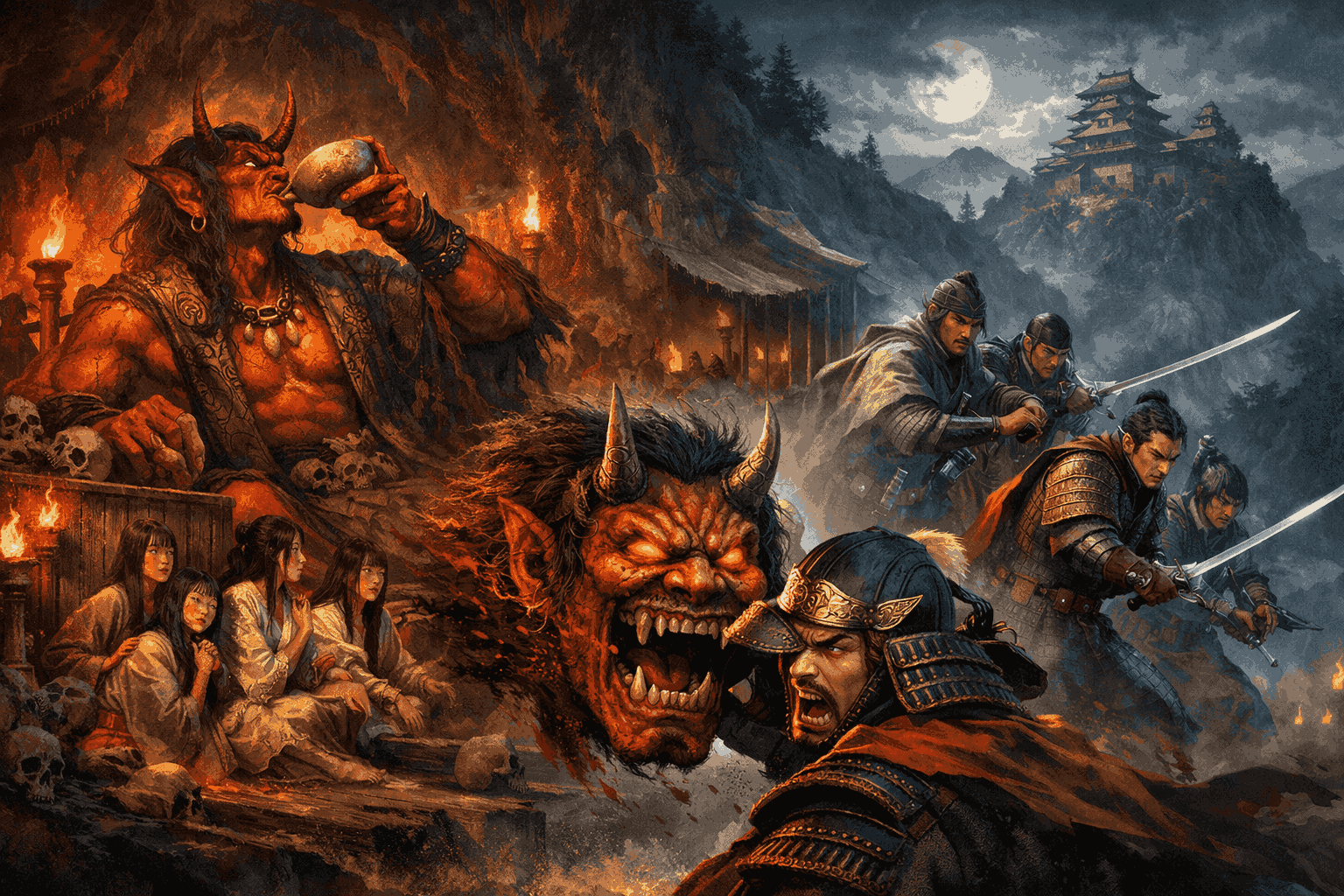
Because Shuten-doji doesn’t drink for fun. He drinks as a signal of excess: greed, appetite, domination. In some retellings, the party in his fortress is powered by stolen lives.
And that leads to the most persistent horror of the legend: Shuten-doji kidnaps people—often young women—and his reign becomes a local nightmare that the authorities can’t ignore.
Mount Oe and the fear of the unknown
The mountain setting matters. In folklore, mountains are boundaries: between village and wilderness, civilization and chaos, living and dead.
Shuten-doji is what happens when the boundary breaks.
So when the panic reaches the court, the question becomes simple: Who can walk into a place like Mount Oe and come back?
The Hero of the Tale: Minamoto no Yorimitsu (Raikō)
The hero most associated with defeating Shuten-doji is Minamoto no Yorimitsu, also widely known as Raikō.
If Shuten-doji is chaos, Raikō is order—disciplined, strategic, and backed by the authority of the court.
Raikō’s reputation and why the emperor turns to him
In the canonical shape of the legend, Raikō is summoned because normal responses have failed. This isn’t a “send more soldiers” problem. It’s a “how do you fight something that doesn’t play by human rules?” problem.
Britannica’s summary of the myth highlights the key beats that show up again and again: disguise, a magical drink, and a final threat even after Shuten-doji is killed.
The Four Heavenly Kings and teamwork
Raikō rarely goes alone. Many versions emphasize a team—often framed as the Four Heavenly Kings (his elite retainers), a detail that shifts the story from lone-hero fantasy into something more grounded:
- someone plans,
- someone watches the exit,
- someone keeps their nerve,
- and someone acts fast when the moment arrives.
That teamwork becomes the real “weapon” of the tale.
The Plan That Beat a Monster
Here’s the twist that makes this legend unforgettable:
Raikō doesn’t challenge Shuten-doji to a fair fight.
He walks into the lion’s den wearing a mask.
Disguises, sacred help, and the dangerous hospitality test
In several popular retellings, Raikō and his men disguise themselves as religious figures—often mountain ascetics or monks—because it’s the only way to get close.
A disguise in folklore isn’t just costume. It’s a test.
If the oni king sees through you, you die.
If you hesitate, you die.
If you act too early, you die.
And in at least one vivid modern telling connected to a Smithsonian exhibit, the atmosphere is heavy with dread: the heroes are welcomed inside, watching demonic “hospitality” while knowing they must not flinch.
The sake trick: why it works in so many versions
Shuten-doji is associated with sake so strongly that the story uses it against him.
The plan is beautifully simple:
- Offer Shuten-doji a drink.
- Make it a special drink—sleep-inducing, demon-binding, or magically potent.
- Wait until the fortress lets its guard down.
- Strike fast.
Britannica calls it a “magic drink” used to befuddle the creatures before the warriors reveal themselves.
It’s not brute force. It’s timing.
And timing is what defeats an oni king who expects everyone to meet him on his terms.
The Battle at Mount Oe
When Shuten-doji finally collapses into drunken sleep, the story accelerates like a door slammed shut.
The raid and the beheading
Raikō and his men drop the disguise. Weapons appear. The “pilgrims” are suddenly a strike force.
Then comes the moment people remember:
Shuten-doji is decapitated.
The Drunken Oni King—the terror of Mount Oe—falls in seconds.
The severed head attack and the protective helmet
But the legend refuses to end neatly.
Even after Shuten-doji is killed, his severed head still attacks Raikō—one last surge of malice that turns victory into a final, breath-holding near-miss. Britannica keeps this detail in its short summary, which tells you how essential it is to the myth’s identity.
In the Smithsonian retelling, the same horror lands with a storyteller’s punch: the hero thinks it’s over—then the head “jumps back to life” and tries to kill him.
That’s why the helmet matters.
The helmet isn’t just armor. It’s symbolism:
- protection against the “last bite” of fear,
- protection against the cost of daring to face evil,
- protection that says: this mission was bigger than one man’s strength.
So Shuten-doji’s reign ends not in a duel, but in a coordinated act of strategy—followed by a supernatural aftershock that reminds everyone what they were truly dealing with.
What This Legend Is Really About
On the surface, Shuten-doji is an action story: monster, mountain, infiltration, battle.
But it survives because it carries themes people recognize instantly.
Evil as chaos (and why people personify it)
Shuten-doji represents chaos that feels both random and targeted:
- the innocent vanish,
- the powerful feel helpless,
- fear becomes a daily routine.
By giving that chaos a name—Shuten-doji—people can talk about it, warn each other, and imagine an ending.
Strategy over strength
This is the part readers love, even if they don’t say it out loud:
Raikō wins because he’s smarter than the situation.
The legend teaches that courage isn’t always loud. Sometimes it looks like:
- waiting,
- pretending,
- risking shame to survive,
- and choosing the tactic that works, not the tactic that feels heroic.
In other words: bravery is not just fighting—it’s planning.
Justice, divine aid, and moral order
In many versions, the heroes receive help that feels sacred: guidance, protective objects, or “right timing” that doesn’t happen by accident.
That reinforces a comforting idea:
Even when darkness looks unbeatable, the world still has a moral spine.
Not always visible. But present.
Shuten-doji in Japanese Culture
Shuten-doji didn’t stay trapped on Mount Oe.
He moved into art, literature, and the long memory of popular storytelling.
One reason is visual power. A demon king, a hidden fortress, disguised warriors, an unforgettable beheading, and a head that still bites—this is the kind of tale artists can’t resist.
And it’s not just modern creators. The Smithsonian piece points to how the legend was displayed through Japanese artworks tied to the story’s visual tradition.
So Shuten-doji becomes more than a monster:
- a cautionary symbol of unchecked appetite,
- a portrait of fear given form,
- and a reminder that cleverness can end what strength cannot.
Final Thoughts
The story of Shuten-doji endures because it’s thrilling—but also because it’s practical.
It says:
- evil can be loud,
- fear can spread,
- and monsters can rule for a time…
…but a well-built plan, shared courage, and one decisive moment can end a reign of terror—even on a mountain where people thought no one returned.