Rama and Abraham: Same Person or Shared Pattern? A Clear, Respectful Reality Check
Introduction
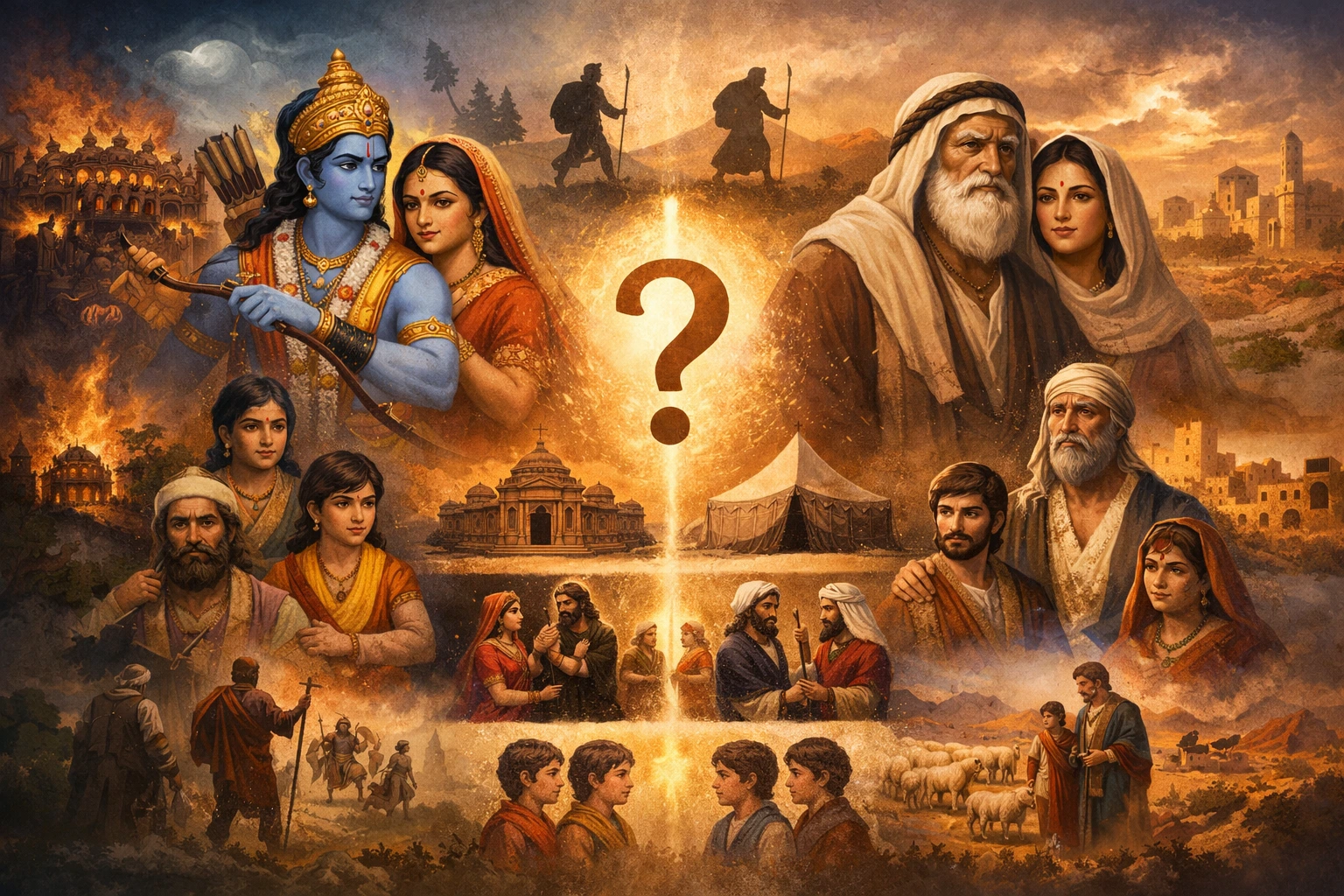
Something odd happens when you place Rama and Abraham side by side.
The more you stare, the more “matches” appear: a journey away from home, a wife who travels too, family conflict, famous descendants… even a name that looks like it hides another name inside it.
Is it a hidden historical secret?
Or is it the kind of pattern that feels inevitable once you start looking for it?
If you’ve ever googled “Rama Abraham same person”, this guide is for you.
Here’s the twist: the similarities are real in the sense that they’re recognizable story-shapes—but that doesn’t automatically make the two figures identical.
If you enjoy this kind of careful myth-and-history decoding, subscribe for more deep dives here: Navora Press updates.
Why this question keeps resurfacing ?
The “Ab-Ram” hook
The theory often starts with a single spark: Abraham was originally named Abram—and some readers split that into Ab-Ram, then interpret it as “Father Ram.”
It’s catchy. It’s memorizable. And it feels like the kind of clue history “hid in plain sight.”
Why human brains love patterns
We’re built to detect patterns quickly—especially in names and narratives.
So when two traditions are both ancient, both widely told, and both morally serious, you’ll naturally find overlaps:
- “Leave home” stories
- “Test of faith” stories
- “Family conflict” stories
- “Founding ancestor” stories
Those patterns can be meaningful without being evidence of a single shared biography.
What the texts actually say ?
Rama’s arc in the Valmiki Ramayana
In the Ramayana, Rama is the central hero—often understood as an avatar of Vishnu in Hindu tradition—whose story includes exile, separation, and a dramatic conflict involving Lanka.
His narrative world is deeply shaped by dharma: duty, righteousness, and right action under pressure.
Abraham’s arc in Genesis
Abraham’s core story in the Bible is about a divine call, migration, covenant, and becoming a foundational patriarch. Encyclopaedia Britannica summarizes the biblical account as Abram (later Abraham) being called by God to leave his country and journey to a new land, linked to the founding of a people.
Already, the “feel” is different:
- Rama’s world is epic, royal, and war-shaped
- Abraham’s world is pastoral, covenant-shaped, and lineage-focused
That doesn’t mean they can’t be compared. It just means the comparison needs to be honest.
Does “Abram” mean “Father Ram”?
This is the make-or-break point for many readers.
Because if the name truly means “Father Ram,” it can feel like a locked door suddenly opening.
The standard linguistic reading
Most mainstream explanations parse Abram as “exalted father” (or a close variant such as “(my) father is exalted”).
In that reading:
- ab = father
- ram = high / exalted
So “ram” here is not a hidden reference to Rama—it’s a Hebrew root connected to height or exaltation.
Where the folk-reading goes wrong
The folk-reading “Father Ram” depends on treating “Ram” as if it’s automatically the Indian divine name.
But across languages, similar-looking syllables can have unrelated roots.
So yes:
- “Ab-Ram” is a real split you can make visually
- but the meaning depends on Hebrew linguistics, not on how it looks in English letters
This is why a respectful “reality check” matters: you can enjoy the curiosity without turning a pun into proof.
The similarities people cite (and what they’re worth)
Let’s go through the most common parallels—carefully.
Leaving home: exile vs calling
Similarity: Both stories involve leaving one’s home region and entering uncertainty.
Difference that matters:
- Rama’s departure is tied to a royal promise and exile logic inside an epic world
- Abraham’s departure is framed as a divine call shaping a covenant story
This is a shared pattern, not a unique fingerprint.
“Kidnapping” comparisons: Sita vs Sarah episodes
Some versions of the claim compare:
- Sita’s abduction to
- Sarah being taken into a foreign ruler’s house in Genesis traditions
These are not the same kind of episode in tone or theology. One sits inside an epic rescue-war framework; the other functions as a patriarchal-journey test scene.
It’s fair to compare themes like protection, vulnerability, and power. But “kidnapping exists” is still too broad to establish identity.
Two sons: Lava–Kusha vs Ishmael–Isaac
This parallel shows up a lot because it’s clean:
- Rama is linked with Lava and Kusha in the Ramayana tradition
- Abraham is linked with Ishmael and Isaac in Abrahamic tradition
But “two significant sons” is one of the most common mythic and historical patterns on earth. It’s also a natural storytelling device: it allows contrast, conflict, and lineage branching.
Still—this is the part readers find most emotionally convincing, so it deserves a gentle explanation rather than dismissal.
Conflict and separation: Lakshmana/Durvasa vs Lot
Another common comparison is “conflict leads to separation.”
In Abraham’s story-world, conflict around herdsmen and separation with Lot is a known narrative element in popular retellings and commentaries.
In Rama traditions, later episodes (often discussed around the Uttara material in broader Ramayana traditions) include moments of tension involving Lakshmana and larger vows/duties.
But even when these scenes rhyme thematically, the mechanics differ:
- Who initiates the conflict
- What the moral lesson is
- What consequence follows
At best, the parallel supports “shared moral themes”:
- loyalty vs duty
- peace vs principle
- family unity vs responsibility
Not “same person.”
Place-name matching: Ai / Ayodhya
This is where pattern-hunting becomes risky.
Because once you allow “sounds similar” to stand in for evidence, almost any geography can be remapped.
Ai and Ayodhya look alike in English letters, but that isn’t a linguistic chain. It’s a coincidence until supported by:
- original-language forms
- attested transmission routes
- dates and manuscripts
- intermediary spellings across centuries
Without that, it stays in the “interesting but unproven” pile.
What would count as real evidence?
If Rama and Abraham were the same person historically, we’d expect multiple strong signals—not just narrative resemblance.
1) A credible linguistic pathway
Not “they sound alike,” but:
- original spellings in the source languages
- historically plausible borrowing routes
- intermediate forms that show gradual change
2) Timeline compatibility
Traditions place Rama and Abraham in very different time-frames, and even within each religion there are debates about dating.
But for “same person,” you’d need a timeline that doesn’t collapse under basic scrutiny.
3) Geographic coherence
Rama’s story is anchored in South Asian epic geography; Abraham’s in West Asian Bronze Age settings, as summarized in standard references.
To bridge that, you’d need something stronger than place-name resemblance.
4) Textual transmission evidence
This is the big one:
- manuscripts
- quotations
- translation records
- shared proper nouns with traceable borrowing
Without transmission evidence, “same person” remains a theory driven more by pattern-satisfaction than by history.
A better takeaway than “same person”
Here’s a more satisfying conclusion—one that keeps the wonder and respects both traditions:
Shared human questions create shared story-shapes
Rama and Abraham each sit at the center of a tradition asking huge questions:
- What is duty when it hurts?
- What does obedience cost?
- How do you lead a family through uncertainty?
- What does “righteousness” look like in public life?
When cultures ask similar questions, they often create stories with similar scaffolding.
Compare respectfully: “parallel” is not “identical”
A good comparative mythology habit is this:
- Appreciate resonances
- Avoid forced equivalences
- Separate literary comparison from historical claims
So, is Rama of the Valmiki Ramayana the same as Abraham of the Bible?
Based on mainstream reference framing of Abraham’s context and the Ramayana’s literary-cultural setting, it’s far more likely they are distinct figures—with some shared narrative patterns that invite comparison.