Pandora’s Box: The Hidden Secret Behind the Myth, the Jar, and the Hope That Stayed
Introduction
There’s a detail most retellings quietly skip—one small “translation slip” that changes how the entire story feels.
You’ve heard the warning: Don’t open it.
You know what happens next: Everything goes wrong.
But here’s the secret twist: the object at the center of Pandora’s Box may not have been a box at all—and the thing left behind, hope, might be either humanity’s greatest comfort… or its longest-lasting trap.
The Myth in One Breath (So You Don’t Get Lost)
The story of Pandora’s Box is often told like a simple moral: curiosity leads to chaos.
But in the oldest famous version, it’s more like a cosmic chain reaction.
Prometheus, fire, and Zeus’ payback plan
It begins with Prometheus, who tricks Zeus and steals fire for humans—an act that gives people power, warmth, and progress. Zeus, furious, decides that punishment shouldn’t look like punishment.
It should look like a gift.
Pandora: “all-gifted,” crafted to be irresistible
Zeus orders the gods to create Pandora. She’s “all-gifted”—beauty, charm, skill, and a mind that can’t stop wondering. In Hesiod’s telling, multiple gods contribute to her making, like a divine team building a masterpiece with consequences baked in.
Pandora is sent to Epimetheus (Prometheus’ brother). And with her arrives the famous sealed container—told not to be opened.
You can already feel the trap closing.
Was It Really a Box?
This is where the myth hides its first secret.
In the most influential ancient source, the container is described as a pithos—a large storage jar, not a small jewelry-box-sized chest.
The original word pithos (a storage jar)
A pithos wasn’t cute or dainty. It was practical. Big. Heavy. A household object.
That matters, because a “jar in the home” feels like something you live beside every day—something ordinary that quietly holds extraordinary consequences.
How “Pandora’s box” became the phrase people remember
So why do we all say Pandora’s Box?
Over time, “box” became the catchy version that stuck in later European storytelling traditions. Britannica notes that Pandora’s jar became a “box” in the Renaissance era, linked to Erasmus’ handling of the story.
In other words: the world didn’t just inherit a myth. It inherited a memorable mistranslation—and then built an idiom on top of it.
What Actually Escaped (and Why It Feels So Modern)
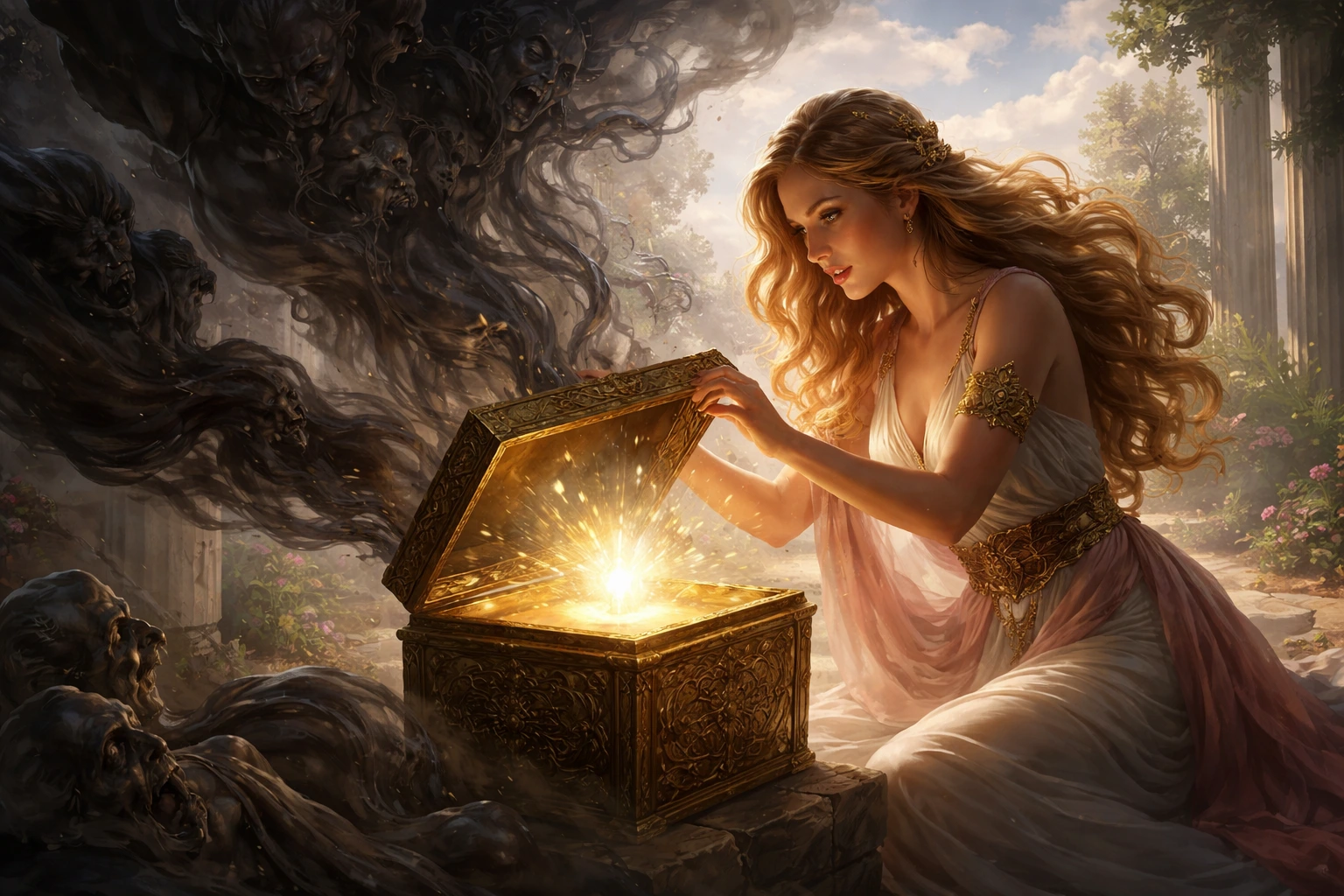
When Pandora opens the container, the myth says the world changes permanently.
All the “ills” fly out—sickness, sorrow, pain, toil—everything that makes life hard. Britannica describes the jar as containing “all manner of misery and evil,” released across the earth.
Evils as “conditions of life”
A modern reader may picture cartoon “evil spirits.”
But another way to read the myth is simpler: this is an origin story for why human life includes hardship at all.
- Why do people get sick?
- Why does grief exist?
- Why do we work so hard and still struggle?
Myths often answer “why” questions with story logic instead of scientific logic. And this one says: suffering wasn’t random. It entered the world through an irreversible moment.
Why myths explain suffering without using science
The Greeks didn’t write Pandora’s story to give medical explanations.
They wrote it to give emotional explanations:
- Life feels unfair.
- Actions have consequences.
- Even beautiful gifts can carry hidden costs.
That’s why Pandora’s story still hits. It’s not just mythology. It’s psychology in myth-clothing.
The Biggest Twist: Hope (Elpis) Stayed Behind
After the jar is opened and horror spills out, Pandora closes it.
And one thing remains: Elpis—usually translated as hope. Britannica summarizes this clearly: evils escape, but hope remains inside because the lid is shut before it can leave.
That sounds uplifting… until you ask the uncomfortable question:
Is it good that hope stayed?
Reading 1: Hope as a comfort we’re allowed to keep
In the warmest interpretation, hope is the one mercy humanity gets.
The world becomes difficult, but people aren’t left helpless. Hope becomes:
- the reason we try again,
- the reason we endure,
- the reason we rebuild after loss.
This is the version that makes Pandora’s story survivable. It’s why the myth doesn’t end in total darkness.
Reading 2: Hope as a problem that prolongs suffering
But there’s a colder interpretation that shows up in serious discussions of the myth:
If the jar contains evils… and hope is inside the jar… is hope also an evil?
Some readings treat hope as “false expectation”—something that keeps humans chasing outcomes that never arrive, stretching suffering over time.
This interpretation doesn’t say hope is worthless. It says hope is dangerous when it turns into denial.
What Hesiod’s wording suggests (and why scholars debate it)
Hesiod is the key reason this debate exists at all. The ancient wording and context create room for more than one conclusion, and that ambiguity is part of why the myth has lasted.
So rather than asking “Which reading is correct?” a better myth-reader question is:
Which version of hope are we talking about—steady courage, or endless self-deception?
Why Greeks Told This Story Again and Again
Pandora isn’t just a character. She’s a narrative tool.
Work, consequence, and human limits
In Hesiod’s world, human life involves labor, uncertainty, and limitation. The Pandora myth helps explain why people can’t simply live in effortless ease.
It’s not a “gotcha” story about one person’s mistake.
It’s a story about the human condition.
Pandora and later “first woman” stories: similarities and differences
Many cultures have “first woman” or “first disobedience” stories. What’s unique here is the myth’s double edge:
- Pandora is made to be irresistible.
- The forbidden object is placed near her.
- Curiosity is practically guaranteed.
That structure matters if you’re reading the story thoughtfully—especially in a classroom or at home. It shifts the conversation from blame to design, power, and consequence.
Pandora’s Box Today
The phrase “opening Pandora’s box” outlived the myth and became shorthand for a familiar modern experience: one action unleashes a chain of unexpected problems. Cambridge Dictionary defines it as something that creates many new problems you didn’t expect.
What “opening Pandora’s box” means now
Today, “Pandora’s box” usually means:
- starting a controversy you can’t contain,
- changing something and triggering fallout,
- revealing information that changes everything.
Real-life examples (without flattening the myth)
Think of moments like:
- pressing “send” on a message that can’t be unsent,
- sharing a secret that reshapes friendships,
- launching a new technology that brings both benefits and harms.
In all those cases, the story isn’t “never be curious.”
It’s: be honest about consequences, because some doors don’t close the same way again.
A Better Takeaway for Students, Parents, and Educators
Pandora’s story is often taught as a warning against curiosity.
That’s the simplest reading—but it’s not the most useful one.
Discussion questions (classroom + home)
For students:
- If Pandora was designed as a “gift,” who is responsible for what happens?
- Is curiosity always a flaw—or is it a force that needs wisdom?
- If hope stayed inside, did humans gain hope or lose it?
For parents:
- How do we teach children “think first” without teaching “don’t wonder”?
- What’s the difference between healthy curiosity and risky impulse?
For educators:
- Compare “jar vs. box”: how does translation change meaning?
- Discuss Elpis: why might “hope” be comforting or complicated?
Vocabulary mini-glossary
- Pandora: “all-gifted,” crafted by the gods.
- Pithos: a large storage jar (often later called a “box”).
- Elpis: “hope” (or “expectation,” depending on interpretation).
- Prometheus: figure linked to fire and human advancement.
- Epimetheus: Prometheus’ brother; Pandora’s husband in the famous version.
Conclusion: The Hope We Choose to Carry
The real power of Pandora’s Box isn’t that it blames curiosity.
It’s that it admits something adults and children both recognize: life is a mix of wonder and consequence. One moment can change everything.
And yet—whether hope escaped into the world, or stayed behind as something we must actively claim—hope remains the myth’s final word.