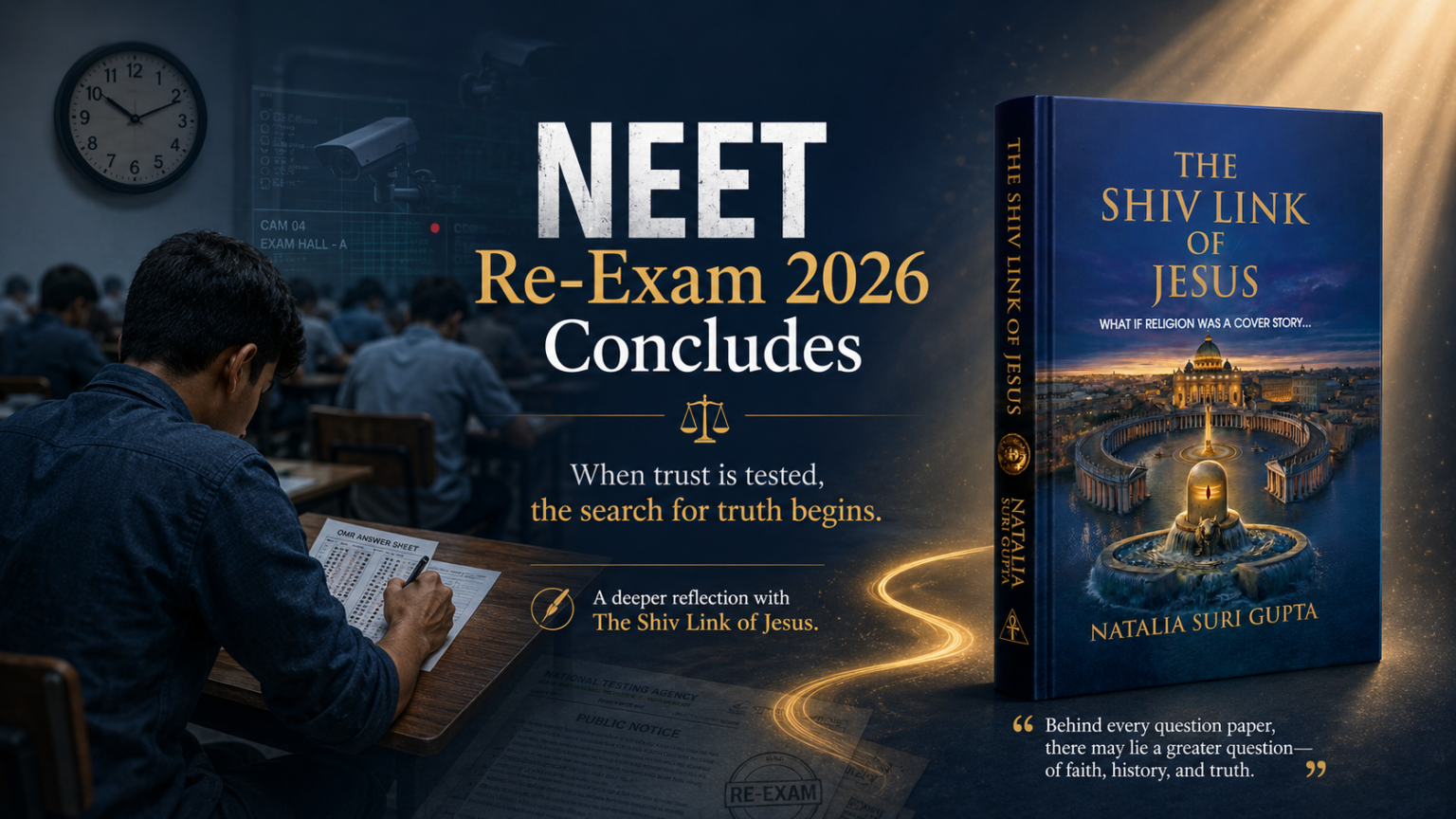
The NEET re-exam 2026 concludes story is not just another education headline. For lakhs of students, it marked the end of one exam day, but not the end of the anxiety surrounding results, answer keys, admissions, and fairness.
The National Testing Agency’s official NEET portal had listed the June 21, 2026 re-examination updates, including admit card notices and security-related advisories. According to reports, around 22.7 lakh students appeared for the re-test across 5,440 centres in India and 14 centres abroad, under AI monitoring, CCTV surveillance, biometric checks, and large-scale administrative supervision.
On the surface, the story is simple: the exam is over. But beneath that lies a much larger question: when young lives depend on one national test, how does a country protect not just the paper, but the faith placed in it?
What Happened in the NEET Re-Exam 2026?
The NEET-UG re-exam was conducted on June 21, 2026, in offline mode. Candidates marked answers on OMR sheets, and early reactions described the paper as moderate, with some students finding sections lengthy or demanding. The official answer key is expected to be released later on the NEET portal, along with OMR sheets and recorded responses.
The NTA’s FAQ for the re-examination confirmed the exam timing as 2:00 PM to 5:15 PM, including time for formalities, and noted that 15 extra minutes were provided for documentation, verification, and exam-related processes.
For students, this matters deeply. The moment the paper ends, a second exam begins—the mental calculation of scores, cut-offs, rank expectations, college possibilities, and family hopes.
Why Is “NEET Re-Exam Concludes” Trending?
The phrase is trending because NEET is not just an entrance exam. It is one of India’s most emotionally charged academic events. It decides the path to medicine for millions of aspirants and carries the weight of years of coaching, sacrifice, family investment, and personal identity.
This year’s re-exam drew attention because of the scale of the exercise and the intense security measures used to restore confidence. Reports described the re-test as a “whole-of-government” effort, involving lakhs of officials, observers, police personnel, jammers, CCTV networks, biometric verification, and AI-based surveillance.
That is why people are searching for:
When will the NEET re-exam answer key be released?
The provisional answer key will be released by NTA on the official NEET portal. Candidates will be able to compare it with their recorded responses and OMR sheets before the final answer key and result are announced.
Was the NEET re-exam difficult?
Early reports suggest the paper was generally rated moderate, though reactions vary by subject and student preparation.
What happens next?
The next steps are provisional answer key release, challenge window, final answer key, result declaration, and counselling.
The Real Issue: Trust Is the Invisible Syllabus
Every exam has a visible syllabus: Physics, Chemistry, Biology. But NEET also has an invisible syllabus: trust.
Students trust that the paper is secure. Parents trust that effort will be rewarded. Institutions trust that scores reflect merit. Society trusts that future doctors are selected through fairness.
When that trust is shaken, even a successfully conducted re-exam cannot immediately erase the emotional damage. It can only begin the repair.
This is why the NEET re-exam conclusion feels symbolic. It is not just the closing of a test booklet. It is the reopening of a larger national conversation about transparency, systems, pressure, and the cost of uncertainty.

What the Re-Exam Reveals About Student Pressure
NEET aspirants do not simply prepare for an exam. Many organize their entire teenage years around it.
They give up festivals, hobbies, sleep, social life, and sometimes emotional ease. A re-exam adds another layer of strain: the fear that months of preparation may have to be summoned again, under even greater psychological pressure.
This is where the conversation must become more humane. A secure exam system is essential, but so is emotional support. India often discusses ranks and cut-offs, but not enough about burnout, fear, isolation, and the silent burden of expectation.
A fair system must protect both the answer sheet and the human being holding the pen.
A Subtle Connection to The Shiv Link of Jesus
Stories like “The Shiv Link of Jesus” explore a similar tension between belief, hidden truth, and the search for meaning. The book is a fictional work that blends spiritual reflection, mystery, and the meeting point of Indian and Western thought.
At first glance, NEET and a spiritual mystery novel may seem unrelated. But both touch a deeper human question: what happens when faith in a system is tested?
In the world of The Shiv Link of Jesus, characters are drawn toward buried truths and unseen connections. In the NEET story, students and families are also searching for truth—not mystical truth, but institutional truth. Was the process fair? Were the safeguards enough? Will merit be protected?
Both journeys reveal that truth is not only about facts. It is about the courage to question, the patience to wait, and the strength to continue even when uncertainty becomes heavy.
Key Takeaway
The conclusion of the NEET re-exam is not the end of the story. It is a turning point. The coming answer key, result, and counselling process will decide admissions, but the larger lesson is already clear: competitive exams need not only efficiency, but credibility, compassion, and transparency.
Deeper Reflection: Why We Keep Searching for Certainty
Modern life often feels like an endless examination. We wait for results, approvals, rankings, verdicts, and signs that our effort has meaning.
NEET makes this visible on a national scale. Millions of young people sit in silence for three hours, hoping that years of preparation will be recognized. Outside the exam centre, parents wait with prayer, calculation, fear, and hope.
This is why the story resonates. It is not only about medicine. It is about the human desire for justice.
We want to believe that hard work matters. We want to believe that systems can be fair. We want to believe that truth, though delayed, will eventually become visible.
That is also why stories of mystery and spiritual discovery continue to attract readers. Whether in a courtroom, an exam hall, a temple, a laboratory, or a hidden archive, human beings are always searching for the same thing: a sign that truth has not been lost.
FAQ
1. When did the NEET re-exam 2026 conclude?
The NEET-UG 2026 re-exam was conducted on June 21, 2026, with exam timing listed as 2:00 PM to 5:15 PM, including formalities.
2. How many students appeared for the NEET re-test?
Reports said around 22.7 lakh candidates appeared across 5,440 centres in India and 14 centres abroad.
3. When will the NEET re-exam answer key be released?
The official provisional answer key will be released later on the NEET portal, followed by a challenge window, final answer key, and result.
4. Was the NEET re-exam paper difficult?
Early student reactions described the paper as moderate, though difficulty perception varies by subject and preparation level.
5. What is the deeper meaning of the NEET re-exam story?
Beyond admissions, it reflects a national concern for fairness, transparency, student pressure, and trust in public institutions.
Conclusion
As the NEET re-exam 2026 concludes, students now enter the waiting phase—answer key, result, rank, counselling, and the future they have imagined for years.
But this moment also asks something larger of society. Can we build systems where ambition does not become fear? Can transparency become stronger than suspicion? Can young people feel that their effort is protected?
For readers drawn to mysteries where faith, history, and hidden truth quietly meet, “The Shiv Link of Jesus” offers another path into that timeless search.