Japanese and Hindu Mythology: The Hidden Bridges Between Two Ancient Worlds
Introduction
Something strange happens when you read Japanese myths right after Hindu ones.
A sun deity disappears, and the world panics.
A goddess of music holds an instrument and blesses artists.
A fierce protector in armor guards the moral order.
It feels less like coincidence… and more like someone left a secret doorway open between two civilizations.
The “Secret Passage” Between India and Japan
When people talk about Japanese Hindu mythology connections, they usually mean one of two things:
- Shared archetypes: many cultures invent similar story-roles (sun, storm, underworld judge).
- Shared history: some ideas actually traveled, changed names, and took new local forms.
Both can be true—but they’re not the same thing.
The real bridge: Buddhism’s travel route across Asia
A major historical “highway” for religious ideas ran through Asia for centuries: India → Central Asia → China → Korea → Japan. Along that route, certain Hindu deities entered Buddhist cosmology, then arrived in Japan with Buddhist texts, art, and rituals.
That’s why some parallels aren’t just “similar.” They’re connected by translation, transmission, and reinvention.
Shared archetypes vs shared history (how to tell the difference)
A quick rule of thumb:
- If the match includes a known transmission path and a renamed figure, it leans historical.
- If it’s more like “both have a sun deity,” it’s often a universal archetype.
Now let’s look at the most fascinating overlaps—without flattening either tradition.
Creation Stories That Start in the Same Place
Creation myths often begin where certainty doesn’t exist yet.
Chaos, ocean, and ordering the world
In Japanese mythology, the primal pair Izanagi and Izanami shape land out of the formless. In many tellings, the act of “ordering” happens through sacred action and divine authority tied to place and lineage.
In Hindu mythology, creation stories vary across texts and eras, but a common image appears again and again: a cosmic ocean and a universe taking form through divine will and cosmic principle.
This is a classic mythology similarities pattern: “the world begins in watery chaos, then becomes structured.”
What each tradition emphasizes
Here’s the hidden difference that matters:
- Japanese creation stories often anchor identity in land, ancestors, and sacred geography.
- Hindu creation stories often anchor reality in cosmic cycles, metaphysics, and time.
Same starting mood—different destination.
Sun Power and Sacred Light
Sun deities aren’t just “the sun.” They’re the story’s operating system: order, rhythm, legitimacy, life.
Amaterasu and the myth of the cave
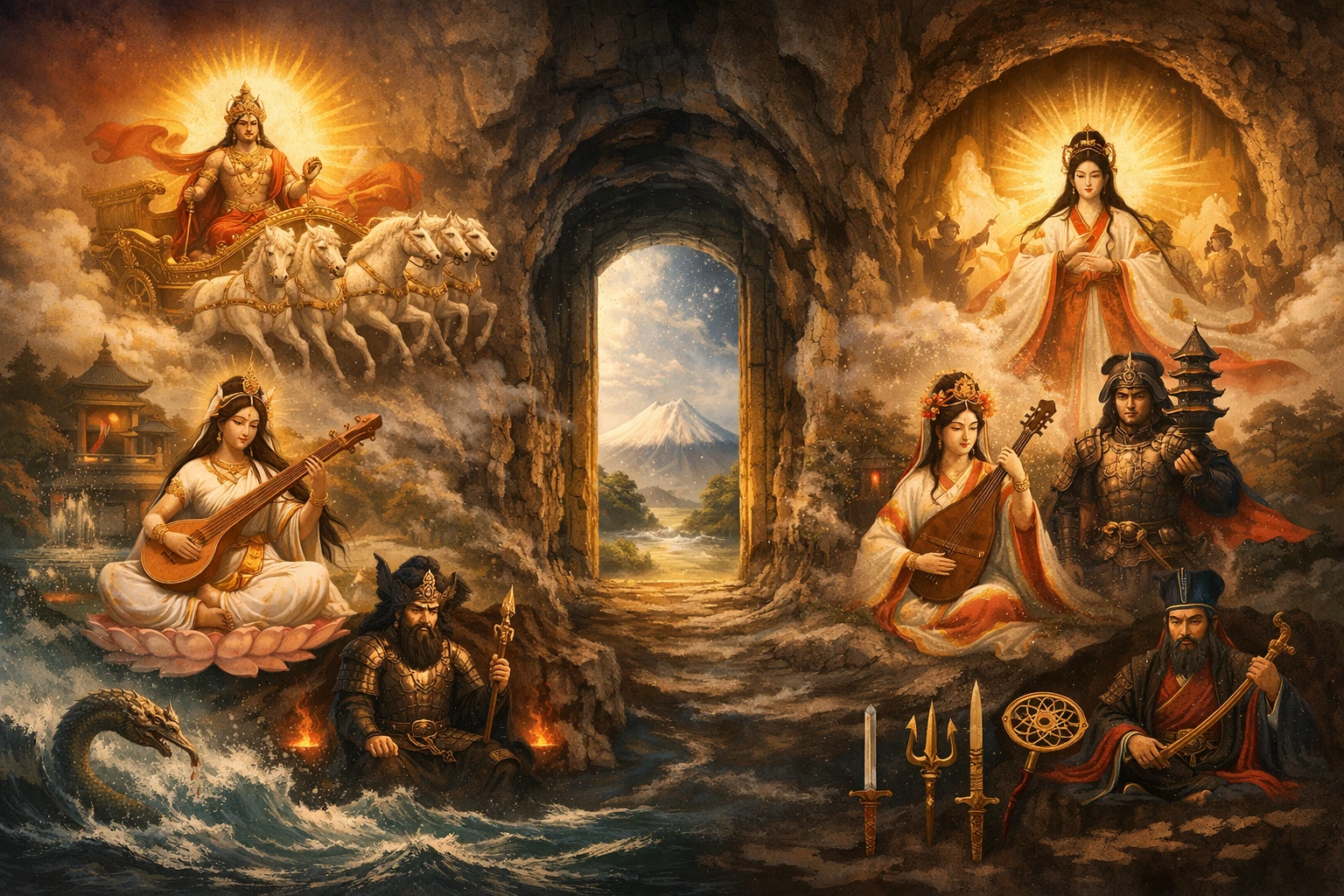
The Amaterasu sun goddess is central in Shinto mythology, often treated as the supreme light that keeps the world coherent. In the famous cave episode, when Amaterasu withdraws, darkness spreads and the world stalls—until community, ritual, and cleverness draw her back out.
This isn’t just drama. It’s a lesson:
light = order, presence = life, ritual = restoration.
Surya and the chariot of time
The Surya sun god embodies vitality, clarity, and the steady turning of days. The chariot imagery (often described with seven horses) makes Surya feel like time itself in motion—an engine that keeps life reliable.
Why sun deities become “order-makers”
Across cultures, people depended on sunlight for food cycles, safety, and timekeeping. So the sun naturally becomes divine.
That’s why the similarity here is mostly archetypal—yet still emotionally powerful inside Japanese Hindu mythology comparisons.
The Divine Feminine of Learning and Music
This is where the connection gets less “coincidence” and more “history.”
Benzaiten as a transformed Saraswati
In Japan, Benzaiten is celebrated as a goddess of “what flows”—often linked with water, eloquence, knowledge, and music. Strong sources explicitly describe Benzaiten as originating from the Hindu goddess Saraswati, arriving through Buddhist transmission and evolving inside Japanese religious life.
That’s why “Benzaiten Saraswati” isn’t just a poetic comparison. It’s a real example of cultural movement and transformation.
Why water, speech, and music travel together
It sounds odd until you notice the pattern:
- Water flows.
- Words flow.
- Music flows.
So a goddess of a river can become a goddess of speech.
A goddess of speech can become a goddess of music.
And in Japan, those meanings can blend with local shrine settings near water.
This is one of the most teachable examples of Hindu deities Japan syncretism—because you can literally see it in iconography and shrine placement.
Warrior Protectors and Cosmic Security
Every civilization needs a mythic answer to one big fear:
“What protects the world when chaos attacks?”
Bishamonten and the Vaiśravaṇa/Kubera lineage
In Japan, Bishamonten is a Buddhist guardian figure—often armored, associated with protection and victory. Importantly, strong sources connect Bishamonten to Vaiśravaṇa/Kubera—a guardian/wealth/protector lineage in Indic traditions.
So “Bishamonten Vaisravana” is another place where the connection leans historical, not just archetypal.
Indra and the protector-king archetype
Indra appears as a powerful warrior and defender figure in Hindu mythology—often framed as a kingly protector who battles threats to cosmic order.
Even when two warrior deities aren’t direct “same-being” equivalents, the role repeats:
- defender of righteous order
- punisher of wrongdoing
- protector of the community under threat
This is where mythology similarities can be both universal and culturally specific at the same time.
Underworld Judges and Moral Accounting
Judges of the dead show up everywhere because humans don’t just fear death—they fear unfairness.
Enma and Yama: why they look alike
In Hindu tradition, Yama is a ruler of the dead associated with moral order and the afterlife.
In Japan, Enma (Enma Daiō) is widely known as a judge figure in the underworld. Sources that discuss India–Japan religious blending explicitly map Japanese Enma/Enmaten to Yama through Buddhist frameworks traveling into Japan.
That’s a strong example of Shinto Buddhism syncretism territory: the figure becomes part of Japanese religious imagination through a wider Buddhist-cultural ecosystem.
What “judgment” means in each worldview
This is where respectful comparison matters.
In many Hindu frameworks, moral consequence is tied to karma and cycles of rebirth, with liberation as an ultimate horizon.
In Japanese religious life, ideas about afterlife vary by tradition (Shinto, Buddhist schools, folk belief), but Enma’s presence often emphasizes moral reflection, consequence, and community values.
Same emotional question. Different philosophical scaffolding.
Divine Weapons as Symbols
Yes, divine weapons are cool. But they’re rarely “just weapons.” They’re portable philosophy.
Kusanagi and legitimacy
In Japanese mythology, the sword Kusanagi is tied to authority, protection, and the symbolic legitimacy of rule.
Chakra, trident, and cosmic roles
In Hindu mythology, divine weapons often express a god’s function:
- protection and preservation
- destruction of illusion
- restoration of balance
When comparing Japanese Hindu mythology, weapons are a great lens because they reveal what each culture thought power should do.
A Respectful “How to Compare Myths” Toolkit
If you’re a student, parent, or educator, this section turns curiosity into a method.
For students
- Track roles, not just names: sun, protector, judge, wisdom-giver.
- Ask: “Is this similarity archetype or historical transmission?”
- Use at least one reliable source before claiming “X came from Y.”
For parents
- Frame it as “shared human questions,” not “who copied whom.”
- Emphasize respect: these are living traditions for many families today.
- Invite comparison through art: instruments, symbols, shrine/temple imagery.
For educators
- Teach a two-column model: Universal patterns vs Transmission pathways.
- Use Benzaiten/Saraswati as the clearest case study of movement and transformation.
- Use Enma/Yama to discuss how ideas travel through religious networks across regions.
Conclusion
The most surprising thing about Japanese Hindu mythology isn’t that there are similarities.
It’s that the similarities come from two different sources at once.
Some are timeless, universal story-patterns: light vs darkness, order vs chaos, justice after death.
And some are historical: names, roles, and images traveling through Buddhism, transforming as they enter Japan.
When you spot the difference, the myths don’t get smaller—they get deeper.