Is Corona a Sign of Shiva’s Third Eye? The Meaning Hidden Inside the Myth
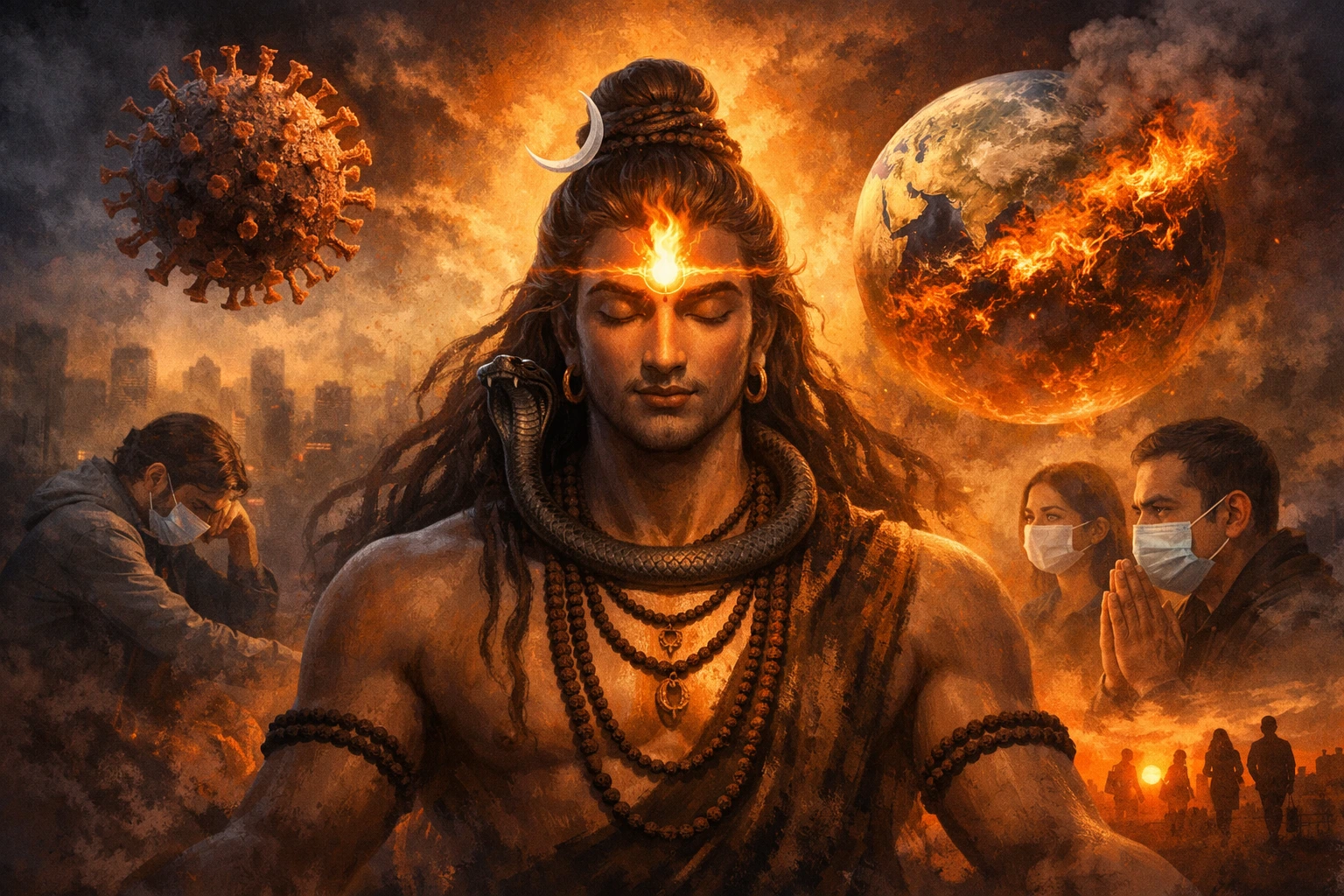
Introduction
There’s a strange pattern in human history.
When life feels predictable, we ask practical questions.
When life breaks open, we ask cosmic ones.
During Corona, many people didn’t just ask, “How do we stay safe?”
They also whispered, “What does this mean?”
If you’ve ever wondered whether Corona is significant of Shiva’s third eye, you’re not alone. This isn’t a “science vs faith” fight. It’s a deeper curiosity: why does the mind reach for Shiva’s most powerful symbol when the world shakes?
The question people are really asking
When someone asks, “Is Corona Shiva’s third eye?”, they may not be asking for a literal yes/no.
They might be asking:
- Did we cross a line as a society?
- Did our desires become louder than our wisdom?
- Are we being forced to “see differently” now?
Symbol vs sign: what mythology is (and isn’t)
Myths aren’t newspaper headlines from heaven.
In most traditions, myth is a symbolic language—dense, emotional, memorable. Shiva’s third eye is one of the strongest symbols in Hindu imagination: it represents a kind of perception that can burn through confusion.
Sadhguru’s explanation captures this well: the “third eye” points inward—toward seeing what is happening within us, not behind a tree in the outside world.
Why crises trigger sacred metaphors
Crises remove distractions.
They strip away the illusion that tomorrow is guaranteed.
And in that exposed moment, symbols become mirrors.
So the real question becomes: what does the third eye meaning offer us when life feels uncertain?
What Shiva’s Third Eye symbolizes
If the two eyes look outward, the third eye is often described as what sees beyond surface reality—beyond habit, ego, and illusion.
This is why Shiva is called Trinetra (three-eyed): not because he is “more supernatural,” but because he represents complete perception—the ability to see what most of us avoid.
Trinetra: seeing beyond time and illusion
Many explanations describe Shiva’s third eye as piercing maya—the fog of appearances. That fog can be material (possessions), emotional (attachment), or mental (stories we tell ourselves).
In daily life, maya looks like:
- “If I buy this, I’ll finally feel complete.”
- “If I win, I’ll be safe.”
- “If I’m liked, I’ll matter.”
The Shiva third eye symbol challenges that spell.
Fire as transformation (not just punishment)
Popular retellings focus on destruction: “Shiva opens the third eye and burns everything.”
But across modern spiritual explainers, the fire is repeatedly framed as transformation—burning away what blocks truth rather than attacking life itself.
That matters, because it changes the pandemic question.
Instead of “Who did Shiva punish?” we can ask:
“What illusions did the fire of reality burn away?”
Three famous Third Eye stories
Your original draft mentioned several myths. Let’s keep the spirit, but sharpen the clarity—so readers can actually carry the lesson into modern life.
Kamadeva: desire meets discipline
The most famous third-eye episode is the Kamadeva story.
Kamadeva, the god of desire, interrupts Shiva’s meditation. Shiva opens his third eye and reduces Kamadeva to ashes—often interpreted as desire being burned by awareness.
But here’s the twist many people miss:
Desire isn’t always “bad.”
Unconscious desire is what causes suffering.
In the symbolic reading, Shiva isn’t declaring war on joy. He’s refusing compulsive craving—the kind that controls you.
That’s why this story keeps returning in third-eye explanations: it makes the lesson unforgettable.
Darkness and awakening: when the world goes blind
Another well-known theme across traditions is “darkness before awakening”—when a disruption forces deeper perception.
Many retellings place the third eye as the answer when ordinary sight fails. The deeper message is consistent: when you lose your usual way of seeing, you’re pushed toward another kind of seeing.
For modern readers, this matters because Corona also did that:
- routines collapsed
- certainty collapsed
- social masks collapsed
People didn’t just fear illness. They feared the loss of control.
Creation-then-correction: why the cycle repeats
Several third-eye myths follow a pattern:
- an imbalance arises
- a force is created or revealed
- balance is restored—often through destruction of what harms
This cycle is why Shiva is both feared and loved.
He represents the truth that creation and destruction are not enemies. They’re partners in change.
And that’s exactly why the Corona question sticks: pandemics feel like unwanted “destruction,” but they also force change.
Ajna chakra, pineal gland, and metaphor
Your original post mentioned the pineal gland as the “rice grain” of Shiva’s third eye. That’s a common modern bridge—but it needs careful handling.
Ajna chakra in everyday language
In Hindu yogic language, the “third eye” often maps to the Ajna chakra, associated with intuition, clarity, and inner guidance.
In plain terms, Ajna practice is about:
- noticing your thoughts without drowning in them
- pausing before reacting
- seeing patterns clearly
This is why many modern explanations connect the Shiva third eye to the “power of observation”—responding with awareness instead of impulse.
Pineal gland: where metaphor often gets over-literal
The pineal gland is real biology. The “third eye” is spiritual metaphor.
People often mix them. Sometimes it’s poetic; sometimes it becomes misinformation.
A balanced approach is:
- You can use the pineal gland as a symbolic bridge (a “center point” inside the head).
- But you shouldn’t claim that “opening your third eye” is a medical event or a guaranteed supernatural ability.
If you want one crisp, reputable anchor for symbolism on the forehead, even medical-history writing notes that many Hindus wear a forehead mark (tilak) as a representation connected to enlightenment/third-eye ideas.
Is Corona “Shiva opening his Third Eye”?
Let’s answer with honesty—and still keep the wonder.
A grounded answer: no literal proof, yes meaningful lens
There’s no verifiable way to say a pandemic is a literal act of Shiva’s third eye.
But mythology is not useless just because it isn’t literal.
As a lens, the third eye can ask:
- What did Corona reveal about us?
- What desires did it expose?
- What illusions did it burn away?
Sadhguru’s framing—that the third eye is about seeing inward, beyond the physical—fits this approach: the “burning” is psychological and spiritual clarity.
The pandemic as a mirror: desire, fear, humility, community
Corona shook the modern world’s favorite beliefs:
- “I can plan everything.”
- “Growth will always continue.”
- “Money can protect me from uncertainty.”
Suddenly, people had to curb desires—not as a moral punishment, but as a reality constraint:
- travel stopped
- shopping slowed
- status symbols went quiet
- the “outside world” became less accessible
In that sense, Corona behaved like a third-eye story:
a force that interrupts trance.
Not Shiva’s trance—our trance.
Practical takeaways for families and classrooms
A good myth doesn’t end with “wow.”
It ends with “now what?”
Parents: turning fear into curiosity
If a child hears “Shiva’s third eye destroys the world,” it can become fear.
Try this gentler framing:
- “The third eye is the eye of truth.”
- “It burns confusion, not people.”
- “It reminds us to pause and choose wisely.”
Then ask:
- “What did Corona teach our family?”
- “What matters more than buying things?”
- “How do we help someone who is scared?”
Students: journaling “desire vs values”
Use the Kamadeva story as a mirror, not a lecture.
Prompt ideas:
- What do I desire most right now?
- Which desires help me grow? Which make me anxious?
- If I had a “third eye,” what truth would I see about my habits?
This turns “desire vs detachment” from moral guilt into self-knowledge.
Educators: discussion questions and respectful boundaries
In diverse classrooms, keep it respectful and optional:
- Myth as literature: symbolism, archetypes, themes
- Compare interpretations: literal, metaphorical, psychological
- Invite reflection, not agreement
Discussion starters:
- Why do cultures personify desire (like Kamadeva)?
- What does “fire” symbolize in transformation stories?
- Why do people seek meaning after collective trauma?
Conclusion
So—is Corona significant of Shiva opening his third eye?
Not as a provable cosmic event.
But as a metaphor, it’s powerful: a sudden interruption that forces humanity to see what it was avoiding.
The Shiva third eye doesn’t have to be a threat hanging over the earth. It can be a daily practice:
- pause
- observe
- burn illusion
- choose what’s true
Because the real “third eye opening” isn’t oceans yelling or mountains screeching.
It’s the quiet moment you stop being controlled by your cravings—and start living awake.