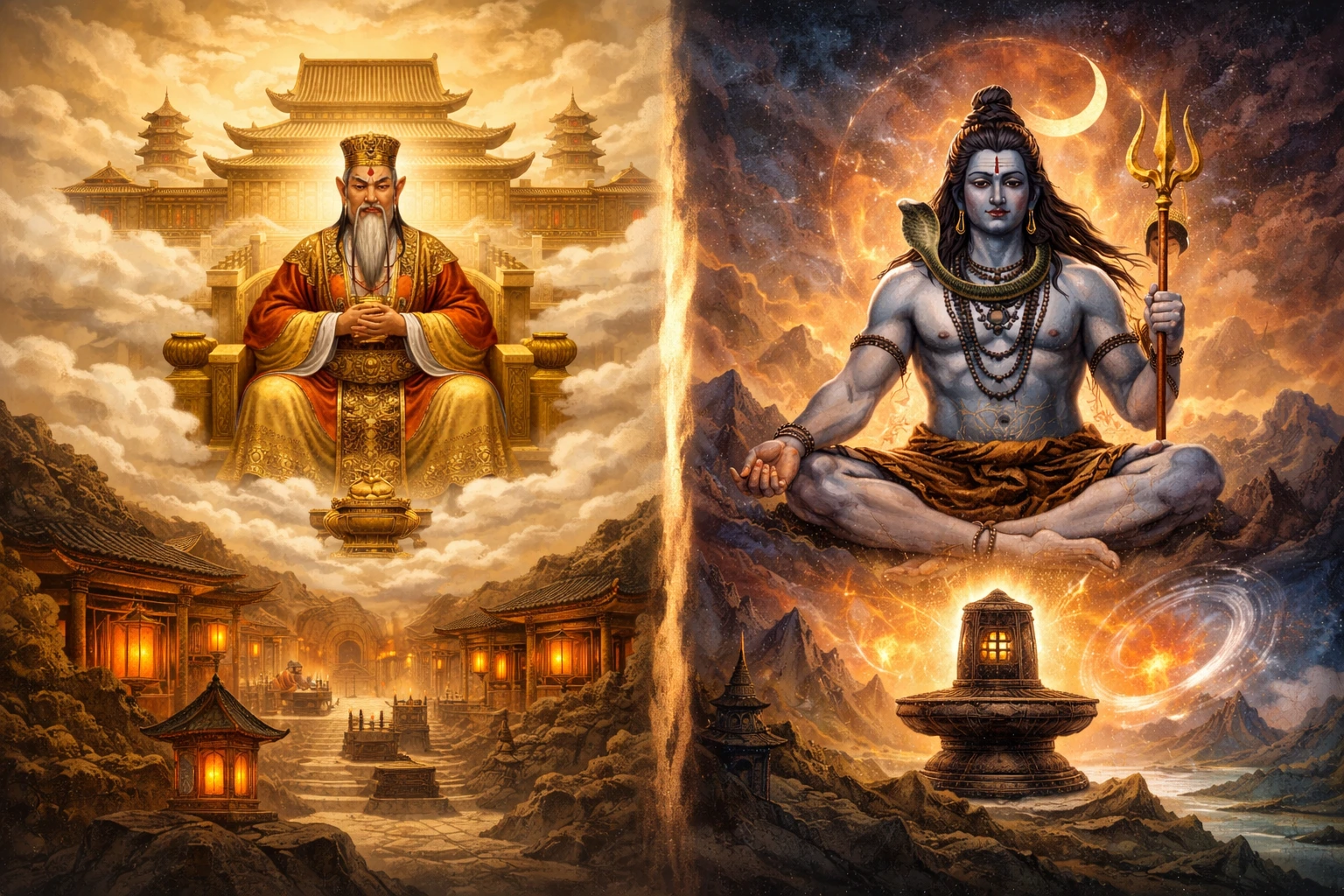
Is China’s Jade Emperor the Same as Lord Shiva? The Surprising Truth Behind the Similarities
Introduction
In the world’s biggest mythologies, there’s a strange pattern: two gods can sound uncannily alike… until you look one layer deeper and everything flips.
That’s exactly what happens with the question: Is the Jade Emperor of China actually Lord Shiva?
Why People Compare the Jade Emperor and Shiva ?
At first glance, the comparison feels persuasive.
Both are described as supreme in their worlds.
Both appear in stories about order vs chaos.
Both are linked (in popular retellings) to the idea of cosmic power reached through spiritual practice.
And if you’ve ever heard that “many gods are the same being with different names,” this question seems like a perfect test case.
But here’s the hidden twist: the kind of supremacy matters more than the title “king of gods.”
In Chinese religion, the Jade Emperor is most often presented as a ruler who presides over a heavenly court—a structured cosmic administration that mirrors imperial governance.
In Hindu tradition, Shiva is a radically multi-layered figure—destroyer in one framework, and supreme being in Shaivism, tied to liberation (moksha), asceticism, and transformation.
So the overlap is real… but the identity claim is where things slip.
Who the Jade Emperor Is?
The Jade Emperor (Yuhuang / Yudi) is widely described as the ruler of Heaven in Chinese popular religion, presiding over other deities in a court-like hierarchy.
Heavenly ruler and cosmic administrator
A helpful way to picture him—especially for newcomers—is as the head of a celestial government: decisions, roles, moral accounting, and order flow down through many divine “officials.”
This doesn’t mean the tradition is “just bureaucracy.” It means cosmic order is imagined through a familiar cultural lens: a structured realm where Heaven, Earth, and the Underworld are populated by many beings and responsibilities.
The heavenly court and moral order
Educational sources commonly highlight the Jade Emperor’s place at the top of the heavenly domain. Popular summaries also note how his court can mirror the imperial structure of historical China.
That’s why stories about him often feel like “cosmic governance” tales: who has authority, how justice is delivered, and how harmony is maintained.
Who Shiva Is ?
Shiva is one of Hinduism’s principal deities, and his meaning shifts depending on the tradition and text.
Britannica describes Shiva as the destroyer within the Trimurti framework, while also noting that for Shaiva devotees he is the supreme being who can encompass creation, preservation, and dissolution.
Shiva’s major roles: dissolution, transformation, liberation
Shiva’s “destruction” is not only violent ending—it’s also cosmic reset, clearing the ground so life can renew.
At the personal level, he is also invoked for guidance, protection, and liberation from rebirth (moksha).
Shiva as yogi, householder, and supreme being
Shiva’s iconography frequently connects him to ascetic practice—meditation, inner discipline, and spiritual power.
At the same time, he can also be portrayed as a householder with Parvati, Ganesha, and Kartikeya—showing that he spans both renunciation and worldly life.
So Shiva is not a single “job description.” He’s a complex religious center of gravity.
Jade Emperor vs Shiva: The Clean Comparison
If you want the honest answer, you need a comparison that’s more than “both are important.”
1) Role and function
- Jade Emperor: supreme ruler of the heavenly domain; presides over a hierarchy and moral order in Chinese popular religion.
- Shiva: deity of transformation and dissolution in one framework, and supreme being in Shaivism—deeply tied to liberation, asceticism, and multi-form theology.
This is the big divide: the Jade Emperor is most often “cosmic governance,” while Shiva is “cosmic transformation + liberation.”
2) Symbols and worship
- Shiva is widely worshipped in the form of the lingam (alongside many anthropomorphic forms).
- Jade Emperor worship commonly appears through temples, festivals, and rites oriented around Heaven’s authority and order (in traditions that venerate him).
So when a blog claims “Shiva lingams in China prove Shiva = Jade Emperor,” a better interpretation is: Indian religious presence can exist without collapsing identities.
3) Myths and story patterns
Yes—many mythologies share story shapes:
- defeating disruptive forces
- restoring order
- guiding humans
- representing the “top” of a divine hierarchy
But shared story shapes are not proof of shared identity. They’re often proof of shared human concerns.
If Not Shiva, Then Who’s the Closest Counterpart?
In cross-cultural comparisons, the Jade Emperor is often linked to Indra/Śakra—not Shiva.
That matters because it shows how “equivalence” works in religious history: sometimes traditions map gods by function (king of gods, ruler of Heaven), not by theology.
Why Indra/Śakra comparisons appear?
Wikipedia’s overview explicitly notes the Jade Emperor’s “counterparts” list including Indra and Śakra in broader Asian context.
This doesn’t mean every tradition agrees, or that these figures are interchangeable in worship. It means comparisons tend to follow the “ruler of Heaven” pattern more than the “destroyer/transformer” pattern.
What “counterpart” really means (and what it doesn’t)?
A “counterpart” is often:
- a translation shortcut
- a comparative religion tool
- a way of explaining unfamiliar ideas
It is not a claim that two deities are historically identical.
Hinduism in China: Influence Without Identity
Cultural contact between India and China is real—and it can produce shared motifs, borrowed words, adopted practices, and new religious syntheses.
But the strongest sources in our SERP set make a quieter point: Chinese religious life often describes Heaven as a domain ruled by the Jade Emperor within a structured system. Meanwhile, Shiva’s core framing in Hindu tradition is anchored in a different theological universe.
So a responsible takeaway is:
- Yes: influence and exchange can happen.
- No: that doesn’t automatically create one-to-one deity identity.
A Better Way to Think About Parallels
Instead of asking “Are they secretly the same god?”, try three better questions:
1) What human problem does the deity solve?
- Jade Emperor stories often highlight order, justice, cosmic administration.
- Shiva stories often highlight transformation, liberation, and paradox (ascetic and householder; destroyer and supreme).
2) What’s the tradition’s native explanation?
When you let each tradition speak in its own voice, the differences become clearer—and more interesting.
3) Where do similarities come from besides “identity”?
Similarities can come from:
- shared storytelling patterns
- translation and reinterpretation
- cultural exchange without merger
- the simple fact that many societies imagine Heaven with a ruler
This isn’t “watering down” religions. It’s treating them with precision.
Final Answer
No—China’s Jade Emperor is not the Hindu god Lord Shiva.
They can seem similar because both are framed as “supreme” in popular storytelling, and both appear in narratives about cosmic order and power. But their core roles, worship forms, and theological placement are different: the Jade Emperor is primarily a ruler of Heaven within a celestial hierarchy, while Shiva is a multifaceted Hindu deity tied to dissolution, transformation, and liberation, and is treated as the supreme being in Shaivism.