How Christianity and Egyptian Mythology Share Virtues and Ethics
Introduction
There’s a quiet “tell” that shows up in two places you’d never expect.
In one world, a carpenter from Nazareth teaches love, mercy, and a coming judgment.
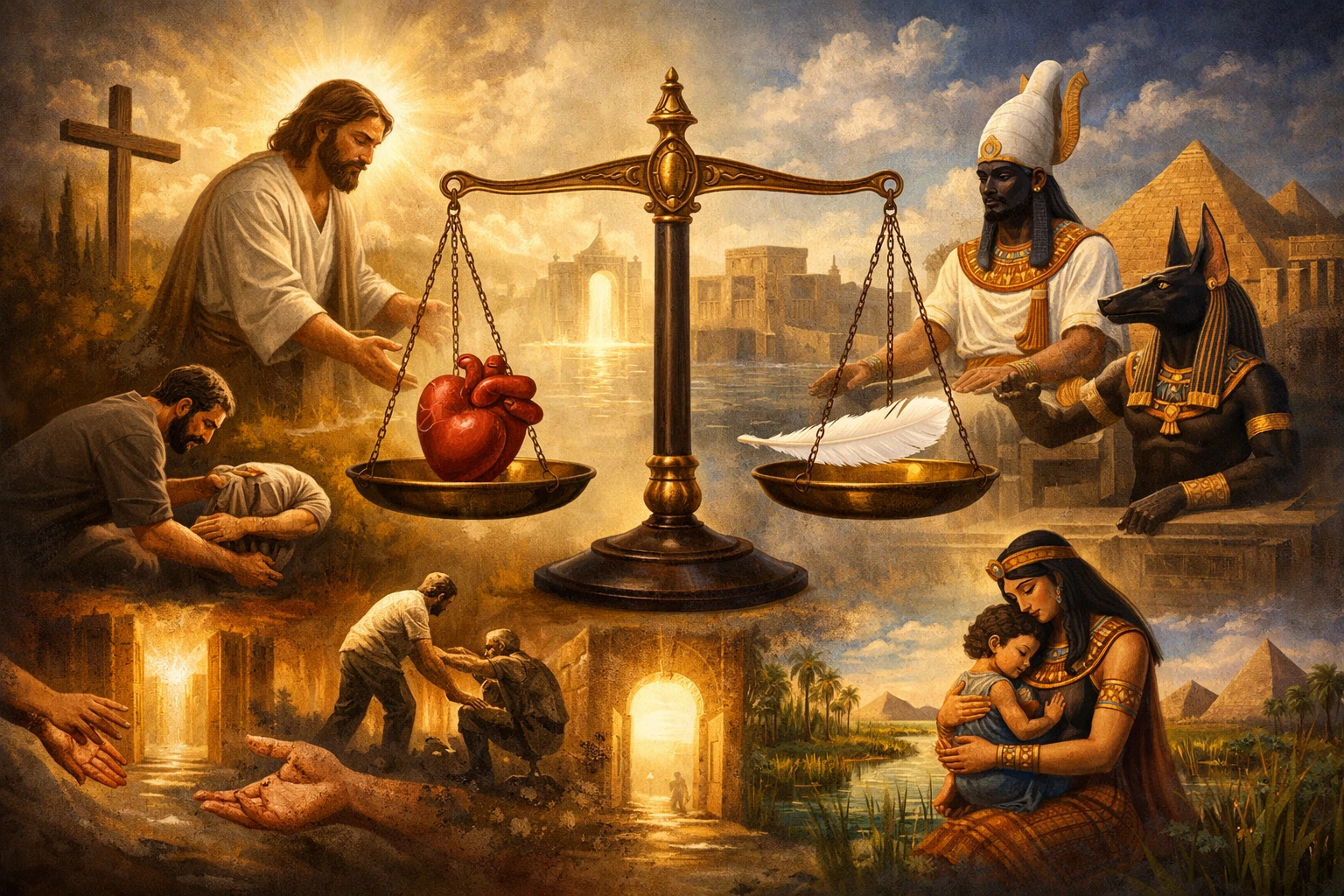
In the other, a heart is placed on a scale—balanced against a single feather.
Different languages. Different centuries. Different gods.
Yet the ethical question underneath is strangely similar: What kind of person are you becoming—and what will your life weigh when it’s measured?
Here’s how Christianity and Egyptian mythology share virtues and ethics, without forcing them to be the same thing.
The “Hidden Thread” Between Two Very Different Faith Worlds
Before we compare, one important reset:
- Christianity is a living, global faith centered on one God, Jesus Christ, and scripture.
- Egyptian mythology is a complex ancient religious world with many gods, rituals, and texts across long dynasties.
So when we say “shared virtues,” we’re not claiming they’re identical.
We’re noticing that both traditions emphasize ethical themes that humans keep returning to: truth, justice, compassion, accountability, and hope beyond death.
What we mean by “shared virtues” (and what we don’t mean)
A fair comparison focuses on ethics, not “gotcha” claims.
- We do compare moral principles and how people are encouraged to live.
- We don’t jump straight to “one religion copied the other” without evidence.
- We do recognize that cultures can influence each other over centuries.
- We don’t flatten thousands of years into one meme.
With that in mind, let’s follow that feather-and-heart thread.
Virtue #1 — Morality and Righteous Living
Both Christianity and Egyptian mythology teach a simple but demanding idea:
Your daily choices matter.
Christian moral teaching (commandments, conscience, community)
In Christianity, morality is tied to God’s character—truthful, just, loving.
The ethical life is shaped by commands (like prohibitions against theft and false witness), but also by positive responsibilities: honesty, faithfulness, care for neighbor, humility.
Even when Christian traditions differ in emphasis, the through-line is clear: righteousness isn’t just a private feeling. It’s lived.
Ma’at as truth, balance, and right order
Ancient Egypt had a word that carried enormous ethical weight: Ma’at.
Ma’at wasn’t only a goddess. It was also the idea of truth, justice, balance, and the proper order of life and society.
Living well meant living “in Ma’at”:
- telling the truth,
- keeping promises,
- treating people fairly,
- resisting chaos and injustice.
Think of it as an ancient moral compass aimed at harmony—inside the person and across the community.
Virtue #2 — Justice and Accountability After Death
Here’s where the comparison becomes vivid.
Christianity imagines a final evaluation of life.
Egyptian mythology imagines an actual courtroom scene.
Final judgment in Christianity (why justice is central)
In Christian teaching, final judgment is connected to God’s justice.
The point isn’t “fear for fear’s sake.” It’s the insistence that evil doesn’t get the last word, and goodness is not meaningless.
That belief changes how ethics works:
- injustice matters,
- repentance matters,
- mercy matters,
- choices matter.
Weighing of the heart (heart vs feather; Osiris tribunal)
In Egyptian tradition, the ethical climax is often pictured as the weighing of the heart.
The heart—seen as the seat of the person—is weighed against the feather of Ma’at. If the heart aligns with truth and justice, the soul can pass toward peace.
Many depictions place this in a larger judgment scene involving gods and assessors, with Osiris connected to the judgment of the dead.
The takeaway is ethical, not just mythical:
- A life of deceit makes the heart “heavy.”
- A life of integrity makes the heart “light.”
Different theology than Christianity—but a familiar moral logic.
Virtue #3 — Eternal Life and the Hope of “More”
Both Christianity and Egyptian mythology are not only about rules.
They are also about hope.
Heaven as fulfillment (Christian frame)
Christianity offers the promise that death is not the final wall.
Eternal life is often framed as communion with God—justice made right, love made complete, suffering no longer the final chapter.
That hope can motivate courage and endurance, especially for people facing hardship.
Field of Reeds/A’aru as flourishing (Egyptian frame)
Ancient Egyptians also envisioned a life beyond death.
One well-known image is the Field of Reeds—a flourishing realm often described as an idealized continuation of life, where the worthy live in peace and abundance.
What matters for our comparison:
- Eternal life is connected to moral alignment (Ma’at / righteousness).
- The afterlife isn’t random; it’s tied to how one lived.
Virtue #4 — Compassion, Kindness, and Protecting the Vulnerable
Ethics isn’t only about judgment.
It’s also about how you treat the person in front of you.
“Love your neighbor” as an ethical centerpiece
Christian ethics repeatedly returns to one question:
Do you love?
Not as sentiment—but as action:
- feeding,
- forgiving,
- protecting,
- serving.
In practice, it means human dignity is not optional.
Divine protection themes (Isis and the vulnerable as moral imagination)
In Egyptian religious imagination, divine figures can model protection and care—especially in stories of healing, guarding, and restoring order after harm.
Even when myths aren’t “commandments,” they shape what a culture admires:
- protection over exploitation,
- restoration over cruelty,
- care over indifference.
That’s one way Christianity and Egyptian mythology share virtues and ethics: both treat compassion as a mark of the good life.
Virtue #5 — Forgiveness, Repair, and Returning to the Right Path
If justice is one pillar, forgiveness is the balancing pillar.
Repentance and mercy (Christian frame)
In Christianity, forgiveness is not “pretending it didn’t happen.”
It’s closer to moral repair:
- admitting wrongdoing,
- turning away from it,
- seeking reconciliation,
- trusting God’s mercy.
This makes ethics dynamic: people can change.
Re-aligning with Ma’at (Egyptian frame)
Egyptian ethics, framed around Ma’at, also values correction.
The goal is not perfection from birth.
The goal is returning to truth and order—repairing what’s been bent toward chaos.
In both traditions, redemption is possible because ethics is about direction, not just a scorecard.
Common Misconceptions (and a Better Way to Compare)
Comparisons between Christianity and Egyptian mythology often get messy online.
Here’s a cleaner approach.
“Similar” doesn’t automatically mean “stolen”
Shared themes can happen because humans ask similar questions:
- What is justice?
- What happens after death?
- Why be good when no one is watching?
Sometimes there is influence across cultures, too—but that claim requires careful evidence, not viral lists.
Myth stories vs moral principles
A smart comparison separates:
- narrative parallels (stories),
- ritual parallels (practices),
- ethical parallels (virtues).
This article is ethics-first: shared virtues and ethics, not “these are the same religion.”
That keeps the discussion fair—and more useful.
What This Means for Parents, Students, and Educators
Parents: values conversations without turning it into a debate
Try asking:
- “What does ‘a light heart’ mean in real life?”
- “What behaviors make a community feel safe and fair?”
- “How do different faiths motivate kindness?”
Keep the focus on virtues, not competition.
Students: essay angles that are fair and well-sourced
Strong angles include:
- comparing justice frameworks (final judgment vs weighing of the heart),
- comparing the role of truth (commandments vs Ma’at),
- comparing afterlife as moral motivation.
Use reputable references for Ma’at and the weighing ritual (encyclopedias/museums), then interpret carefully.
Educators: discussion questions + activity idea
Discussion prompts:
- “Is morality stronger when tied to an afterlife belief, or can it stand alone?”
- “What does it mean to ‘live in order’ versus ‘live in love’?”
- “How do stories teach ethics differently than rules?”
Quick activity:
-
Have learners create a two-column “Virtue Map” (Truth, Justice, Compassion, Forgiveness, Hope) with one example from each tradition.
Conclusion
Christianity and Egyptian mythology come from vastly different worlds.
Yet when you zoom in on ethics, you find familiar virtues:
- Morality: live truthfully, live rightly.
- Justice: your actions matter, and justice is bigger than the moment.
- Afterlife hope: death is not the last meaning.
- Compassion: protect the vulnerable, practice mercy.
- Redemption: return to the right path; repair is possible.
That’s the quiet surprise.
Not that the traditions are the same—but that humans keep reaching for the same moral ideals, using different symbols to hold them.
And maybe that’s the real secret of the feather: it’s not measuring theology.
It’s measuring the weight of a life.