Hera: The Queen Goddess of Olympus (And the Secret Behind Her “Jealousy”)
Introduction
Something about Hera doesn’t add up.
She’s introduced as the Queen of Olympus—a goddess of marriage, family, and order. And yet, the stories people remember most are about rage, revenge, and jealousy.
So what’s the secret?
It’s this: many Hera myths aren’t really “about” her temper. They’re about what happens when the most important promise in the universe—a sacred vow—gets treated like it’s optional.
If you’ve only met Hera as “Zeus’s angry wife,” you’re missing the real Hera goddess: the ruler who protects legitimacy, law, and the structure holding Olympus together.
The Hidden Side of Hera
Hera is one of the Twelve Olympians and is widely described as the goddess of marriage, women, and family—and the queen who sits beside Zeus on Olympus.
But there’s an important distinction that gets blurred online:
- Myth Hera (the character in dramatic stories) is written for tension.
- Worship Hera (the deity honored in temples and festivals) is about stability, protection, and social order.
That’s why a single trait—“jealousy”—can’t explain her full identity. In many myths, Hera is the force that pushes back when boundaries collapse.
If you want to understand Hera goddess properly, start here:
- Hera stands for lawful union and “legitimate rule,” not simply romance.
- Hera’s anger often appears when vows are broken or status is threatened.
- Her role is political as much as personal: she is Queen of Olympus, not a background character.
Hera’s Origins and Royal Authority
Hera is traditionally said to be the daughter of Cronus and Rhea, making her part of the oldest divine generation before the Olympian “order” is fully established.
That origin matters because it positions her as a goddess who remembers what chaos looks like.
Daughter of Cronus and Rhea
In broad genealogies, Hera is sister to Zeus (and other major gods). The family tree is messy—Greek mythology often is—but the takeaway is consistent: Hera is not “royal by marriage.” She is royal by birth.
Queen of Olympus—more than “Zeus’s wife”
Many modern summaries flatten her into a title: “wife of Zeus.” Yet the older framing emphasizes her rank: queen of the Olympian gods, with her own worship and identity.
If you’re reading Hera through a modern lens, it can help to translate:
- Zeus represents sovereign authority.
- Hera represents authorized, lawful authority—the power that makes rule “legitimate.”
That’s why “Queen of Olympus” isn’t decorative. It’s the point.
Hera and Zeus: A Marriage That Explains Olympus
If Hera and Zeus were a calm couple, Greek myths would lose a major engine of conflict.
Their relationship is often depicted as turbulent, and that turbulence does narrative work: it lets stories explore power, loyalty, justice, and consequence.
What myths are trying to show us
Think of “Hera and Zeus” as a mythic way to talk about society’s biggest tension:
- Authority needs order.
- Desire disrupts order.
- Someone has to defend the boundary.
In many versions, Hera becomes that defender.
Power, politics, and the stability of the gods
It’s also crucial that Hera is not passive. Across traditions, she acts, persuades, plots, and protects her status as Queen of Olympus.
Even when myths portray her harshly, they rarely portray her as powerless.
That combination—high status and high conflict—sets up the question readers still ask:
If Hera is so powerful, why is she trapped in this drama?
The mythic answer is uncomfortable but revealing: Olympus is a throne, not a home. Hera stays because stability has a cost.
The Mystery of Hera’s Jealousy
This is where most internet summaries stop: “Hera is jealous.”
But jealousy is a label, not an explanation.
Hera’s most famous conflicts are tied to Zeus’s infidelity and the chaos it produces.
Sacred vows, legitimacy, and cosmic order
In cultures where marriage was treated as a stabilizing institution, vows weren’t just private promises. They were social architecture.
So when the king of the gods breaks vows repeatedly, the myths treat it like a cosmic crack in the foundation.
In that light, Hera’s fury becomes symbolic:
- She is the guardian of the “rules that hold things together.”
- Her punishments dramatize what happens when status, consent, and legitimacy are ignored.
This doesn’t make every action admirable. It makes her role intelligible.
Why her anger targets “the disruption,” not just the person
Some myths show Hera lashing out at lovers or children rather than Zeus. Readers often find that unfair—and they’re not wrong to question it.
But myth logic is rarely courtroom logic.
Myths frequently personify systems: the lover becomes the visible “breach,” the child becomes the living proof of disrupted order, and Hera becomes the backlash that follows.
When you read Hera goddess this way, she stops being a stereotype and becomes a theme:
Order is protective… until it turns punitive.
Symbols and Sacred Animals
Hera’s symbols are one of the fastest ways to “meet” her without the drama.
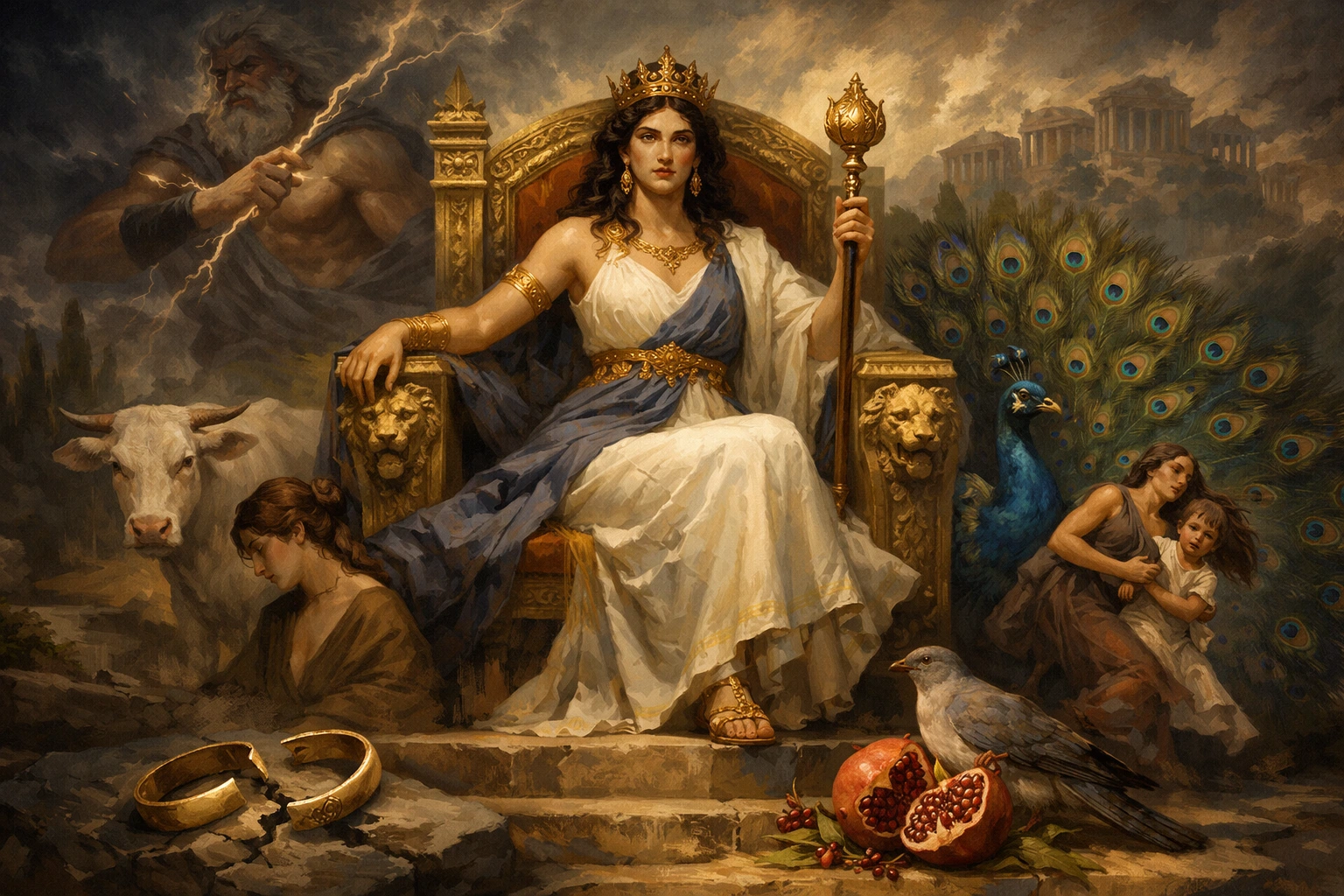
Across common references, Hera is associated with multiple emblems and animals—especially the peacock.
The peacock and Argus—why “a thousand eyes” matters
The peacock is Hera’s best-known symbol today. It’s often explained through the story of Argus, the many-eyed guardian whose eyes are placed onto the peacock’s tail feathers.
Whether you treat that detail literally or symbolically, the meaning is consistent:
- Hera sees what others miss.
- Hera remembers what others want to hide.
- Hera’s authority is watchful, not impulsive.
So “Hera peacock” isn’t just aesthetic trivia. It’s a visual shorthand for vigilance.
Cow, cuckoo, and pomegranate (what each suggests)
Different sources list different associations, but commonly noted symbols include:
- Cow: dignity, abundance, and a kind of ancient “queenly” presence.
- Cuckoo: linked to marriage lore in some traditions around Hera and Zeus.
- Pomegranate: immortality, fertility, and enduring life.
Together, they reinforce a theme: Hera goddess is tied to continuity—life continuing, families continuing, rule continuing.
Hera’s Powers Beyond Marriage
It’s easy to forget that “goddess of marriage” doesn’t mean “goddess of weddings only.”
Hera is also described as a protector of women, connected with childbirth in many references.
Protector of women and childbirth
In broad summaries, Hera appears as a figure women might call upon for protection during childbirth and for the safeguarding of marriage.
That’s a powerful pairing:
- Marriage shapes the household.
- Childbirth shapes the future.
If you’re trying to understand why Hera is Queen of Olympus, this is part of it: she governs the most “society-building” forces humans experience.
Blessings vs. curses (the paradox theme)
And yet the myths don’t sanitize her.
Hera can bless, and Hera can punish.
That’s not a contradiction in myth terms—it’s a warning.
The same institution that protects people can also enforce rules harshly. Hera embodies both sides, which is why she remains one of the most psychologically interesting figures in Greek mythology.
Hera for Students, Parents, and Educators
Student quick-revision box
- Who is Hera? Queen of Olympus; goddess of marriage/family.
- Key relationship: Hera and Zeus (sister-wife in myth tradition).
- Common symbols: Peacock; also cow/cuckoo/pomegranate.
- Big idea: Hera myths explore vows, legitimacy, and order.
Parent conversation prompts
Try these questions after reading a Hera story together:
- When does “protecting rules” become “hurting people”?
- Why might ancient societies connect marriage vows to social stability?
- If Hera is the guardian of order, what would a kinder version of that look like?
Educator mini-activity (compare sources)
Give students two short readings:
- A concise encyclopedia entry (Britannica)
- A primary-text-heavy mythology compendium (Theoi)
Ask:
- What does each source emphasize?
- How does tone change interpretation of Hera goddess?
- Which details feel “mythic drama” vs “religious role”?
This builds source literacy without needing a full unit.
Conclusion
Hera is not just a character in someone else’s love triangle.
She is the Queen of Olympus: a goddess whose stories wrestle with vows, legitimacy, and the cost of keeping order in a world that constantly breaks it.
If you only remember Hera jealousy, you miss the deeper tension her myths are staging: how power protects society—and how it can also punish.
And maybe that’s why Hera remains so modern.
Because the paradox she represents is still here: we want rules that keep us safe, but we also want mercy when life gets complicated.