Greek and Hindu Mythology Similarities: The Hidden Pattern Behind Family Conflict Stories
Introduction
You’ve probably noticed it before—two myths from opposite ends of the world suddenly sound like they’re related.
A god gets challenged.
A child is punished.
A family dispute turns cosmic.
And then you wonder: How can Greek Hindu mythology feel so similar… when the cultures are so different?
Here’s the twist: the “similarity” isn’t always in the names of the gods.
It’s in the problem the story is secretly trying to solve—especially the one that shows up in almost every home, in every era: the parent–child relationship.
Why do Greek and Hindu myths feel so familiar?
The safest answer is also the most useful: humans reuse meaning-making tools.
Across cultures, mythology becomes a “story laboratory” for big, repeating fears:
- Who deserves power?
- What happens when rules break?
- Can anger be repaired?
- What does a child owe a parent—and what does a parent owe a child?
That’s why Greek Hindu mythology can share patterns even when the details differ.
Shared human problems (power, fear, legacy)
In both traditions, gods and heroes aren’t written as perfect role models.
They’re written as intensified humans—bigger emotions, higher stakes, louder consequences.
So when you see mythology similarities, don’t ask only:
“Are these the same gods?”
Also ask:
“Are these solving the same human puzzle?”
Motifs vs copies: what “similar” really means
Comparative mythology often works with motifs—repeating building blocks like:
- father–son conflict
- the jealous spouse
- the hero’s impossible tasks
- the underworld journey
- the “test” that reveals character
Motifs can travel through migration and contact.
They can also appear independently because families, power, and fear are universal.
The family-conflict motif (parents and children)
If you zoom in on the original blog’s theme, one cluster stands out: strained parent–child relationships.
It’s not random. Myth families are messy because myths do two things at once:
- Entertain with drama.
- Teach with consequences.
Why myth families are messy on purpose
A calm household doesn’t create a memorable lesson.
But a household where:
- a parent overreacts,
- a child pushes boundaries,
- and power is misused,
…creates a story people repeat for centuries.
What the story is training you to notice
Family-conflict myths often train audiences to notice:
- impulse vs duty
- authority vs identity
- punishment vs repair
- pride vs responsibility
Now let’s ground that in examples.
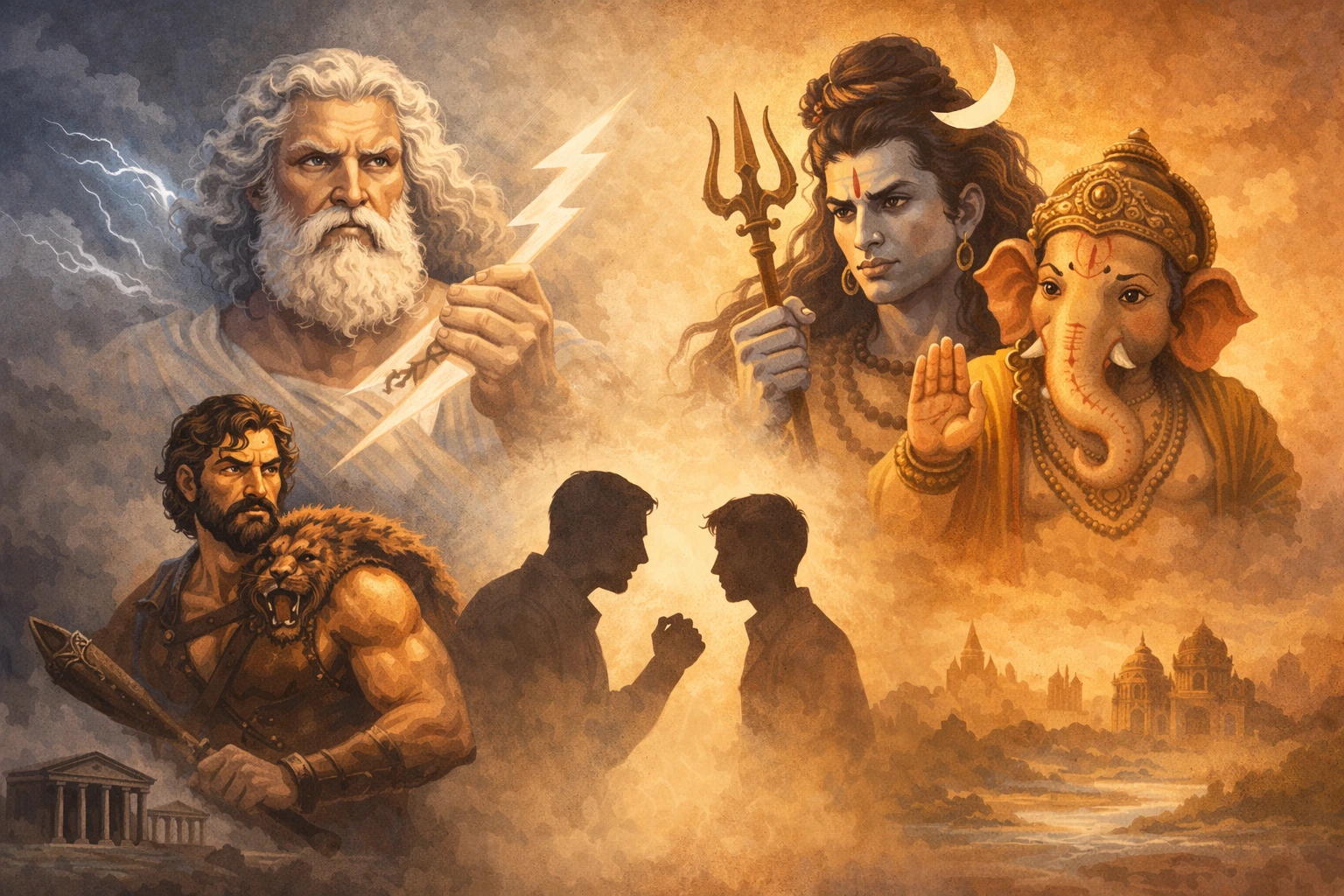
Greek example: Zeus, Heracles, and divine expectations
When people talk about Greek myths, Zeus is usually the lightning-and-throne headline.
But for mythology similarities, Zeus is even more interesting as a father figure in a world where power is inherited, contested, and feared.
Heracles (often called Hercules in Roman retellings) is one of the most famous figures tied to Zeus. Britannica’s overview captures him as a hero defined by extraordinary feats and enormous suffering. (See: Encyclopaedia Britannica — Heracles.)
The tension: authority vs independence
In Greek storytelling, father–son conflict isn’t always a literal “son kills father” moment.
More often, it’s a generational power struggle:
- The parent represents order, law, and legacy.
- The child represents strength, change, and unpredictability.
Heracles is powerful enough to threaten the balance—yet also human enough to be punished by life.
That contradiction is the point.
What audiences were meant to learn
Greek myths frequently warn that power without self-control becomes self-destruction.
So the conflict isn’t only “Zeus vs son.”
It’s “strength vs restraint,” staged inside a family.
If you’re reading this as a student, notice how the story keeps asking:
- What does it cost to be “chosen”?
- Who pays for divine decisions?
- What happens when a family’s mistakes become your identity?
Hindu example: Shiva and Ganesha, anger, boundaries, repair
In Hindu mythic storytelling, Shiva represents enormous force—creation and destruction energies held in tension.
And then the story places something surprisingly domestic in front of him:
A doorway.
A child guarding it.
A moment of anger.
The Shiva–Ganesha story is widely told in many versions, but the core pattern remains: boundary, conflict, consequence, repair. Britannica summarizes Ganesha as a major deity known for removing obstacles and notes his elephant head as a defining feature. (See: Encyclopaedia Britannica — Ganesha.)
The doorway conflict: duty vs impulse
The heart of the scene is simple:
- Ganesha obeys his mother’s instruction to guard the door.
- Shiva arrives and expects entry.
- The clash becomes about authority and role.
In comparative mythology terms, this is a classic “boundary test.”
A child says “no” for a legitimate reason.
A powerful adult reacts from status and heat.
The repair: restoration and responsibility
What makes this story especially rich for parent–child relationship reading is that it doesn’t end at damage.
It moves toward repair—acknowledging grief, restoring life, and transforming identity.
So the lesson isn’t:
“Parents are scary.”
It’s closer to:
“Power must be paired with responsibility—and repair matters after harm.”
Ramayana lens: Ram and his sons (Luv–Kush)
Another strong Hindu example in the original post is the Ramayana thread involving Ram and his sons (Luv and Kush).
Different tellings emphasize different details, but the motif is consistent: recognition happens late, after separation, and sometimes through conflict.
Reputation, exile, and the human cost
This isn’t just a “family misunderstanding.”
It’s a story about how:
- public opinion,
- moral expectation,
- and royal duty
can break the private world of a home.
From a comparative mythology angle, it echoes a common theme:
the child pays for adult systems—honor codes, politics, reputation, war.
What “reunion through conflict” teaches
In many epics, reunion doesn’t happen through a gentle conversation.
It happens after a test:
- a battle,
- a performance,
- a reveal,
- a proof of identity.
That structure keeps the audience asking:
- What counts as truth?
- Who gets believed?
- What does a parent owe a child after absence?
Similarities beyond family drama (quick parallels)
SERP pages love quick “match-ups.” Some are genuinely helpful—as long as we treat them as comparisons, not perfect equivalents.
Sky kings and thunder (Zeus / Indra)
Many popular comparisons point out the “sky ruler with thunder” parallel (Zeus and Indra). It’s an easy example of mythology similarities because the symbolism is intuitive: sky, rain, authority, lightning.
Underworld order (Hades / Yama)
Another frequent pairing is “afterlife authority” (Hades and Yama). Again, the value is in motif: societies imagine moral order extending beyond life.
These parallels are useful as entry points, especially for students building comparative mythology skills.
The biggest differences (don’t flatten cultures)
A strong Greek Hindu mythology comparison has to say this clearly: similarities are real, but they don’t erase differences.
Rebirth vs one-life framing
One of the most important differences many writers highlight is the worldview around rebirth versus a single-life emphasis—this affects what “punishment,” “justice,” and “growth” mean in each tradition. (This “difference-first” perspective is argued strongly in Devdutt Pattanaik’s essay.)
“Religion” vs “myth corpus” in daily practice
Greek mythology is often approached today as a classical story collection.
Hindu narratives, by contrast, are also embedded in living religious practice for many people.
That means tone matters:
- avoid “same-same” claims,
- acknowledge multiple versions,
- and be respectful with sacred figures.
How to read these stories today (parents, students, educators)
Here’s where Navora readers can go beyond the typical listicle.
Parents: emotional lessons without moral panic
If a myth shows a parent harming a child, it doesn’t mean it endorses harm.
Try reading it as:
- a warning about anger,
- a lesson about boundaries,
- a reminder that repair is part of responsibility.
A simple family discussion prompt:
- “What should the powerful person have done instead?”
- “What does repair look like after a mistake?”
Students: compare responsibly
When you write about mythology similarities, aim for clarity:
- Motif: shared story pattern
- Influence: evidence of contact or transmission
- Equivalence: rarely exact, often misleading
A good student sentence sounds like:
“Both traditions use the father–son conflict motif to explore authority and identity.”
Not:
“These are the same gods.”
Educators: discussion prompts that work
- “What does each story define as ‘duty’—and who decides it?”
- “Is the conflict solved by punishment, repair, or recognition?”
- “How does the culture’s worldview shape the ending?”
These keep the classroom respectful and analytical.
Conclusion
So—are there similarities between Greek and Hindu mythology?
Yes. Greek Hindu mythology often shares motifs, especially around family conflict: authority versus identity, anger versus restraint, punishment versus repair.
But the deeper secret is this: myths repeat because humans repeat—our fears, our power struggles, our love, our mistakes.
That’s why these stories still sting.
And why they still teach.