Are the Greek Gods Hindu Gods? The Hidden Reason the Myths Feel Related
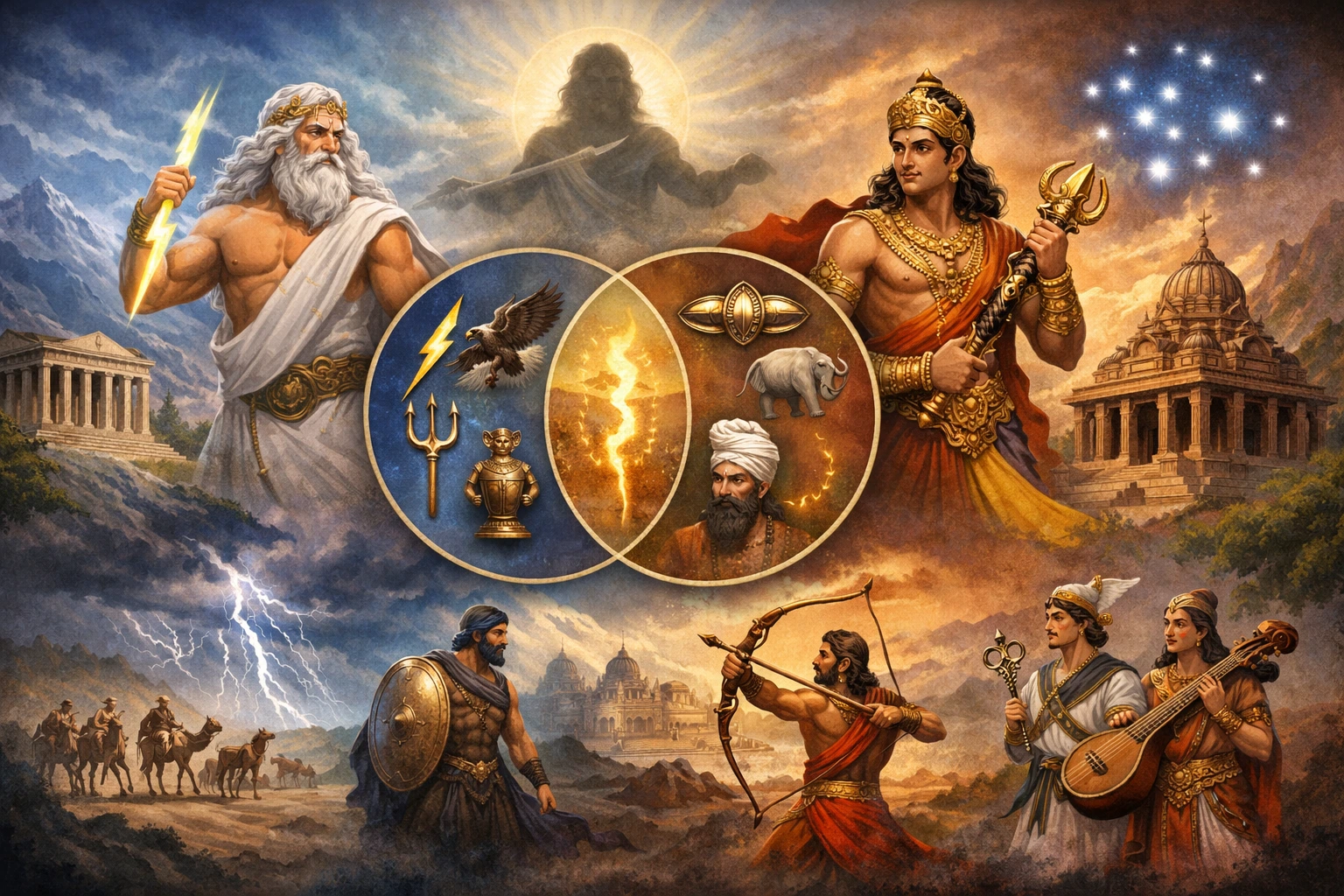
Are the Greek Gods Hindu Gods?
Something strange happens when you line up Zeus with Indra.
The weapons match. The “king of gods” title matches. Even the mountain-home idea feels like it’s echoing across continents.
So the mind jumps to the most dramatic conclusion: Are these literally the same gods wearing different names?
Here’s the twist most comparison posts skip: the similarities are real—but “same gods” is usually the wrong lens. The more interesting answer hides in language, migration, storytelling patterns, and how humans everywhere build meaning.
The one-line answer
No—Greek gods are not Hindu gods in a literal one-to-one sense.
But Greek and Hindu myth systems can feel related because some ideas share deep ancestral roots and because many cultures independently invent similar story-shapes (storm gods, underworld rulers, trickster messengers). One famous bridge is the older Vedic sky figure Dyaus, whose name is etymologically related to Zeus.
Mythology vs religion: why “same” is a trap
People use “Hindu mythology” casually, but Hinduism is also a living religion—practiced, debated, and experienced right now. Greek religion, as it existed in antiquity, isn’t practiced the same way today (even though modern Hellenic revival movements exist).
So when someone asks, “Are the Greek gods Hindu gods?” they may mean two different things:
- Mythology question: Do the stories share motifs, characters, and plot bones?
- Religion question: Are the deities the same beings worshipped under new names?
You can say “the myths resemble each other” without claiming “the gods are identical.” That distinction protects you from two common mistakes:
- forcing every deity into an “equivalent,” and
- flattening living traditions into trivia.
Why the stories resemble each other
Shared Indo-European “family resemblance” (not copying)
One of the cleanest, evidence-based reasons is shared heritage.
Britannica notes that Dyaus is an ancient Vedic sky deity and that the name is etymologically related to the Greek sky god Zeus. That’s not a casual coincidence—names can preserve very old linguistic ancestry.
Britannica also describes Indra as the king of gods in the Rigveda and calls him an Indo-European “cousin” in a family of related sky/thunder figures across cultures (including Greek Zeus).
Important nuance:
- Dyaus ↔ Zeus is largely a name/etymology relationship.
- Indra ↔ Zeus is often a role/function relationship (storm authority, leadership, thunder power).
Sometimes the “name cousin” and the “role cousin” are not the same figure. That’s why comparisons can get messy fast.
Universal story patterns (storm-gods, underworlds, messengers)
Even without shared ancestry, humans repeatedly create similar myth solutions to similar questions:
- Who controls rain and lightning? (storm gods)
- What happens after death? (underworld rulers, judges)
- How do gods speak to humans? (messengers, tricksters)
- Why do heroes die even when “blessed”? (fate, loopholes, curses)
That’s not proof of copying. It’s proof that human minds—across regions—reach for similar symbolic tools.
Real historical contact (the world was more connected than we assume)
It’s also not true that Greece and India had “no links.” Contact existed in multiple phases—trade, conquest, diplomacy, and later Indo-Greek kingdoms.
This doesn’t mean “Greek gods came from Hindu gods” or vice versa. It means stories, symbols, and interpretive habits could travel—especially in border regions—while each tradition stayed distinct.
The famous comparisons—what holds up
Zeus and Indra: similar vibe, different story-worlds
This comparison is popular for a reason:
Shared surface features
- Both are portrayed as high-ranking divine authorities.
- Both are linked to sky phenomena and thunder imagery.
- Both become shorthand for “power above.”
Where people overreach
- Indra’s strongest identity is Vedic (especially in Rigvedic layers), while later Hindu devotion often centers other deities more prominently depending on tradition.
- Zeus in Greek myth sits inside a very specific Olympian family drama and political order.
So yes: Zeus and Indra are a strong “comparative mythology” pairing. But “pairing” is not “identity.”
“The Big Three” vs Trimurti: a common misunderstanding
Many posts say:
- Greece has Zeus–Poseidon–Hades
- Hinduism has Brahma–Vishnu–Shiva
…and conclude: “Both have a trinity, so they’re the same.”
But the logic is too quick.
- The Greek “three brothers” are primarily a division of realms (sky/sea/underworld).
- The Trimurti frames cosmic functions (creation/preservation/transformation), and even that lens varies across Hindu traditions.
Same number ≠ same theology.
A better way to phrase it:
Both cultures use “big-three” structures because triads are a powerful human way to organize complexity—not because the systems are duplicates.
Hermes and Narada: the messenger archetype
This comparison is more about role than biography.
- Hermes: messenger, boundary-crosser, clever communicator.
- Narada: divine messenger-sage figure who moves between realms, sparking events through speech.
The overlap is “messenger who moves the plot.” That’s an archetype you’ll find everywhere—because stories need a character who carries information and provokes change.
Karna and Achilles: heroic brilliance with a built-in vulnerability
Karna and Achilles are often linked because both feel “nearly unbeatable,” yet the story demands they fall.
This is a classic heroic pattern:
- exceptional skill + divine favor
- a vulnerability (fate, curse, loophole, moral dilemma)
- a tragic end that teaches the audience what power cannot solve
It’s less “these are the same person” and more “these cultures both understood tragedy as a form of truth.”
“Seven sisters,” star clusters, and why the sky repeats itself
Star clusters are shared human reference points. When multiple cultures look up at the same sky, they:
- notice the same patterns,
- create stories to remember them,
- teach those stories to children.
So “seven” groupings around bright clusters show up often. Similarity here is expected—not suspicious.
A simple guide for students and educators
5 rules for responsible comparison
- Compare the right layers. Vedic, epic, and Puranic materials aren’t identical “one era.”
- Separate name-cousins from role-cousins. Dyaus/Zeus isn’t the same as Indra/Zeus.
- Avoid “copy” as the default. Similarity can come from ancestry or human universals.
- Ask what the culture is teaching. Myths are moral maps, not just character catalogs.
- Let differences matter. Differences are usually more historically revealing than overlaps.
Mini activity (10 minutes)
Pick one pairing (example: Zeus–Indra). Then fill this quick grid:
- Domain: what do they “control”?
- Symbol: what object/animal represents power?
- Weakness: what causes conflict or downfall?
- Cultural lesson: what does the story warn against?
Students learn comparison without turning it into a “who copied who” argument.
What to say when someone insists “they’re identical”
Try this calm line:
“They’re not identical gods—but some ideas are related, and some story patterns repeat. The similarities are the clue; the differences are the proof they’re distinct.”
If you want a sharper version:
“Think of it like languages. Hindi and Greek aren’t the same language—yet some roots can be cousins.”
That framing keeps the wonder while avoiding misinformation.
Conclusion
So, are the Greek gods Hindu gods?
Not in a literal sense.
But it’s completely fair to say Greek and Hindu myth worlds can feel eerily familiar—because parts of the vocabulary of the sacred are ancient, shared, and human. The real secret isn’t that one culture copied the other. The secret is that myth is a mirror: sometimes it reflects ancestry, and sometimes it reflects the universal shape of human questions.