Anubis: Protector of the Dead and the Guardian of Egypt’s Most Mysterious Trial
Introduction
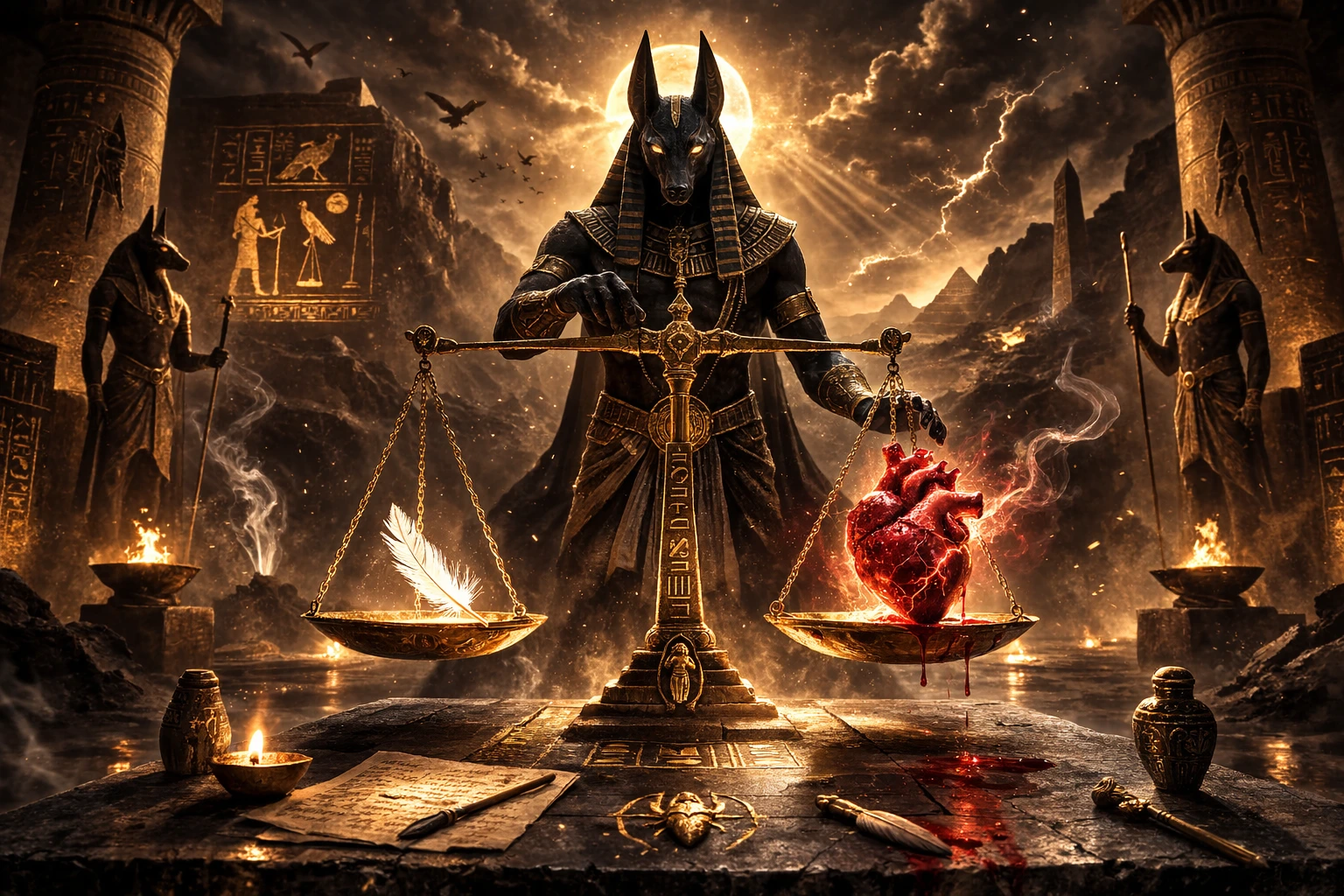
In the deepest corner of the afterlife, there’s a courtroom no living person can enter—only a scale can speak.
One side holds a single feather. The other holds your heart.
And the figure adjusting the balance isn’t a king, or a monster, or even the judge.
It’s Anubis.
Ancient Egyptians didn’t treat death as a full stop. They treated it like a passage—dangerous, rule-bound, and oddly fair. At the center of that passage stood Anubis, the jackal-headed god known as a protector of the dead, a guide through the Egyptian underworld, and the careful guardian of the scales.
The Secret Behind the Jackal Head
Anubis is instantly recognizable: human body, canine head, upright ears, watchful stillness. Even people who’ve never read an Egyptian myth can identify him in a heartbeat.
Why cemeteries shaped the symbol
In the ancient world, jackals and wild canines were often seen near desert burial grounds. That reality created a terrifying problem: graves could be disturbed.
So Egyptians did something psychologically brilliant: they turned the threat into the guardian. A jackal-headed god didn’t invite danger—he warned it off. In art and prayer, Anubis became the one who watches the boundary between safety and desecration.
Why Anubis is painted black
Anubis is often shown in black, even though real jackals aren’t. In Egyptian symbolism, black carried layered meaning: the dark fertile soil of the Nile, regeneration, and the transformation that follows decay. That matters because Anubis wasn’t just about endings—he was about the “safe conversion” from one state of being to another.
What “Protector of the Dead” Really Meant
Calling Anubis the protector of the dead can sound like a spooky title. But in practice, it meant three very specific kinds of protection—body, place, and moral order.
Protector of bodies: mummification rituals
To Egyptians, the body wasn’t disposable. Preservation mattered because the afterlife journey required wholeness and recognition.
Anubis is strongly tied to embalming and funerary preparation—so strongly that ritual specialists sometimes wore masks to represent him during mummification work. It wasn’t cosplay. It was a way to say: “This isn’t just a human task. This is divine care.”
What that protection looked like (conceptually):
- Keeping the body intact so identity could endure.
- Guarding the deceased from physical corruption and spiritual vulnerability.
- Creating a “prepared state” for entry into the next world.
Britannica describes Anubis plainly as a god of funerary practices and care of the dead—simple words for an enormous responsibility.
Protector of places: tomb guardian duties
Tombs weren’t just storage. They were sacred addresses for the dead.
Images and prayers invoking Anubis appear in tomb contexts because his role included guarding graves and the space around them. In museum collections and descriptions, he’s repeatedly linked to the judgment scene and the wellbeing of the dead—exactly what a tomb was meant to secure.
Protector of order: Ma’at as the rulebook
Here’s the twist many modern summaries skip:
Anubis protects the dead by protecting order.
In Egyptian thought, Ma’at is more than a goddess. It’s the principle of truth, balance, justice, rightness—the idea that the cosmos doesn’t collapse into chaos.
Anubis serves Ma’at when he serves the dead. Because a safe afterlife isn’t just comfort—it’s fairness.
The Duat Journey
If you imagine the afterlife as a single “heaven or hell” door, Egyptian belief can feel complicated. That’s because it was.
The dead had a route. A sequence. A process.
Duat basics (what it is, what it isn’t)
The Duat is often described as the Egyptian underworld—a realm between death and final destination. It’s not simply a place of punishment. It’s a passage filled with tests, thresholds, and divine rules.
Think of it like this:
- The Duat is the “in-between.”
- Judgment is the checkpoint.
- The Field of Reeds is the goal.
Psychopomp explained: Anubis as guide
A psychopomp is a guide of souls. In Egyptian scenes, Anubis leads the deceased toward judgment—literally introducing them to the next stage. British Museum object descriptions emphasize this escort role in Book of the Dead imagery: Anubis brings the deceased into the judgment scene and attends the scales.
Protection here isn’t about fighting monsters. It’s about guidance:
- Keeping you on the correct path.
- Bringing you to the proper “court.”
- Making sure the process is followed.
The Weighing of the Heart
If Anubis had one scene that made him immortal in modern imagination, it’s this.
A scale. A feather. A heart.
And silence loud enough to feel like thunder.
Hall of Ma’at / Hall of Two Truths
The British Museum’s learning materials describe the “ultimate test” as weighing the heart against the feather of Ma’at—the final check for worthiness.
In many depictions, Anubis is shown adjusting or overseeing the balance. He is not the one being tested. He is the one ensuring the test is real.
Feather, scales, and the heart
The heart mattered because it was seen as the seat of identity and moral record—something that could speak for or against you.
A scholarly-style piece archived on PMC summarizes the idea succinctly: the heart “gave evidence,” and if it outweighed Ma’at’s feather, it faced immediate consequences.
So what is Anubis doing?
He is the technician of justice:
- verifying the measure,
- preventing interference,
- making sure truth isn’t just claimed—it’s weighed.
Ammit and the “second death”
If the heart is heavier than the feather, the creature Ammit devours it. The British Museum explains this as failure of the test: the heart is eaten, and the person doesn’t pass on.
This is where Anubis feels different from many “death gods” in pop culture.
He’s not portrayed as cruel. He’s portrayed as impartial.
That impartiality is the comfort:
- the rules are known,
- the test is consistent,
- the scales don’t care about your status.
Field of Reeds: what “passing” looked like
If the heart balances, the deceased is considered worthy to move forward into a blessed afterlife—often described as a paradise-like continuation of life, cultivated and familiar.
This is why Anubis isn’t “just scary.” He’s part of an ecosystem of hope.
Tomb Ritual Spotlight: Opening of the Mouth
You can understand Anubis better by looking at what people did, not only what stories said.
One of the most famous funerary rites is the Opening of the Mouth ceremony.
What the ceremony did (symbolically)
The goal was to restore the deceased’s senses—so they could breathe, speak, eat, and function in the afterlife.
Museum education material from the Spurlock Museum describes a key moment: a priest wearing a jackal-headed mask (representing Anubis) holds the coffin upright while another priest touches the mouth with ritual tools.
That detail is powerful:
- Anubis is present as the stabilizer.
- The ritual is “activated” through precision.
- The dead are treated as continuing persons, not abandoned remains.
Why priests wore Anubis masks
In modern terms, it’s like saying: “We’re not improvising this. We’re enacting a divine script.”
The mask makes the ritual feel supervised by the god of proper passage—Anubis as quality control for eternity.
Anubis in Modern Pop Culture
Anubis shows up everywhere: movies, comics, games, merch. Usually he’s presented as ominous, powerful, maybe villain-adjacent.
That version isn’t totally wrong—but it’s incomplete.
What pop culture keeps:
- the striking iconography,
- the association with death,
- the aura of judgment.
What it often flattens:
- his protective function (body and tomb),
- his relationship to Ma’at (truth and balance),
- his role as guide more than executioner.
If you remember one correction, make it this:
Anubis doesn’t represent death as horror.
He represents death as a process with care and rules.
Quick Glossary + Takeaways
Key terms (fast)
- Duat: The Egyptian underworld; a passage realm leading to judgment and beyond.
- Ma’at: Truth, justice, balance—cosmic and personal order.
- Weighing of the Heart: Judgment ritual comparing heart to Ma’at’s feather.
- Ammit: The devourer who consumes the heart if it fails the test.
- Opening of the Mouth: Ritual restoring senses for afterlife function.
The big takeaway
Anubis, at his core, is a guardian of transitions.
He protects the dead by:
- preserving what must remain,
- guarding what must not be violated,
- and ensuring the final test is honest.
That’s why he still resonates—because the fear of death is often a fear of chaos. Anubis is the mythic answer: there are rules, and someone is watching the scale.
Conclusion
The most unsettling thing about Anubis isn’t his jackal head.
It’s his calm.
Because calm implies certainty: a world where actions matter, where balance can be measured, where guidance exists even at the edge of life. In ancient Egypt, that wasn’t meant to terrify people. It was meant to steady them.
Anubis wasn’t the end.
He was the protector of the dead—making sure the crossing was done properly.