ARE THERE ANY SIMILARITES BETWEEN GREEK AND HINDU MYTHOLOGY?
Introduction
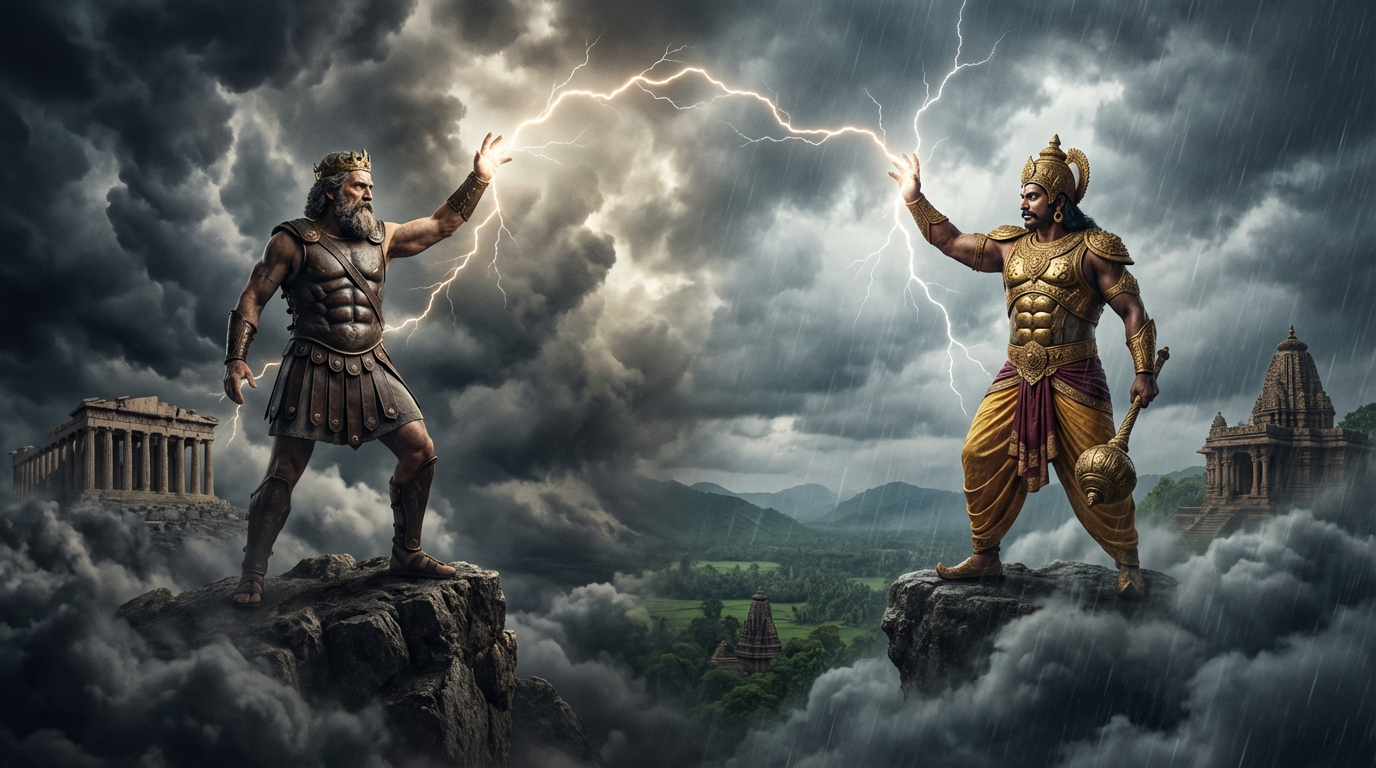
Have you ever noticed how a Greek myth can feel strangely familiar if you’ve grown up hearing Hindu stories? A thunder-wielding sky god. Epic wars driven by duty and honour. Gods who protect the universe — and others who destroy it so it can begin again. Greek and Hindu mythology come from different parts of the world, yet their stories often echo each other.
That’s not a coincidence. And it doesn’t mean one copied the other.
In this article, you’ll see where the similarities lie, why they exist, and what they reveal about how humans everywhere use myth to explain life.
1. Gods with Similar Roles
Many gods in Greek and Hindu mythology perform similar cosmic roles, even if their personalities differ.
-
Zeus and Indra are both kings of the gods and controllers of thunder and storms.
-
Athena and Saraswati represent wisdom, learning, and strategy.
-
Hades and Yama rule over death and judgement.
These parallels exist because ancient cultures needed ways to explain nature, power, morality, and the afterlife.
2. Shared Mythological Themes
Despite cultural differences, both traditions return to the same core ideas:
-
Order vs chaos — the universe must be protected from collapse
-
Fate and duty — actions have consequences
-
Moral struggle — even gods face ethical challenges
Greek myths often show what happens when pride and emotion run wild. Hindu myths focus more on dharma — acting in harmony with cosmic law. Different approaches, same human concern.
3. Epic Stories and Hero Journeys
The great epics also share structural similarities.
-
The Iliad centres on war, honour, and personal glory.
-
The Mahabharata explores war too — but places heavier emphasis on moral duty and consequence.
Both feature:
-
Large-scale wars
-
Heroes facing impossible choices
-
Divine involvement in human affairs
The difference is emphasis: Greek heroes chase honour; Hindu heroes wrestle with responsibility.
4. Cycles, Time, and the Universe
Greek mythology generally sees time as linear — events move towards an end.
Hindu mythology sees time as cyclical — creation, destruction, and rebirth repeat endlessly. Gods like Shiva don’t end the universe out of malice, but to allow renewal.
Both systems are trying to answer the same question: How does the universe survive change?
5. Why These Similarities Exist
The most likely reason is shared human psychology, not copying.
Many scholars also point to ancient Indo-European cultural roots, where early societies shared language patterns and mythic structures before spreading across regions.
In short:
Humans everywhere tell stories to explain fear, power, death, and meaning — and those stories naturally overlap.
Conclusion
Greek and Hindu mythology aren’t the same. They don’t teach identical lessons, and they aren’t interchangeable. But they rhythmically rhyme.
Their similarities show that long before modern science or global communication, humans across the world were asking the same questions — and answering them with gods, heroes, and epic stories.
When you notice those connections, you’re not blurring cultures.
You’re seeing how deeply human storytelling is shared.