IS THE JADE EMPEROR OF CHINA THE HINDU GOD LORD SHIVA?
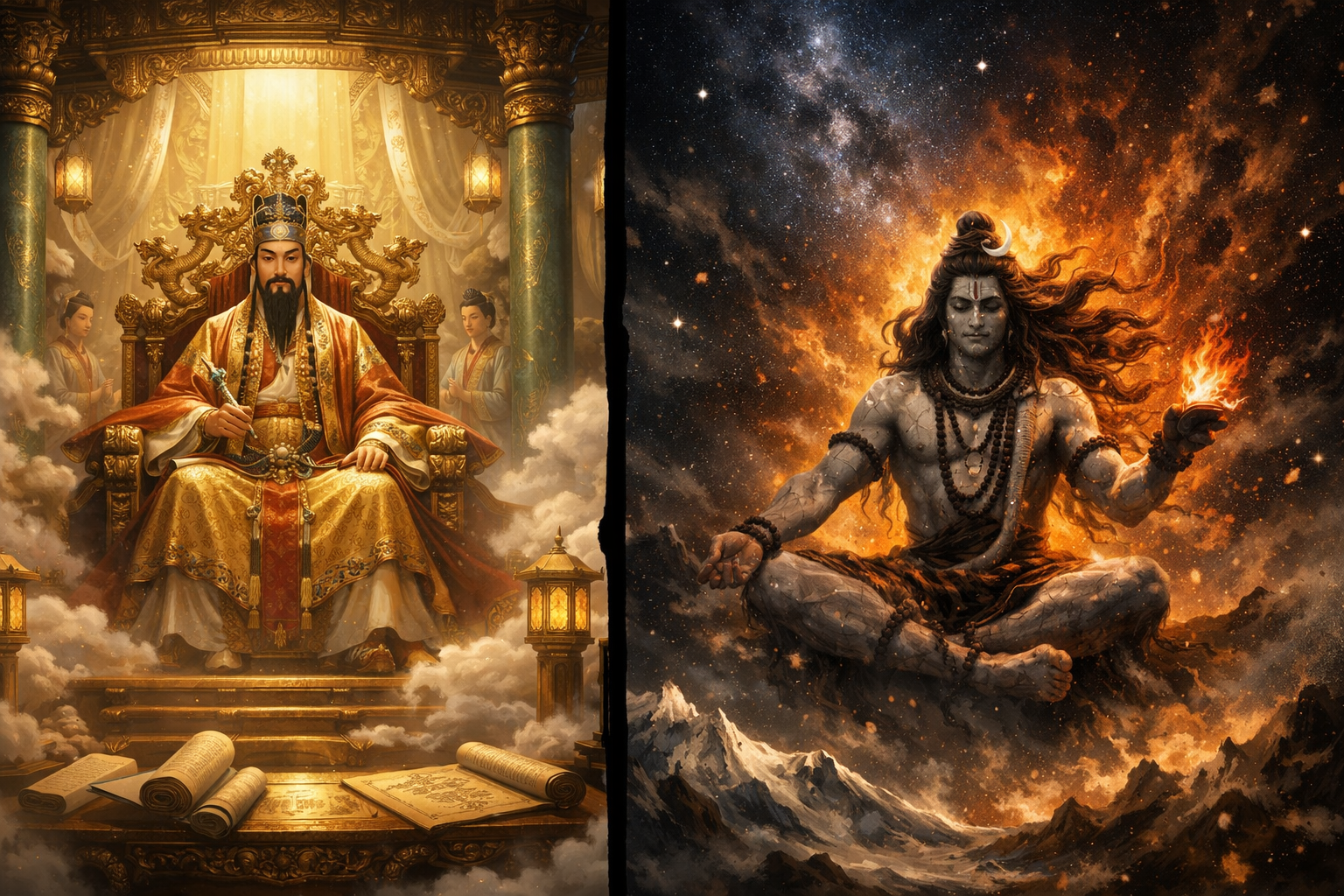
Is the Jade Emperor of China the Hindu God Lord Shiva?
The short answer? No.
The longer answer is more interesting — and worth understanding properly.
This question keeps coming up because people notice similarities between Eastern religions and assume similarity means sameness. It doesn’t. Let’s break it down simply.
Who the Jade Emperor actually is
The Jade Emperor is the supreme ruler in Chinese folk religion and Daoist cosmology. Think of him as an emperor of heaven.
His role is administrative:
-
He governs heaven like a bureaucracy
-
He oversees gods, spirits, and human affairs
-
He maintains cosmic order, law, and hierarchy
He’s not a creator god. He’s not a destroyer. He’s a ruler — calm, distant, and structured. His authority comes from order, not raw cosmic power.
In Chinese stories, the Jade Emperor rises to power through moral discipline and cultivation, not through eternal divinity.
Who Lord Shiva actually is
Lord Shiva is something entirely different.
Shiva is:
-
A primordial cosmic force
-
The god of destruction and transformation
-
Outside hierarchy, time, and social order
He doesn’t rule heaven. He transcends it.
Shiva destroys not to punish, but to reset existence so creation can begin again. He’s an ascetic, a yogi, a householder, and a wild god all at once. In Hindu theology, Shiva doesn’t answer to a higher authority — he is fundamental reality in motion.
Why people think they’re the same
The confusion usually comes from three places:
-
Surface-level symbolism
Both are powerful male figures associated with the cosmos. That’s where the similarity ends. -
“All gods are one” thinking
This idea sounds spiritual, but it flattens rich traditions into something vague and inaccurate. -
Historical contact between cultures
India and China did exchange ideas — especially through Buddhism — but that doesn’t mean their gods merged or became identical.
Influence is not identity.
Shared themes ≠ shared gods
Many ancient cultures created gods to answer the same human questions:
-
Who runs the universe?
-
Why does order exist?
-
Why does destruction happen?
When different cultures answer similar questions, you’ll naturally see overlap. That doesn’t mean they’re talking about the same being.
A king and a storm aren’t the same thing just because both are powerful.
Key differences people overlook
-
The Jade Emperor maintains order
-
Shiva destroys and transforms order
-
The Jade Emperor exists within a hierarchy
-
Shiva stands outside all hierarchy
-
The Jade Emperor governs
-
Shiva dissolves
Function matters more than appearance.
The honest conclusion
The Jade Emperor of China is not Lord Shiva under another name.
They come from different cultures, serve different roles, and express entirely different ideas about how the universe works. The similarities people point to are symbolic at best — not theological, historical, or functional.
Curiosity is good. Questioning is good.
But clarity matters more than mystical shortcuts.
If you respect these traditions, the most accurate thing you can say is this:
They are different gods answering different human questions — and that’s what makes them interesting