Is Ram of Valmiki Ramayana the same as Abraham of the Bible?
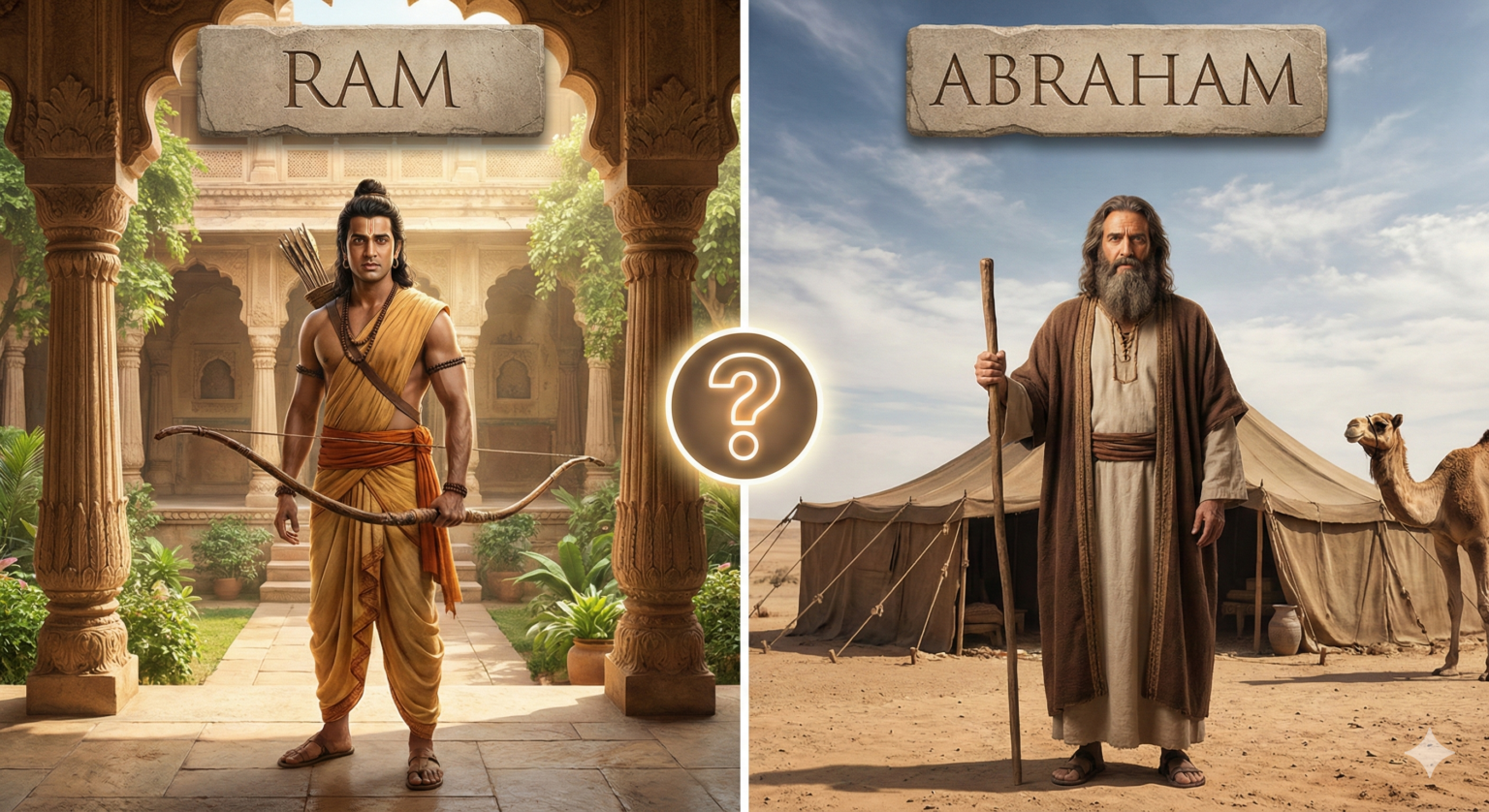
Is Ram of Valmiki Ramayana the Same as Abraham of the Bible?
Have you ever looked at the names Ram and Ab-ram (Abraham) and wondered if they are connected? You aren’t alone!
For years, history buffs and theology enthusiasts have debated whether Lord Ram, the hero of the Valmiki Ramayana, and Abraham, the patriarch of the Bible, could be the same historical figure.
It sounds like a conspiracy theory, but is there any truth to it? Let’s break down the facts, the myths, and the differences in simple terms.
The Argument: Why Do People Think They Are the Same?
The primary reason this theory exists comes down to linguistics (language). The similarities in names and relationships are definitely striking:
-
The Name: The name “Abraham” can be broken down into Ab-Ram, which some interpret as “Father Ram” or “High Father.”
-
The Consorts: Ram’s wife is Sita, but in Hindu tradition, the god Brahma (who is phonetically similar to Abraham) has a consort named Saraswati. In the Bible, Abraham’s wife is Sarah.
-
The Direction: Abraham traveled from the East to the West. Some theorists suggest this represents a migration of culture from India to the Middle East.
On the surface, it looks like a perfect match. But does history support it?
The Reality Check: Why They Are Likely Different
While the wordplay is interesting, most historians and religious scholars agree that Ram and Abraham are two distinct figures. Here is why:
1. The Geography
-
Ram: The Ramayana is deeply rooted in the geography of the Indian subcontinent. The journey from Ayodhya to Lanka is specific to Indian and Sri Lankan geography.
-
Abraham: The biblical account places Abraham’s life in Mesopotamia (modern-day Iraq) and Canaan (modern-day Israel/Palestine).
2. The Timeline
-
Ram: According to traditional Hindu timelines, Ram existed in the Treta Yuga, dating back thousands (or even millions) of years before recorded history.
-
Abraham: Biblical scholars and archaeologists generally date Abraham to around 2000 BCE (the Bronze Age). The timelines simply don’t match up.
3. The Story Arcs
-
Ram was a warrior prince and an avatar of Vishnu who fought a massive war against a demon king to uphold Dharma (righteousness).
-
Abraham was a shepherd and a nomad who made a covenant (agreement) with God to become the father of many nations. He wasn’t a king who fought a great war like the one in the Ramayana.
The Verdict
So, is Ram the same as Abraham? Probably not.
It is most likely a case of linguistic coincidence or shared roots in ancient Indo-European languages. While the names sound similar, their stories, cultures, and timelines are worlds apart. However, these similarities do remind us that ancient cultures were often more interconnected than we think!
What do you think?
Do you believe the name similarity is just a coincidence, or is there a lost link in history? Let me know in the comments below!