Reinterpreting Myths: Feminism and Modern Morality in the Stories We Still Tell
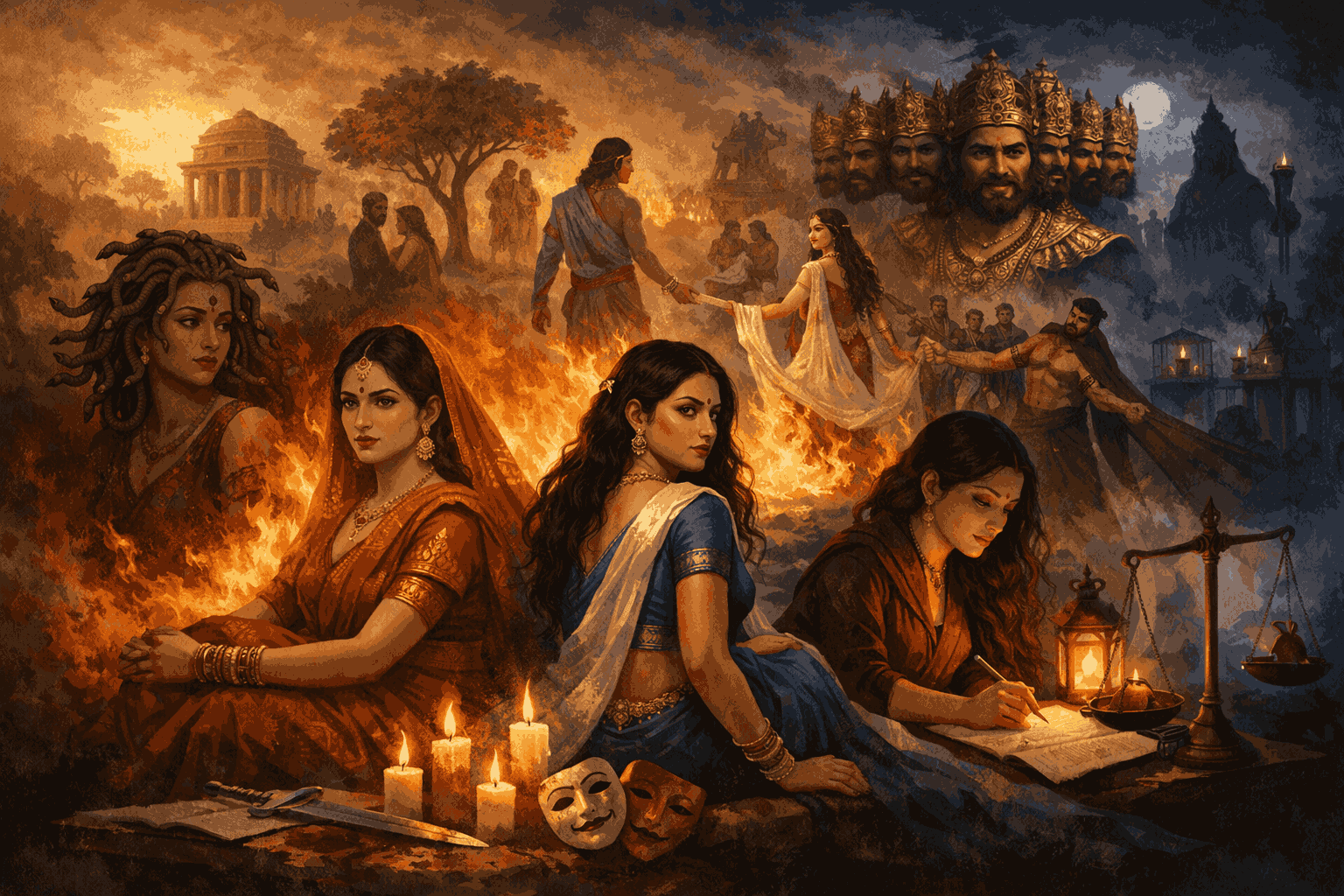
Introduction
There’s a strange trick myths play on us.
We assume they’re ancient—and therefore finished.
But the truth is almost the opposite: myths keep moving. Quietly. Every time a generation rereads a scene and whispers, “Wait… why is this considered normal?”
That whisper is where feminism and mythology collide—in the best possible way.
If you’ve ever felt both moved and uneasy while reading an epic, you’re not alone. And you don’t need to pick a side between “cancel the past” and “never question tradition.”
Why myths change when we change
Myths aren’t just stories about gods and kings.
They’re stories about what a society rewards, fears, and expects—especially from women.
That’s why the same character can look completely different depending on the lens you use:
- In one era, obedience is the highest virtue.
- In another, self-respect is.
- In another, survival itself becomes heroic.
This doesn’t mean old myths were “bad.” It means they were written inside a social reality—often patriarchal—that shaped what felt “moral” at the time.
Context vs endorsement: the difference that stops culture-wars
A useful rule: A myth can depict a norm without endorsing it.
Sometimes epics show injustice because injustice was real. Sometimes they show it because it was acceptable. Sometimes they show it to warn us what power can do.
Modern readers—especially feminist readers—try to separate:
- What the story portrays
- from what the story asks us to admire
That one separation makes room for nuance.
Women in mythology—center of the plot, edge of power
A pattern repeats across cultures: women are crucial to the plot, yet their choices are often constrained by the choices of men.
That’s exactly why women in mythology become the center of feminist reinterpretation.
Sita and the Agni Pariksha: virtue, doubt, and resilience
Sita is revered, loved, and constantly tested.
In many summaries of the Ramayana, Sita undergoes the agnipariksha (ordeal by fire) to respond to public suspicion, and later faces banishment despite her fidelity.
Modern readers often pause at one question:
Why is the burden of proof placed on the woman who was abducted?
A feminist retelling doesn’t have to “attack” the epic to ask that. It can shift the center of gravity:
- from proving purity
- to surviving doubt
- to protecting dignity when society refuses to protect you
In that reading, Sita isn’t an icon of silent endurance.
She’s an icon of resilience under public scrutiny—something painfully modern.
Draupadi and public humiliation: dignity as resistance
Draupadi’s humiliation in the Mahabharata is one of the most disturbing scenes in mythic literature because it isn’t only personal.
It’s political.
It shows what happens when a room full of powerful people decides not to intervene.
Feminist reinterpretations often highlight that Draupadi is not merely “a victim.” She argues. She questions. She demands accountability. The story becomes less about what was done to her and more about what her voice exposes: cowardice dressed up as law.
That’s why Draupadi Mahabharata discussions keep resurfacing in modern classrooms and book clubs—because the scene is an anatomy of power.
What feminist retellings actually do
The best feminist retellings don’t simply reverse the genders and call it a day.
They usually do three deeper things:
- POV shift: letting the woman narrate her own life, not just appear in someone else’s quest.
- Interior life: showing fear, anger, desire, spiritual conflict—rather than one “ideal trait.”
- Agency upgrade: even when choices are limited, the character’s decisions matter.
It’s not erasure. It’s restoration.
Heroes, but at what moral cost?
Modern morality loves clean heroes.
Myths often refuse that.
Duty vs compassion: why “dharma” debates won’t go away
Epics—especially Indian epics—often place duty above emotion.
That can be profound. It can also be brutal.
When modern readers apply today’s moral frameworks (consent, individual rights, harm reduction), old “heroic” decisions start looking ethically complicated.
And that complication is useful.
Because it teaches a mature lesson: virtue without empathy can still harm people.
Public image, private harm: reading Rama with modern ethics
In many retellings and summaries, Rama’s choices around Sita are tied to public doubt and the perceived duty of a king.
Modern morality asks:
- Why should reputation outrank intimacy?
- Why should a wife pay the price for public gossip?
- Is “being ideal” the same as being just?
You can hold reverence for a tradition and still examine the cost of its ideals.
In fact, that examination is how myths stay alive instead of becoming slogans.
“Ends justify means?” reading Krishna without flattening him
Krishna’s strategies in the Mahabharata are often defended as serving dharma, even when they bend rules.
Modern moral reasoning pushes back:
- Is the goal enough to justify manipulation?
- When does strategy become moral compromise?
- If a good outcome requires unethical tools, what do we learn from it?
This is where moral ambiguity becomes a feature, not a flaw.
Myths weren’t always designed to give you a “role model.”
Sometimes they were designed to give you a dilemma.
Villains rewritten—when “evil” gets a backstory
Feminist and modern reinterpretations don’t only “upgrade” heroines.
They also complicate villains—because simplistic evil is rarely psychologically true.
Ravana as scholar-king: complexity without excuse
Modern readers often point out that Ravana is sometimes described as learned, artistic, and devout—yet still commits unforgivable wrongdoing.
That’s not a contradiction.
It’s a warning: intelligence and talent don’t prevent abuse of power.
Reinterpretation here doesn’t mean excusing him.
It means making the villain realistic enough to teach something.
Medusa as victim/symbol: how archetypes flip in modern retellings
Medusa is a classic example of reinterpretation in Greek mythology: once framed as a monster, later reframed as a figure shaped by violence and injustice.
Even in popular modern discussions, her story is often used to explore victim-blaming and the way women are punished for harm done to them.
Why does that matter?
Because archetypes shape instincts. If the “dangerous woman” trope is baked into our stories, it can leak into our reflexes.
Reinterpreting the trope doesn’t rewrite history.
It rewrites what we unconsciously accept.
A simple toolkit for reading myths through modern morality
If you want a practical way to read feminism mythology without turning every discussion into a fight, try this 4-question lens.
The 4-question lens
- Agency: What choices does the character actually have in their society?
- Consent: Who gets to say yes, who is denied a voice?
- Power: Who benefits from the “moral rule” of the story?
- Consequence: Who pays for the hero’s righteousness?
You can apply this lens to Sita, Draupadi, Rama, Krishna, Ravana—anyone—without reducing them to “good” or “bad.”
How to discuss myths with kids/teens without preaching
For parents and educators, the goal isn’t to deliver a verdict.
It’s to build ethical thinking.
Try prompts like:
- “What would fairness look like here?”
- “If this happened today, what would we expect from the community?”
- “What do you think the story is warning us about?”
- “Who didn’t get to speak in this scene?”
That keeps the conversation respectful and honest.
What to keep sacred: respect, plurality, and humility
Reinterpretation works best when it’s done with three values:
- Respect: for believers and cultural context
- Plurality: multiple versions and tellings can coexist (they often always have)
- Humility: the point is learning, not winning
This is where feminism is often misunderstood.
It’s not a hammer. It’s a flashlight.
What reinterpretation gives us in 2026
So why does myth reinterpretation matter now?
Because the stories we repeat become the scripts we live by.
When we reinterpret myths through modern morality, we get:
- Better role models: not “perfect,” but honest, resilient, and human
- Deeper empathy: even for characters society labels as “fallen” or “impure”
- Sharper ethics: we learn to question power, not just admire it
- Living tradition: myths survive by adapting, not by fossilizing
And perhaps most importantly:
We learn to love a story without surrendering our conscience.
Conclusion
Myths don’t stop being powerful when we question them.
They become more powerful.
Because a story that can survive critique is a story that can grow—along with the people who carry it forward.
When feminism and mythology meet, the goal isn’t to erase the past. It’s to rescue the human truth inside it—especially the truth of those who were told to stay silent.