The Curse of King Tut: Myth, Mystery, or Media Storm?
Introduction
There’s a secret hiding in one of history’s most famous discoveries—and it isn’t made of gold.
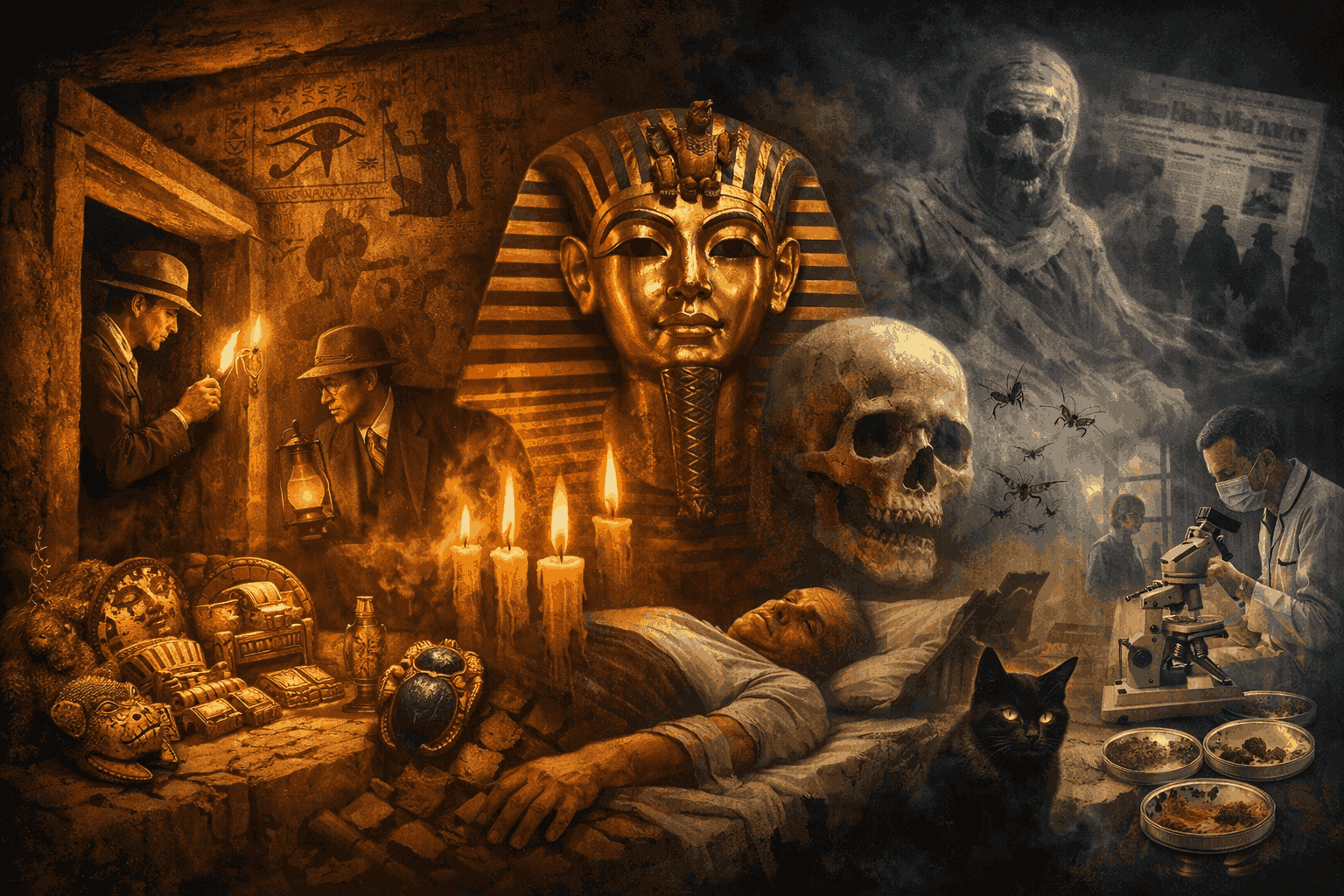
When King Tutankhamun’s tomb was opened in 1922, the world expected treasure. It got treasure… and then something stranger: a story that seemed to hunt the people who told it. A few deaths, a few eerie coincidences, and suddenly the King Tut curse felt less like a rumor and more like a warning whispered across 3,000 years.
The Night the Story Was Born
Howard Carter’s discovery in Egypt’s Valley of the Kings didn’t just open a tomb—it opened a global obsession. Newspapers followed every detail. Crowds wanted updates. Writers wanted drama. And drama, as history keeps proving, spreads faster than facts.
What happened in 1922 (and what people think happened)
Here’s the grounded version: a team led by Carter uncovered the entrance to Tutankhamun’s tomb in November 1922, then carefully proceeded through its sealed spaces.
Here’s the version that went viral (1920s style): a sacred door was broken, an ancient warning was found, and a punishment began.
That second version is the seed of the Tutankhamun curse—and once it took root, almost anything could become “proof.”
Why “sealed tomb” stories hit a nerve
Humans love a rule with consequences:
- Don’t cross the line.
- Don’t touch the forbidden thing.
- If you do… something happens.
So when a sealed tomb met sudden tragedy, the public didn’t just see coincidence. They saw a plot.
What Is the Pharaoh’s Curse, Really?
The phrase “Pharaoh’s curse” sounds ancient. But most of the famous curse narrative—the one tied to King Tut—was shaped by modern media, not ancient inscriptions.
Ancient Egyptian protection warnings vs modern “curse” lore
Yes, some ancient tombs include protective texts or threats aimed at tomb robbers. But those are not the same thing as a Hollywood-style curse that targets any visitor with instant doom.
In other words: ancient Egyptians did protect the dead… but the modern “mummy’s curse” formula is a later cultural creation that grew through literature and headlines.
Did Tut’s tomb actually have a curse inscription?
Many reputable history sources emphasize that no verified curse text was found inside Tutankhamun’s tomb—yet newspapers and popular retellings often claimed there was.
That’s an important clue.
When a story includes a dramatic “inscription,” but historians can’t confirm it, you’re often looking at a legend evolving in real time.
The Deaths That Fueled the King Tut Curse
This is the part that keeps the King Tut curse alive: people really did die. And some of the timing really was unsettling.
But timing alone isn’t evidence—so let’s separate what’s known from what’s repeated.
Lord Carnarvon: what we know about the cause
Lord Carnarvon, who funded the excavation, died in April 1923 after a mosquito bite became infected, worsened by a shaving cut, leading to serious infection/blood poisoning.
That’s not magic. It’s tragically believable—especially in an era when antibiotics weren’t widely available yet.
Still, headlines didn’t want “infection.” They wanted “curse.”
Other deaths often listed—and why timelines matter
Lists of “curse victims” often include:
- wealthy visitors who later fell ill,
- team members who died years later,
- people loosely connected through a single visit.
Some sources note that the legend gained traction because several associated individuals did die after the tomb was opened—yet the causes are typically explainable and the connections vary in strength.
When you read a curse list, ask:
- How close were they to the tomb?
- How soon after exposure did they die?
- Is the cause of death known?
A death “years later” may be sad, but it’s weak evidence for a supernatural chain reaction.
The “survivors list” nobody talks about
Here’s the twist most curse stories avoid: many people connected to the discovery lived normal lifespans for their time. Even the broader idea of a deadly “mummy’s curse” doesn’t hold up well when researchers compare survival outcomes.
A curse story needs a tight pattern.
Real life is messy—and messy doesn’t sell as well.
Science vs Supernatural
If the curse isn’t supernatural, could it be natural?
That question has produced some fascinating (and sometimes overhyped) scientific ideas.
Infection and 1920s medicine
Carnarvon’s case is a reminder of how dangerous infections once were—especially while traveling, exhausted, and far from modern treatment.
Sometimes “mystery” is simply history + weaker medicine.
Tomb toxins, mould, and microbes—what’s plausible
The “tomb toxins” theory suggests that sealed spaces might contain moulds, bacteria, or irritating compounds that could make visitors sick—particularly if someone already has health issues.
National Geographic famously discussed this possibility while also noting the uncertainty and the role of pre-existing illness.
What’s reasonable to say:
- Sealed tombs can trap dust, spores, and poor air quality.
- Some microbes can be harmful in the right conditions.
- People with weaker immune systems may be more vulnerable.
What’s not reasonable to say:
-
“The tomb definitely killed people like a booby trap.”
Science deals in probabilities, not dramatic guarantees.
What research says about life spans of the “exposed”
A key reality check comes from epidemiological thinking: if exposure to the tomb were deadly in a consistent way, you’d expect a clear survival pattern among those most exposed.
But research into the so-called mummy’s curse has been summarized as finding no strong evidence of shortened survival among the “exposed” group compared with others of that era.
That doesn’t mean tomb environments are “perfectly safe.”
It means the Pharaoh’s curse doesn’t behave like a real cause-and-effect mechanism.
Why the Myth Refuses to Die
Even when evidence is weak, a story can be strong.
And the King Tut curse is built like a perfect blockbuster.
Headlines, fear, and storytelling
Multiple historical analyses point out how quickly the press and popular writers amplified the curse narrative—especially after high-profile deaths.
Once a spooky explanation becomes popular, later events get pulled into the same storyline—even if they don’t really fit.
The psychology of patterns and coincidence
Our brains are pattern machines.
So when we see:
- a forbidden place,
- a warning,
- a sudden death,
…we instinctively connect the dots.
But coincidence can look meaningful when:
- the event is famous,
- the people are memorable,
- and the story is repeated for decades.
The curse survives because it feels like a lesson: “some doors should stay closed.”
What We Can Learn From the Mystery
Whether you’re a student writing a report, a parent answering big questions, or an educator building critical thinking, the Tutankhamun curse is actually a brilliant learning tool.
For students: a 5-step “myth check” method
Use this checklist for any historical mystery:
- Define the claim
What exactly is being claimed—and what would count as proof? - Separate primary vs secondary sources
A diary entry, a medical report, or a dated newspaper is different from a retelling. - Check the timeline
“Right after” and “years later” are not the same thing. - Look for base rates
People died more often (and younger) in the 1920s than today. - Test the alternative explanations
Infection, pre-existing illness, environment, and media hype often explain “mystery.”
For parents/educators: discussion prompts that build critical thinking
Try these in class or at home:
- If a headline says “curse,” what questions should we ask first?
- Why do people prefer a spooky explanation over a medical one?
- How can a true event (a death) produce a false cause (a curse)?
- What is the difference between evidence and a good story?
These questions don’t ruin the mystery—they upgrade it.
Conclusion
So, is the King Tut curse myth or mystery?
It’s a little of both—but mostly, it’s a media storm powered by human psychology.
Real deaths happened. Real fear followed. Real headlines turned coincidence into a narrative that still thrills us today. And science gives us grounded alternatives—like infection risk and the limits of early 20th-century medicine—without needing ancient magic.
The greatest secret of Tutankhamun’s “curse” may be this: it teaches us how stories are built—one dramatic detail at a time.