The Jade Rabbit and Chang’e: The Moon’s Most Tender Secret in Chinese Myth
Introduction
There’s a secret hiding in plain sight every time the moon turns bright.
Not a crater. Not a shadow.
A gesture.
A small figure that seems to be working—steadily, quietly—while the rest of the sky watches. If you’ve ever squinted up and thought, “Is that… a rabbit?” you’ve stepped into the doorway of the Jade Rabbit legend.
A Mystery in the Moonlight
Why do people see a rabbit on the moon?
Humans are meaning-makers. We look at clouds and find dragons. We stare at ink blots and find faces.
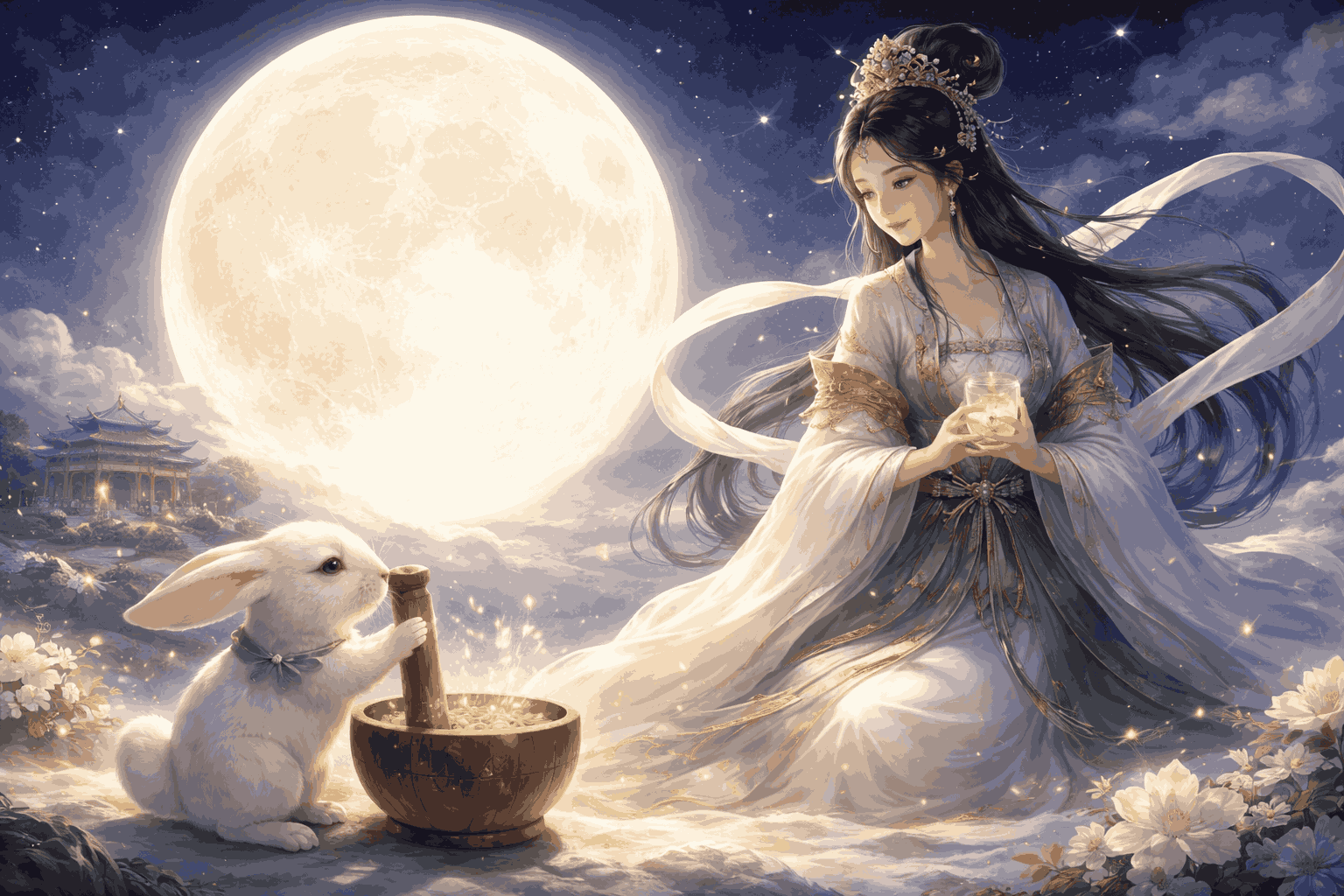
So when the moon’s darker patches arrange themselves into a familiar outline, folklore does what folklore always does—it turns shape into story. Across Asia, that outline becomes the moon rabbit, often shown with a mortar and pestle, tirelessly pounding something precious.
In Chinese tradition, that rabbit gains a special name: Yu Tu, the Jade Rabbit—not because it’s literally green, but because “jade” signals purity, value, and the kind of goodness that lasts.
And then the myth asks its first quiet question:
What kind of creature ends up on the moon?
The Jade Rabbit Legend, Told Simply
The most beloved version of the Jade Rabbit legend begins as a test.
The “test of kindness” and the fire
Three divine beings descend to earth disguised as hungry elders. They approach a monkey, a fox, and a rabbit, asking for food.
- The monkey brings fruit.
- The fox brings what it can find or catch.
- The rabbit searches—and finds nothing.
But the rabbit doesn’t walk away. It doesn’t explain. It doesn’t negotiate.
In the boldest moment of the story, the rabbit offers the only thing it has: itself—leaping into a fire as an act of total generosity. Variants of this “charity test” are widely told, including versions recorded in Chinese cultural explainers.
The twist is merciful: the rabbit isn’t harmed. The disguised beings reveal who they are, moved beyond words.
To honor the rabbit’s devotion, they place its image in the moon—an eternal reminder that compassion can become a constellation.
Why the rabbit becomes “jade”
“Jade” isn’t just a pretty adjective. In Chinese symbolism, jade is associated with moral beauty—integrity, steadiness, purity.
So the Jade Rabbit legend isn’t only saying “a rabbit lives on the moon.”
It’s saying: a certain kind of goodness deserves a heavenly home.
Chang’e’s Moon Story
If the Jade Rabbit is the moon’s quiet worker, Chang’e is the moon’s aching heart.
The elixir of immortality
In many tellings, Chang’e becomes the moon goddess after an encounter with an elixir of immortality—a substance that promises life beyond limits, but also changes everything. The British Library’s educational overview describes Chang’e’s moon residence and the jade rabbit as one of her companions, pounding for everlasting life.
Different versions disagree on details (as myths do). But the emotional core stays recognizable:
- Love, threatened by fate
- A choice made under pressure
- A sudden ascent—beautiful, and devastating
The loneliness-and-longing motif
Chang’e is often portrayed not as a villain or a saint, but as something more haunting: a figure who has gained eternity and lost the world.
That’s why the Jade Rabbit legend pairs so well with her story. Where Chang’e embodies longing, the rabbit embodies loyalty. Where her myth feels like a sigh, the rabbit’s feels like a vow.
Together, they make the moon feel less like a cold rock in space—and more like a lit window in the distance.
What the Rabbit Is Pounding
The mortar-and-pestle image is one of the most enduring visuals in moon rabbit folklore—but what’s actually in the bowl?
In Chinese stories, the rabbit often pounds herbs or medicine associated with immortality, linked to Chang’e’s moon palace.
Medicine, immortality, and the symbol of quiet labor
This detail matters more than it seems.
The rabbit isn’t shown ruling. Or conquering. Or dazzling the heavens.
It is shown working.
That’s a radical kind of heroism: service without applause.
In many cultures, healing work is sacred work—slow, repetitive, careful. The rabbit’s motion becomes a symbol of:
- devotion that doesn’t demand attention
- kindness that repeats itself daily
- the belief that care can outlast crisis
Festival foods and moon-viewing traditions
Across Asia, versions shift: sometimes the rabbit pounds medicine; sometimes it pounds ingredients for rice cakes.
That flexibility is the genius of folklore. It adapts the same image—a rabbit at work—to whatever a culture most wants to remember: healing, nourishment, or reunion.
Mid-Autumn Festival: Where the Myth Lives Today
If you want to see the Jade Rabbit legend still breathing, don’t look for it in a museum first.
Look for it at a table.
The Mid-Autumn Festival (often called the Moon Festival) is where families gather, admire the full moon, share mooncakes, light lanterns, and retell the stories that make the sky feel close.
Mooncakes, reunion, and storytelling
Even when the world changes, this festival keeps one theme steady: reunion.
The moon becomes a shared mirror—no matter where you live, you can look up at the same bright circle and feel connected to someone else doing the same.
And somewhere in that brightness, the rabbit is still working.
Family-friendly ways to celebrate (parents, students, educators)
You don’t need to be an expert to let this story do its work.
For parents
- Ask: “What would you give if you had nothing else to offer?”
- Keep it gentle: emphasize kindness, not harm, in the sacrifice moment.
For students
- Compare versions: Why do some stories focus on immortality, others on food?
- Track symbols: mortar, pestle, moon palace, elixir.
For educators
- Mini-activity: have students write a “moon myth” explaining another sky pattern.
- Discussion prompt: “Is devotion still heroic if no one sees it?”
These aren’t just “cute myths.” They’re cultural technologies for teaching values.
Many Versions, One Heart
One reason people get confused by the Jade Rabbit legend is simple: there isn’t only one “official” version.
There are families of versions.
Buddhist Jataka parallels
A widely known parallel appears in Buddhist Jataka traditions, where the rabbit’s act of charity is part of a moral test—again featuring a leap into fire and a divine reveal.
You’ll also see the companion animals shift (fox, monkey, otter, jackal). That doesn’t weaken the myth—it shows how stories travel, borrowing local animals and local textures while protecting the same moral core.
Cross-Asia “moon rabbit” cousins
Across East Asia, the moon rabbit appears in different cultural clothing. The rabbit may be making mochi or tteok, or pounding herbs—yet the visual stays familiar: a small being whose goodness becomes cosmic.
So here’s a helpful way to hold it:
- What stays the same: the rabbit, the moon, the act of selfless giving, the quiet labor
- What changes: the cast of animals, what’s in the mortar, and which festival frames the story
From Folklore to Space: “Yutu”
Here’s the modern twist people love most:
The Jade Rabbit didn’t stay in storybooks.
It rolled onto the moon.
China’s lunar rovers have used the name Yutu (Jade Rabbit) and Yutu-2 (Jade Rabbit-2), explicitly tying space exploration to the ancient moon myth. The China National Space Administration even notes the folklore connection in its naming announcement for YuTu-2.
That’s not just branding. It’s cultural continuity.
It’s a way of saying: We are still looking at the moon the way our ancestors did—through story.
Conclusion: What the Moon Rabbit Asks of Us
The Jade Rabbit legend survives because it doesn’t demand you believe in magic.
It only asks you to recognize a kind of goodness that feels rare—and urgently needed.
A small creature, faced with a hungry stranger, chooses generosity over self-preservation. The reward isn’t wealth or power. It’s remembrance—etched into the sky.
And Chang’e, the moon goddess, becomes more than a distant deity. She becomes the figure the story refuses to leave alone. In the moon’s quiet palace, the rabbit’s steady work becomes companionship—devotion made visible.