The Book of the Dead: Spells, Amulets, and Egypt’s Secret Roadmap to the Afterlife
Introduction
There’s a quiet twist hiding inside ancient Egypt’s most famous “death book.”
It wasn’t written to scare the living.
It was written to coach the dead—like a secret roadmap, stuffed with passwords, protective tricks, and spiritual gear for the most dangerous journey an Egyptian could imagine.
And the strangest part? It wasn’t even one book.
It was a build-your-own survival kit.
The “Book” That Wasn’t a Book
The Book of the Dead is a modern name for a collection of magical texts used to help a person reach a safe, successful afterlife.
Think of it less like a novel—and more like a custom playlist of spells, chosen and arranged based on needs, budget, and personal beliefs.
Egyptians themselves had a more revealing title: “Spells for Coming Forth by Day.”
That’s not the title of something meant to trap you in darkness. It’s the title of something meant to bring you out again.
Where did it live?
These spells could be written on papyrus scrolls, linen, or placed in burial contexts so the deceased could use them.
And no—there wasn’t one standard edition. Scholars and museums emphasize that no single copy contains every spell, and copies vary widely.
The Afterlife, Explained Like a Journey
Many modern summaries say the Book of the Dead is a “guide,” but the best way to picture it is as a travel plan through a hazardous landscape.
The Egyptian afterlife wasn’t just floating bliss.
It was a place of:
- gates that demanded the right words,
- beings that tested identity and purity,
- and cosmic rules that could end you a second time.
The end goal was paradise—often described as the Field of Reeds, an ideal version of life where you could live in abundance and order.
So the Book of the Dead didn’t just say, “Be good.”
It said, “Be prepared.”
Spell Categories That Show What Egyptians Feared
The Book of the Dead is packed with spells that reveal very human worries: What if I’m attacked? What if I forget who I am? What if I can’t breathe?
Here are the categories that matter most for understanding the Egyptian mindset.
Protection spells: “Don’t let me be erased”
Many spells focus on avoiding danger and surviving the underworld’s hazards. Even major summaries describe the afterlife journey as risky enough to require magical support.
These aren’t abstract prayers.
They’re more like spiritual body armor.
Transformation spells: becoming fast, fierce, untouchable
Some spells grant the dead the ability to transform—a supernatural advantage when facing threats or barriers.
The idea is simple: if the underworld is dangerous, don’t walk through it as a fragile human. Walk through it as something that can’t be cornered.
Name + identity spells: “Let me stay me”
One of the eeriest Egyptian fears is the fear of losing identity. In many ancient cultures, forgetting is sad.
In Egypt, forgetting could be fatal.
If your name and selfhood dissolved, what exactly would enter eternity?
So spells that preserve identity aren’t sentimental—they’re survival logic.
Comfort spells: breath, water, and food still matter
The Book of the Dead includes spells linked to basic needs like breathing and water—a reminder that Egyptians imagined the afterlife as real life continued, not a dreamy abstraction.
Eternity, in their imagination, still had thirst.
Still had hunger.
Still had the need for air.
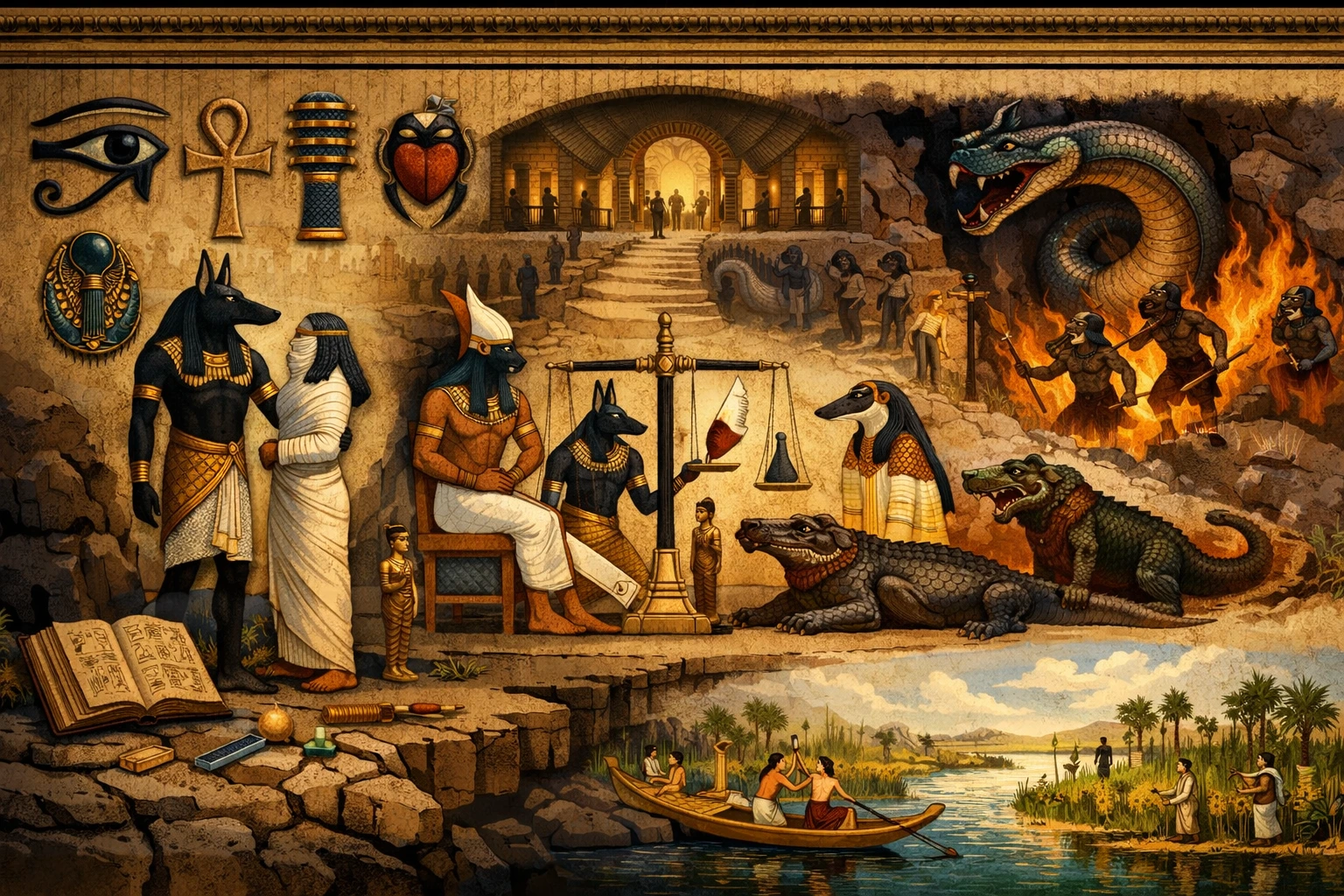
Spell 125 and the Weighing of the Heart
If the Book of the Dead has a “most famous scene,” it’s this one:
Spell 125: The Weighing of the Heart.
It’s the ancient Egyptian moment of truth—the cosmic checkpoint that decides whether you move forward or vanish.
The courtroom cast: who’s who?
In the classic judgment scene:
- Anubis brings the deceased into the judgment space.
- The heart is weighed against Ma’at (often shown as a feather), symbolizing truth and right order.
- Thoth is associated with recording the outcome.
- Osiris presides as a ruler of the afterlife in many depictions.
- Ammit waits nearby—the terrifying “devourer” who ends the story if you fail.
Museum and educational sources repeatedly describe Spell 125 as a central moment where the heart is weighed against Ma’at.
The Negative Confession: proving you belong
Spell 125 also contains what’s often called the Negative Confession—a long series of declarations of innocence.
Instead of saying, “Here’s what I did,” the deceased says, in effect: “Here’s what I did not do.”
It’s part moral statement, part legal defense, part sacred performance.
The terrifying idea of “second death”
Failing judgment didn’t just mean “no paradise.”
It meant annihilation—being removed from existence in the afterlife.
That’s why the Egyptians didn’t treat morality as a casual suggestion. They treated it as the foundation of cosmic safety.
Amulets: The Physical Magic You Could Hold
If spells are the words, amulets are the hardware.
Egyptians didn’t separate “religion” and “tools” the way we often do. They layered protection—text, image, object—until the afterlife journey looked almost engineered.
Heart scarab: the amulet with a job to do
The heart scarab is one of the most famous funerary amulets because it connects directly to judgment.
In simple terms: your heart can betray you.
So Egyptians used protective magic to make sure it didn’t.
Scholarly summaries note that certain “heart” spells were associated with scarabs and the heart’s role in judgment contexts.
Eye of Horus, ankh, djed pillar: protection, life, stability
Even if you’ve never read the Book of the Dead, you’ve probably seen these symbols:
- Eye of Horus (Wedjat): protection and wholeness
- Ankh: life—often understood as life that continues beyond death
- Djed pillar: stability and endurance (often linked with Osiris in funerary symbolism)
Museums frequently contextualize these objects as funerary protection items found with the deceased (including djed and wedjat pieces).
Why spells and amulets belong in the same story
The Book of the Dead makes more sense when you stop treating it as “literature.”
It’s closer to an afterlife system:
- Spells give you knowledge, identity, permissions, and power.
- Amulets give that power a physical anchor—something placed with you, on you, around you.
Words + objects = layered protection.
And that’s why this “death book” feels strangely alive.
Why We Still Can’t Look Away
We keep returning to the Book of the Dead for one reason:
It admits what humans rarely say out loud.
That death is not just an ending—it’s an unknown territory, and we crave a map.
The British Museum describes the Book of the Dead as a practical set of spells to help reach the afterlife, reflecting how real and risky that journey felt.
The Fitzwilliam Museum frames spells as help through danger, with Spell 125 at the center of judgment and survival.
So when you read it today, you’re not just reading ancient Egyptian religion.
You’re reading an ancient solution to a modern fear:
What happens when we don’t know what happens?