Raijin and Fujin: The Thunder and Wind Gods Behind Japan’s Most Famous Storm Stories
Introduction
You’ve probably felt it: the air turns sharp, the sky darkens, and suddenly the world sounds bigger—thunder cracking overhead, wind pushing at doors like it has hands.
Here’s the twist: in Japan, storms were never just “weather.” For centuries, they were treated like a message—sometimes a warning, sometimes a blessing, sometimes a guardian standing watch.
And two figures kept showing up in that message: Raijin and Fujin.
Who Are Raijin and Fujin in Japanese Mythology?
In Japanese mythology, Raijin and Fujin are the storm duo people remember first: the thunder god and the wind god. They’re often portrayed together because storms don’t arrive in pieces. Wind builds, clouds churn, thunder answers.
That pairing also made them perfect symbols of nature’s double-edge:
- storms can destroy homes and crops,
- but they can also bring rain, cool heat, and reset the land.
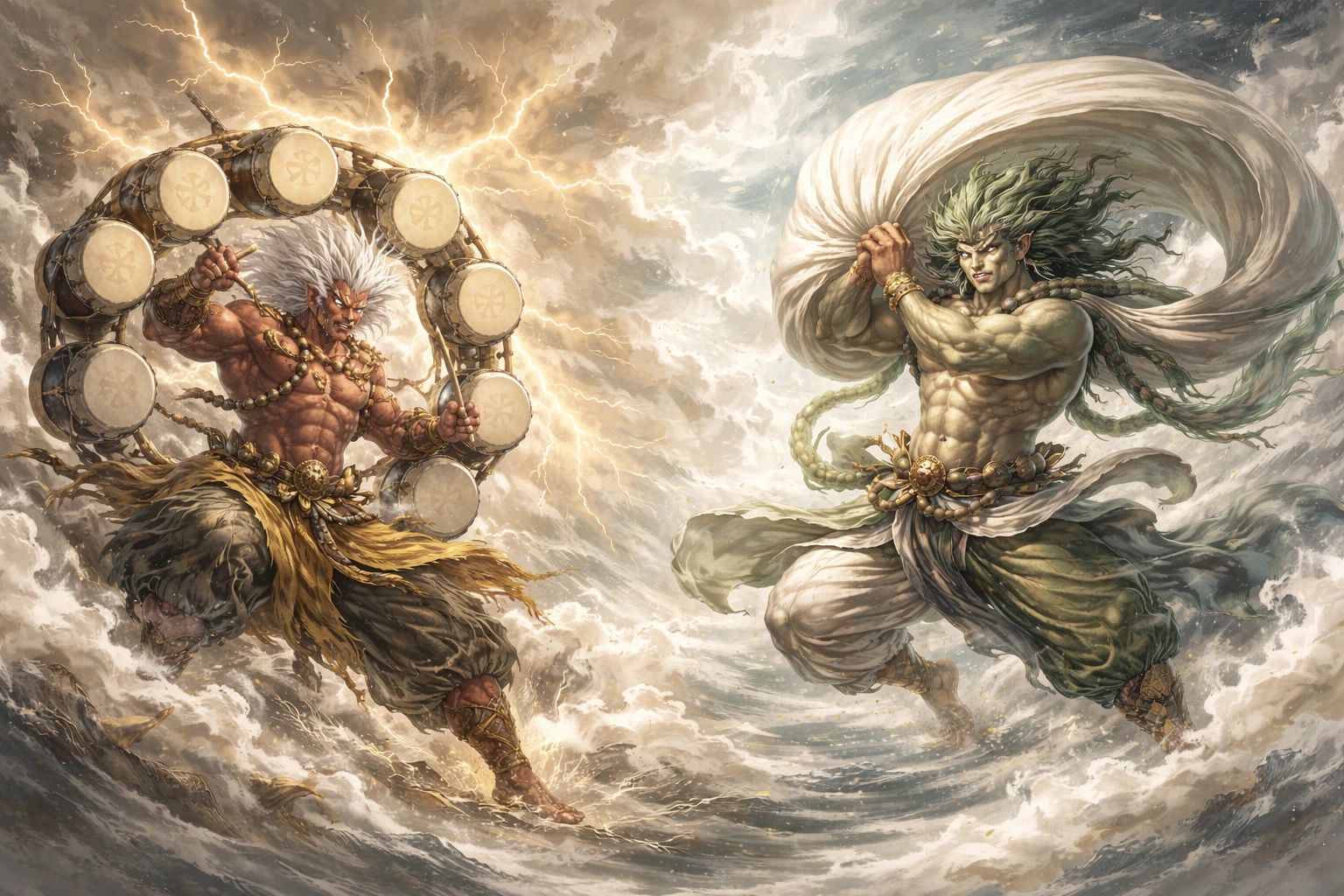
In many depictions, Raijin and Fujin look fierce—muscular bodies, wild hair, intense expressions. That’s not random drama. It’s a visual reminder that nature isn’t “nice” or “mean.” It’s powerful.
Raijin the Thunder God: Symbols, Stories, and Meanings
When people say Raijin, they usually mean the booming force behind lightning and thunder. One reason he’s so easy to spot in art is his signature gear: a ring of drums.
Thunder drums and what they represent
Raijin is commonly shown beating drums to create thunder—an image that turns an invisible sound into something you can see. It’s myth doing what it does best: giving a shape to the ungraspable.
In other words, thunder isn’t “random.” It’s caused. And if it’s caused, people can respond to it—through prayer, offerings, rituals, and respect.
Fear vs. protection: why farmers respected storms
Here’s the part many quick blog posts skip: Raijin isn’t only feared. He’s also treated as protective, especially in farming communities.
Rain means survival. Storm seasons can be terrifying, but drought can be worse. So the thunder god becomes a complicated figure: dangerous, yet needed.
This is one of the most practical reasons Raijin and Fujin stayed important. They weren’t distant gods living in a separate universe. They were gods you could hear outside your house.
“Kaminari” and everyday folklore
Even today, thunder in Japanese is often called “kaminari.” Raijin is sometimes linked with that everyday language and with folk warnings told to kids during storms.
For parents reading this: that doesn’t have to be scary. It can be framed as a cultural way of saying, “Respect storms. Go indoors. Stay safe.”
Fujin the Wind God: The Bag of Winds and Nature’s Wild Card
If Raijin is the sound, Fujin is the pressure—the force that changes how everything moves.
He’s famously shown carrying a huge bag of wind. That “wind bag” is one of the most enduring images in Japanese religious art and storytelling.
The bag of winds and visual cues
In many depictions, Fujin looks like a supernatural being straining against his own power, gripping the bag as if it might burst.
That’s the mythic point: wind can be gentle, but it can also escalate fast. A breeze can become a gale. A helpful gust can become a storm front.
Helpful winds vs. typhoon winds
Wind mattered for everyday life—fishing, farming, travel, seasonal change. But Japan also faces intense storms, and wind becomes the “face” of those disasters.
So Fujin is often treated as a figure you don’t command. You negotiate with him through ritual and respect.
The “divine wind” story and what history supports
The most famous wind-linked story is the “divine wind,” often called kamikaze in popular retellings.
Historically, typhoons are strongly associated with disrupting Mongol invasion attempts in 1274 and 1281—events later mythologized as a providential wind that saved Japan.
Important nuance (especially for students and educators):
- The storms are part of historical discussion and sources.
- The “divine” framing reflects cultural interpretation layered onto real events.
That’s exactly where Raijin and Fujin live best—as mythic language for real human experiences.
Where You’ve Seen Them Without Realizing
Even if you’ve never searched “Raijin and Fujin,” you may have encountered them in images of Japan.
Temple gates and guardian imagery
Across Japanese temples and shrines, storm deities appear in protective roles—standing like supernatural security at entrances. Their fierce faces aren’t meant to frighten worshippers first. They’re meant to frighten away misfortune.
Kyoto highlights and what to look for
One frequently referenced location is Sanjūsangen-dō in Kyoto, famous for its sculpture collection and the presence of Raijin and Fujin among revered figures.
When viewing statues or paintings, look for:
- Raijin’s drums (often behind him),
- Fujin’s wind bag (often lifted or stretched),
- the sense of motion—knees bent, bodies angled, hair blown back.
That “movement” is part of the message: storms aren’t still.
Raijin and Fujin in Japanese Art
If there’s one artwork that made Raijin and Fujin unforgettable, it’s the famous folding screens attributed to Tawaraya Sōtatsu: the Wind God and Thunder God Screens.
Sotatsu’s folding screens and why they became iconic
The Kyoto National Museum describes these as a pair of two-fold screens from Japan’s Edo period (17th century), associated with Kennin-ji Temple in Kyoto.
Why do they hit so hard, even today?
Because the composition feels like a moment captured mid-storm:
- the figures float,
- the space feels boundless,
- the gold background makes them look like they exist outside ordinary time.
How the duo’s “motion” is painted into still images
Sotatsu’s genius is that the gods don’t look posed. They look like they’re doing something right now.
That matters culturally. Storms don’t wait for you to prepare. They arrive.
This is also why the duo works so well in modern design—tattoos, posters, game art. The imagery already contains drama, speed, and force.
What These Gods Teach: Balance, Respect, and Resilience
At first glance, Raijin and Fujin seem like “scary gods.” But their deeper role is about balance.
Storms are destructive. They’re also part of renewal. That’s a core logic in nature-based belief: you don’t worship nature because it’s gentle—you respect it because it’s real.
One simple Shinto-friendly idea
A useful way to think about many Shinto kami is this: they represent presences in the world—forces you live alongside.
So Raijin and Fujin become a cultural reminder:
- don’t pretend you control everything,
- prepare, adapt, and honor what you depend on.
Guidance for parents, students, and educators
For parents:
Frame these stories as “how people made sense of storms before modern science.” It builds empathy, not fear.
For students:
Track the trio: myth → art → history. You’ll understand why these figures persist.
For educators:
Use a compare-and-contrast: wind gods and thunder gods exist worldwide, but Japan’s paired visual tradition is unusually consistent and iconic.
Conclusion
The real secret of Raijin and Fujin is that they aren’t just characters in old stories.
They’re a cultural storm map—two symbols that helped people name what they couldn’t control, respect what they relied on, and find meaning in the loudest moments of nature.
So the next time thunder shakes the windows or wind turns a street into a tunnel of sound, you can remember: in Japan’s mythic imagination, you’re not just hearing weather.
You’re hearing Raijin and Fujin—the thunder god and wind god—still echoing through art, belief, and history.