The Hidden Meaning Behind Ahalya’s Curse: How the Ramayana Rewrites Redemption
Introduction
Before we even say her name, the story hides a secret in plain sight.
Ahalya isn’t remembered for what she built, learned, or loved.
She’s remembered for what happened to her.
And that twist—how one moment can swallow an entire life—is exactly why the Ahalya curse still unsettles readers today.
The Ahalya story in one breath (and why it still stings)
Ahalya is introduced in tradition as extraordinary—brilliant, beautiful, and placed inside an ascetic world of vows and discipline.
She is married to Sage Gautama, a powerful rishi.
Then comes the rupture: Indra disguise and deceit enter the hermitage.
In many tellings, Indra approaches Ahalya by taking the form of her husband.
However you’ve heard it—tricked, tempted, coerced, consenting—the fallout is the same: discovery, fury, and a punishment that feels bigger than a single act.
That punishment becomes the Ahalya curse.
And here is the part most modern readers feel in their bones: the curse doesn’t just punish an action.
It isolates a woman.
It turns her into a symbol.
The Ahalya story lingers because it isn’t only about desire.
It’s about how quickly society decides who deserves to be seen.
What the Ramayana actually says (and what later retellings add)
This is where things get interesting—and where the “hidden secret” lives.
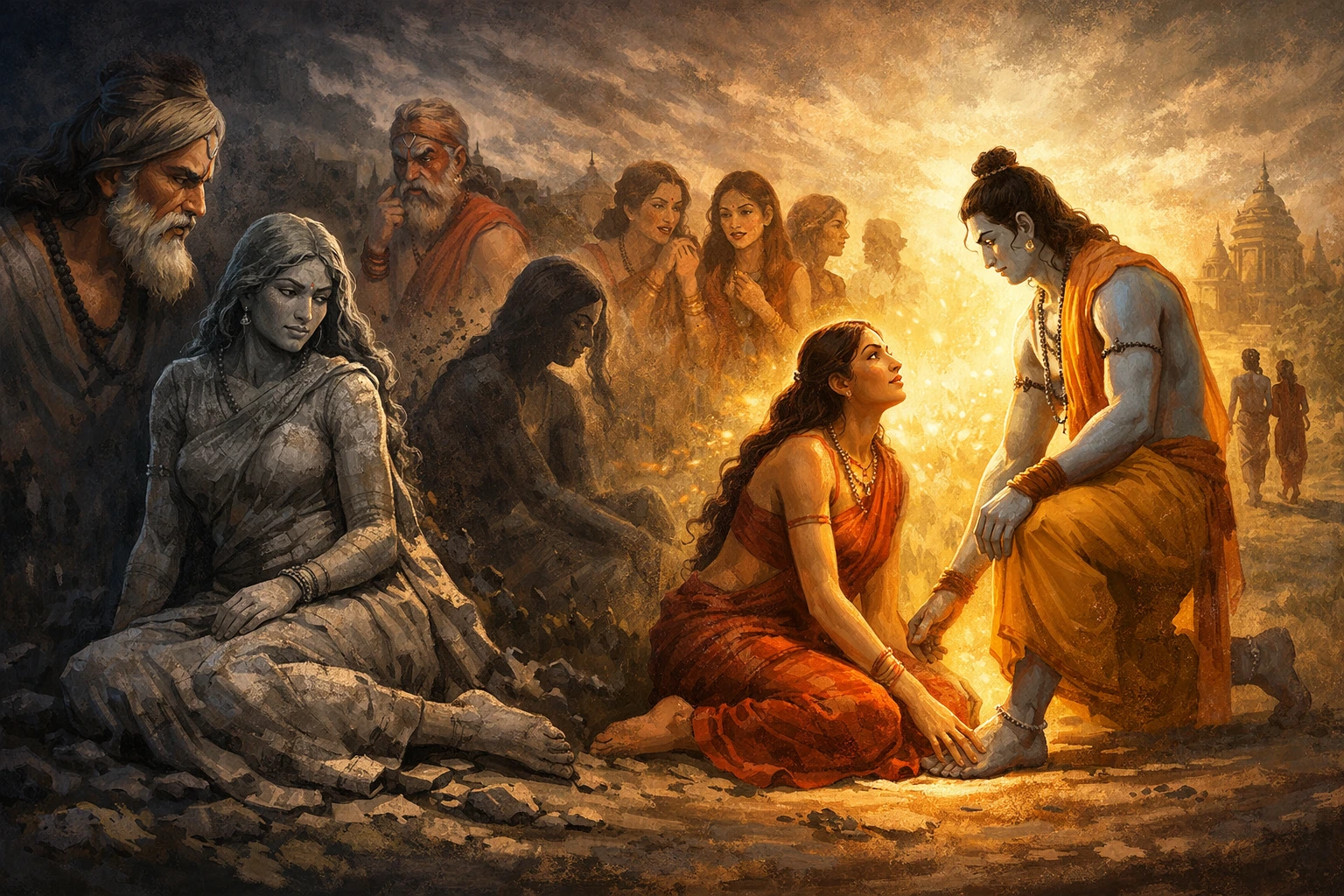
Many popular retellings say Ahalya was literally turned into stone.
That image is unforgettable: a living person locked into lifelessness, waiting for grace.
But several sources point out that versions vary, and Valmiki’s framing is often described differently—including the idea that she becomes unseen/invisible and undertakes severe penance until Rama arrives.
Valmiki’s framing: penance, invisibility, and a promised release
In the Bala Kanda episode, the curse is not presented as “hopeless forever.” It contains a hinge: Rama will arrive, and her suffering will end—often connected to the moment Rama becomes her guest and she offers hospitality.
That matters, because it shifts the theme from “condemnation” to “time + transformation.”
Ahalya is not simply erased.
She is placed into a waiting room of fate.
The “stone” motif: why it became iconic
Later retellings across regions often crystallize the story into one dramatic image: Ahalya as stone, released by Rama’s touch or footstep.
Why does the stone version dominate memory?
Because it’s visual.
Because it’s theatrical.
Because it turns an inner state—shame, numbness, social death—into something you can see.
Even if the details differ across texts, the metaphor hits with one clean blow:
when a person is treated as less than human long enough, they begin to feel like stone.
Why versions differ (and why that’s normal in myth)
The Ahalya episode travels through centuries of retelling, translation, and performance. As it moves, it picks up local values: stricter moral warnings in one place, more compassion in another, more symbolic interpretations elsewhere.
This isn’t a flaw of mythology.
It’s one of its main features.
A living story changes because people keep using it to think.
Indra, Gautama, Ahalya: three fault lines in one episode
To read the Ahalya Ramayana episode with honesty, it helps to name the tensions instead of smoothing them over.
Power, desire, and deception
Indra isn’t just a “romantic rival.”
He’s the king of gods—a figure of power.
When power desires, the question becomes unavoidable:
how free is the other person to say yes or no?
Many modern readers don’t want to reduce this to a single verdict (“Ahalya guilty” or “Ahalya innocent”).
That’s wise.
Myths often operate in moral fog—not to confuse you, but to force you to look longer.
Anger, judgment, and social exile
Sage Gautama reacts with anger, and his curse functions as social removal.
Even if we read it symbolically, it still lands as a statement:
a woman’s “fall” is public, while a powerful man’s wrongdoing often becomes a footnote.
Some traditions also describe consequences for Indra, but popular memory doesn’t hold onto those details as tightly as it holds onto Ahalya’s suffering.
That imbalance is part of what makes the story painful—and relevant.
Where responsibility is placed (and debated)
Different tellings place responsibility differently:
- Some portray Ahalya as deceived.
- Some portray her as aware.
- Some interpret the episode as an allegory rather than literal events.
Instead of pretending there is only one clean meaning, it’s more helpful to ask:
What does each version try to teach—and at whose expense?
Rama’s role: what “redemption” means here
The turning point is famous: Rama frees Ahalya.
But the deeper question is: what exactly is being redeemed?
Ahalya’s body?
Her social status?
Her dignity?
Her inner life?
Grace as restoration—not erasure
In the most humane reading, Ahalya redemption is not “Rama erases the past.”
It’s the opposite.
Rama’s presence restores what the curse removed: visibility, voice, belonging.
The story signals that a human being is not reducible to a worst moment.
And crucially, the episode often includes the idea that the curse had a promised end—Rama’s arrival is built into the arc.
That’s why this isn’t merely punishment.
It’s a narrative about return.
Compassion without denying harm
Modern readers sometimes worry that “forgiveness” sounds like excusing everything.
But mythic forgiveness doesn’t have to mean that.
A stronger interpretation is this:
- Harm happened.
- The response (social death, isolation) may have been excessive.
- Redemption is the decision to rehumanize.
That is forgiveness redemption as an ethical act: not forgetting, but refusing to freeze someone forever.
Reading Ahalya today (parents, students, educators)
Ahalya becomes even more powerful when we stop treating the story like a moral hammer.
Instead, treat it like a mirror.
For parents: how to tell the story without shame
If you’re sharing the Ahalya story with children or teens, keep the focus on three ideas:
- Deception is wrong, especially when power is involved.
- People can make mistakes—or be trapped in someone else’s scheme.
- No one deserves to be reduced to one moment forever.
A simple, age-appropriate line can be:
“Ahalya was judged harshly, but compassion helped her begin again.”
Avoid presenting it as “women must be careful” only.
That turns the myth into blame.
Instead, broaden it:
“Power can misuse trust. Communities can punish unfairly. Grace can restore.”
For students: themes you can use in answers and essays
If you’re writing about Ahalya Ramayana themes, these angles are strong:
- Dharma vs social judgment: what is “right,” and who decides?
- Penance and transformation: time as moral rebuilding, not mere suffering.
- Grace and restoration: redemption as re-entry into humanity.
- Myth variation: how stories shift across texts and eras.
A smart line for essays:
“The Ahalya episode reveals how myths negotiate guilt, gender, and grace through shifting retellings.”
For educators: discussion questions that stay humane
These prompts work well in classrooms without turning the discussion into victim-blaming:
- What changes when Indra is read as “power,” not just a character?
- Why might later retellings favor the stone motif over invisibility?
- Is redemption portrayed as personal change, divine mercy, or social acceptance?
- What does the story imply about how communities treat “transgression”?
- How do variations across sources change the moral center of the story?
Conclusion: the real “curse” Ahalya breaks
Here’s the hidden meaning that keeps the story alive:
The deepest curse isn’t stone.
It’s being permanently defined by one chapter.
Ahalya’s redemption is not just a miracle scene.
It’s a reminder that compassion can reverse social death.
Whether you read the episode literally or symbolically, the movement is the same:
from isolation to recognition, from judgment to dignity.
And that’s why the Ahalya curse still matters—because we’re still deciding, every day, who gets a second chance.