Bhadrakali: The Fierce Protector Goddess Who Defeats Evil
Introduction
There’s a strange pattern in Hindu mythology: whenever chaos gets “too loud,” the answer isn’t always another god with a bigger weapon.
Sometimes, the universe calls a protector—one who looks terrifying not because she’s cruel, but because she refuses to negotiate with evil.
That protector is the Bhadrakali goddess.
Who Is Bhadrakali?
The Bhadrakali goddess is widely understood as a fierce, protective form of the Divine Mother—often linked with Kali, and in many traditions connected with Parvati’s warrior energy.
If Kali represents time, transformation, and the fierce cutting-away of ego, Bhadrakali leans into something very specific:
Protection with zero hesitation.
Meaning of “Bhadrakali”
The phrase “Bhadrakali” is commonly explained as a blend of:
- Bhadra: auspicious, beneficial, protective
- Kali: time, change, transformation, the force that ends what must end
So Bhadrakali meaning isn’t “scary goddess.” It’s closer to:
“The auspicious power that ends evil so life can stay balanced.”
Bhadrakali’s role in Shakti (Divine Feminine power)
Shakti isn’t just softness or nurturing. In Hindu thought, Shakti includes:
- creating
- sustaining
- protecting
- destroying what threatens balance
Bhadrakali sits right at that protective edge—where compassion becomes courage.
The Myth Map: Where Bhadrakali’s Stories Come From
Here’s the part many articles skip: there isn’t only one neat, universal “Bhadrakali story.” India is a tapestry of regional traditions, temple histories, and local retellings.
Instead of forcing one version, it helps to think in “myth clusters.”
Darika Vadham (a Kerala tradition lens)
In Kerala’s ritual tradition, a famous narrative is the slaying of Darika (Darika vadham)—a demon story performed and remembered through living ritual theatre. In this storyline, Darika’s boon creates a loophole: he cannot be killed by a man, which calls forth a divine feminine force to restore order.
This is where Bhadrakali becomes unmistakable:
she isn’t summoned for drama—she’s summoned for dharma.
A quick note on “texts vs traditions”
Some readers meet Bhadrakali through Puranic motifs, some through temple culture, some through folk performance, and some through family lineage (kuladevi traditions).
That’s not a contradiction.
That’s how mythology stays alive.
When you read “Bhadrakali origin” in one place and a different version elsewhere, it often means you’re seeing two regional memory streams—both meaningful to the communities that preserve them.
Bhadrakali vs Kali: Same Power, Different “Job Description”
This is one of the most searched confusions, so let’s clear it up gently.
Same energy, different emphasis
Think of Kali and Bhadrakali like two expressions of the same cosmic principle:
- Kali: the power of time and transformation—ending illusions, ending ego, ending what is false.
- Bhadrakali: the protective expression of that power—ending what harms the innocent and destabilizes dharma.
In other words:
Kali transforms. Bhadrakali protects through transformation.
Fierce doesn’t mean “evil”
A common beginner mistake is to read Bhadrakali’s fierceness like a horror aesthetic.
But in mythology, “terrifying” often means:
- to tyrants
- to demons
- to forces that feed on fear
To devotees, Bhadrakali is approached as a guardian—especially in regions where she is a village protector or family deity.
Symbols and Iconography: What You’re Really Seeing
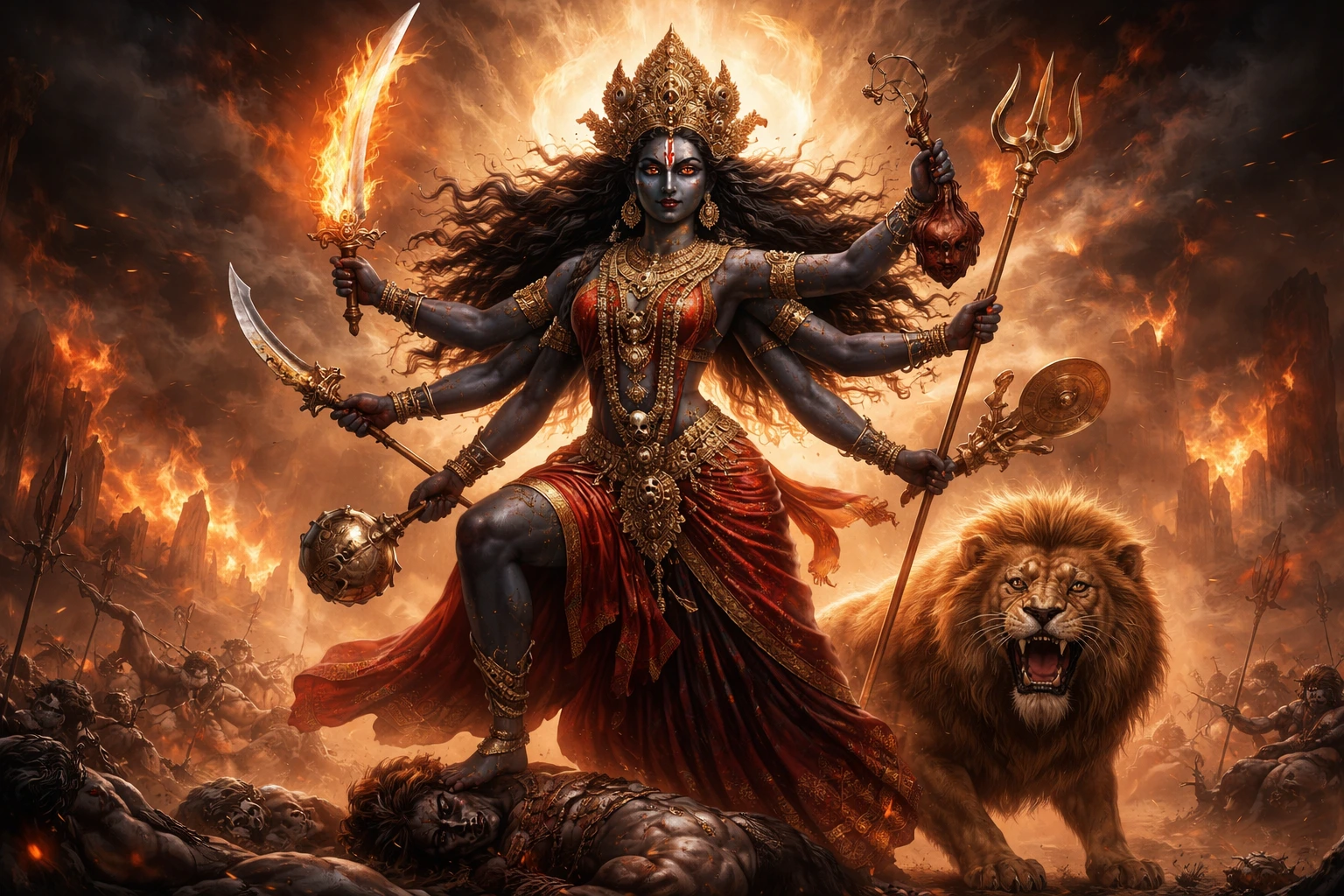
Bhadrakali images can look intense—multiple arms, weapons, strong eyes, sometimes a lion association.
Instead of taking this literally, read it symbolically.
Multiple arms and weapons
Multiple arms usually communicate capacity:
she can respond to many forms of chaos at once.
Weapons often represent inner tools:
- discernment
- courage
- the ability to cut through deception
- the strength to defend the vulnerable
The “protector logic”
Bhadrakali iconography is a visual message:
“If evil arrives armed, protection must arrive prepared.”
This is why devotees find her comforting.
The world can be unpredictable—but the protector isn’t.
How Bhadrakali Is Worshipped Across India
If you search Bhadrakali temples, you’ll quickly notice something: worship varies by region, but the emotional core stays consistent—protection, courage, and justice.
Kerala: temple culture + ritual arts (Theeyattu)
Kerala preserves Bhadrakali not only through daily worship, but through ritual performance traditions.
One well-known example is Theeyattu, a solo ritual practice performed in Bhadrakali temples, connected with elaborate floor art (kalamezhuthu) created from natural colour powders.
If you’ve ever wondered why goddess stories feel “alive” in Kerala, this is part of the reason:
the myth is performed, not merely read.
Other regions: local forms, local names
Across India, you may see Bhadrakali associated with:
- local temple legends
- regional festivals
- village protection traditions
- family deities (kuladevi practices)
A name may shift, a story detail may change—but the goddess remains recognizable by her role:
the one who protects when rules and reason fail.
Temple etiquette (simple and respectful)
If you’re visiting a Bhadrakali temple (or any Devi temple), a safe, respectful baseline is:
- dress modestly
- follow local customs on photography and footwear
- avoid interrupting rituals
- offer prayers quietly (no need for performative devotion)
- remember: you are entering a living tradition, not a museum
Festivals and Celebrations Dedicated to Bhadrakali
Bhadrakali is celebrated both through large festivals and temple-specific annual events.
Navratri context
During Navratri, devotees honour multiple forms of the Goddess over nine days. Depending on region and tradition, Bhadrakali may be remembered as the fierce protective force—especially when the focus is on battling inner and outer negativity.
Local jatras and temple festivals
Many communities have their own annual festivals centered on the goddess—processions, rituals, performances, offerings, and storytelling.
If you ever feel confused by the variety, remember:
Hindu festival life is local-first.
That locality is not a “lesser version”—it’s the tradition’s heartbeat.
Why Bhadrakali Matters Today
It’s easy to treat mythology as “old stories.” But the reason people still search Bhadrakali story and Bhadrakali meaning in 2026 is simple:
Modern life creates modern demons.
Not horned creatures—more like:
- anxiety that never stops talking
- injustice that feels untouchable
- fear that makes you smaller than you are
- environments where kindness is mistaken for weakness
Bhadrakali’s symbolism answers those pressures with one sharp idea:
Protection is sacred.
For students: courage and boundaries
Bhadrakali is a powerful symbol for:
- saying no without guilt
- defending your time and mental space
- staying steady when peer pressure gets loud
The goddess doesn’t “win” by pleasing everyone.
She wins by refusing to compromise with what’s harmful.
For parents: protection and justice
For parents, Bhadrakali can be a teaching symbol:
- protect children without controlling them
- build courage, not just comfort
- model values: truth, justice, responsibility
Protection isn’t panic.
Protection is clarity.
For educators: teaching fierce goddesses responsibly
If you’re an educator (or simply a thoughtful adult), here’s the balanced frame:
- don’t sanitize her into a “sweet” goddess only
- don’t sensationalize her as “violent”
- teach the function: she protects dharma
- connect it to ethics: defending the vulnerable, standing against harm
That is the heart of fierce divinity.
Conclusion
The Bhadrakali goddess isn’t revered because she is frightening.
She is revered because she is dependable.
When chaos rises, she rises higher.
When evil threatens, she doesn’t debate.
And when devotees feel exposed—emotionally, spiritually, or socially—Bhadrakali stands as a reminder:
Protection is also love. Just expressed with a sword of clarity.