The Lost City of Atlantis: The Secret Behind Plato’s Most Famous Mystery
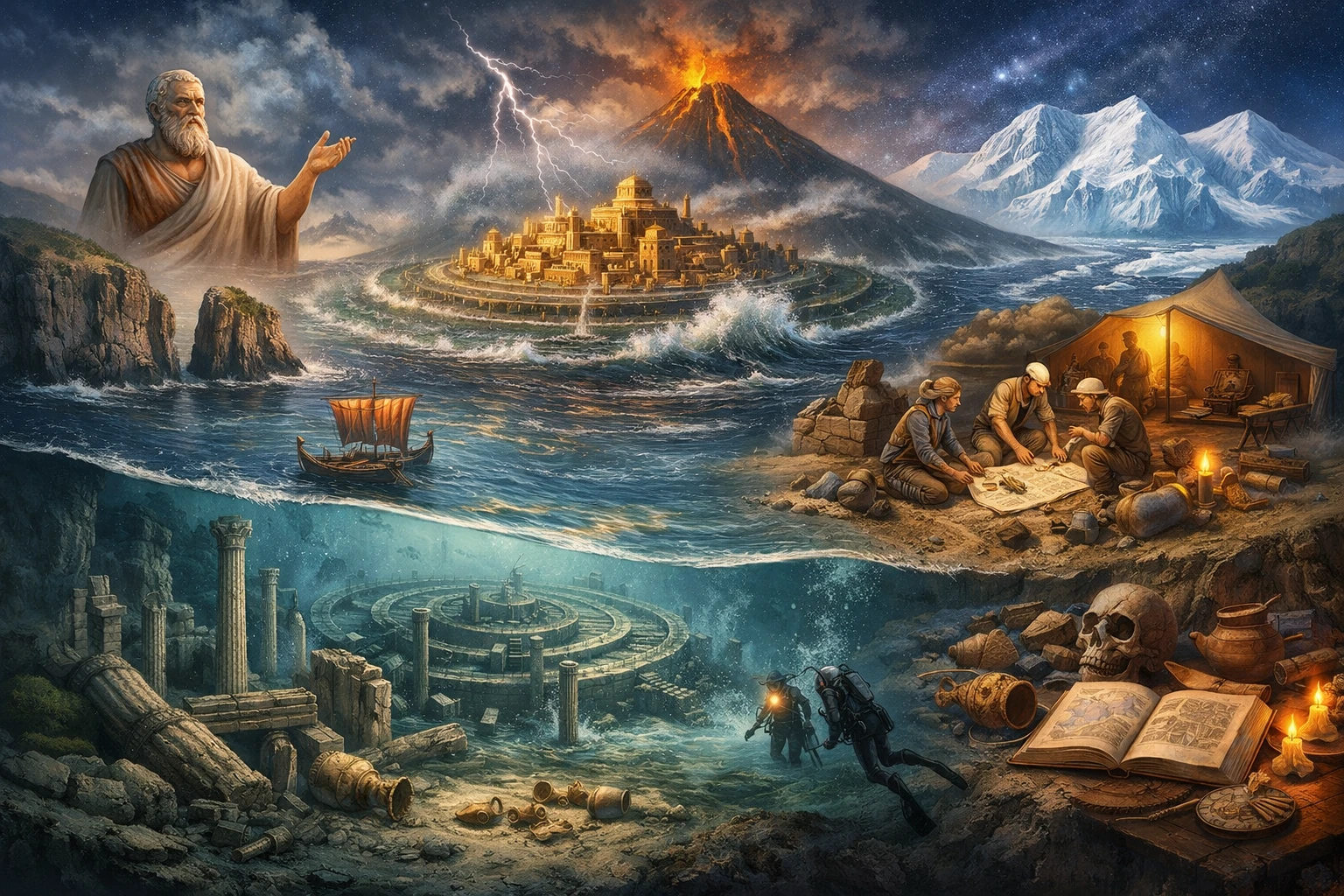
Introduction
There’s one detail almost everyone skips—and it changes the whole Atlantis story.
Not the rings of water. Not the gold. Not the “advanced technology.”
It’s why Atlantis appears in the first place.
Atlantis enters history like a rumor with a purpose—told as if it’s a record, shaped like a warning. And that twist is exactly why the lost city Atlantis still feels just one dive away from discovery.
Atlantis in Plato’s Words (Not Hollywood’s)
The Atlantis legend doesn’t start with archaeologists. It starts with a philosopher: Plato.
In Timaeus and Critias (written around 360 BCE), Plato describes a powerful island civilization located beyond the “Pillars of Hercules,” commonly associated with the Strait of Gibraltar. He portrays Atlantis as wealthy, impressive, and expansive—until it collapses in a catastrophic day and night.
Timaeus and Critias in one clear recap
If you’ve ever searched “lost city Atlantis” and felt instantly overwhelmed, here’s the clean version:
- Atlantis is introduced as a mighty naval power.
- It grows wealthy and dominant.
- It loses its moral balance—becoming arrogant and unjust.
- Then it’s destroyed in a cataclysm, swallowed by the sea.
That arc—rise, corruption, collapse—is the spine of nearly every retelling of the lost city Atlantis.
Pillars of Hercules—what it likely means on a modern map
The “Pillars of Hercules” detail is a big reason the Atlantis location debate never ends. Plato’s phrase has often been linked to Gibraltar, a natural gateway between the Mediterranean and the Atlantic.
But “linked to” doesn’t mean “proves.” It’s a clue in a story, not a GPS coordinate.
Was Atlantis Real—or a Brilliant Warning Story?
Here’s the hidden secret: Atlantis may be less like a missing city, and more like a mirror.
Many modern summaries emphasize that scholars often read Atlantis as a philosophical tale about power, morality, and what happens when societies worship wealth more than wisdom.
Why many scholars read Atlantis as allegory
Plato wasn’t writing like a modern historian. He was building arguments—using dialogue, symbolism, and dramatic examples.
That’s why some of the most credible modern sources treat the lost city Atlantis as an invented myth serving a moral purpose: a warning about hubris, imperial ambition, and ethical decay.
In other words: Atlantis works even if it never existed—because the lesson still does.
Why the story feels historical anyway
Atlantis feels real because it’s written like a real report:
- It’s anchored to a named storyteller chain.
- It includes geography (“Pillars of Hercules”).
- It describes politics, wealth, and conflict in detail.
- It ends in a vivid disaster that sounds like a remembered catastrophe.
This is exactly how powerful myths behave: they borrow the texture of history.
That texture is also why people keep asking, “Is Atlantis real?” even when the evidence stays elusive.
The Top Location Theories (And What Evidence Can—and Can’t—Do)
Let’s treat the Atlantis location debate fairly: theories exist on a spectrum.
Some are “possible inspiration.” Some are “interesting guess.”
Some are “fun, but not evidence.”
Santorini/Crete and the Minoans
This is the most mainstream “inspiration” route.
The idea is simple: the Minoan world in the Aegean was sophisticated, connected by sea, and affected by dramatic natural events. Some sources describe how a major eruption and tsunamis could have shattered regional stability—creating the kind of disaster memory that later stories reshape.
Important nuance: saying “Minoans influenced the story” is not the same as saying “Minoans were Atlantis.”
For students: this is a classic case of myth + memory blending over time.
Azores/Atlantic guesses
The Azores idea stays popular because it sits in the Atlantic and “feels” compatible with the beyond-Gibraltar framing.
But the challenge is scale and proof. Claims often rely on imagined sunken landmasses rather than direct archaeological evidence tied to Plato’s timeline and description.
Spain and other “near Gibraltar” proposals
Many hypotheses cluster around “close enough to the Pillars” to feel plausible.
This is where it helps to ask a research-minded question:
What would we expect to find that clearly links a site to Plato’s Atlantis, not just to a flood story?
Without inscriptions, datable architecture, and cultural traces, “possible” stays “possible.”
Antarctica and why it persists
Antarctica is the most cinematic theory—and that’s partly the point.
It survives because Atlantis isn’t just a place in people’s minds. It’s a symbol of a hidden world, buried truth, and lost greatness. Even credible journalism notes how “pick a spot” speculation keeps multiplying.
So yes: Antarctica is a stretch.
But it reveals something real—our craving for mystery.
If Atlantis Were Found Today, What Would Count as Proof?
If tomorrow’s headline screamed “lost city Atlantis discovered,” what should you look for before believing it?
What archaeologists would look for
A serious claim would need more than underwater shapes.
Stronger evidence would include:
- Datable human material (tools, ceramics, building remains) tied to a known period.
- Cultural continuity showing a real society, not random stones.
- Context: harbors, roads, settlements—signs of lived life, not just geometry.
- Peer review and multiple independent teams confirming results.
Why “underwater shapes” aren’t enough
Our brains are pattern-finders. We see circles, grids, and walls everywhere—especially in blurry sonar images.
Some science explainers also point out geological constraints on the dramatic “continent sank” version of the Atlantis legend, stressing that tectonics and ocean-floor mapping don’t support a giant landmass simply dropping beneath the Atlantic in recent human time.
For educators: this is a perfect lesson in the difference between:
- A compelling image, and
- A tested claim
Why We’re Still Obsessed With Atlantis
People don’t chase the lost city Atlantis only for treasure.
They chase it because Atlantis sits at the intersection of three powerful desires:
- The desire to discover something no one else has seen
- The desire to believe our past is deeper than our textbooks
- The desire to find a lesson inside a legend
The psychology of lost worlds
Atlantis is a “perfect mystery.” It’s specific enough to imagine, but vague enough to relocate anywhere.
And it gives us a safe way to explore big questions:
- Can great societies collapse overnight?
- Does wealth weaken character?
- Do we repeat the same mistakes in new forms?
That’s why reputable sources keep emphasizing the moral architecture of the story, not only the map.
A myth-literacy takeaway (students, parents, educators)
For students: Treat Atlantis like a research gym. Start with Plato. Separate primary sources from later commentary.
For parents: Encourage wonder, but reward evidence. Ask “How do we know?” before “What if?”
For educators: Use Atlantis to teach sourcing—how a single origin text can spawn centuries of claims.
Atlantis doesn’t need to be “real” to be valuable. It needs to be read well.
Conclusion: Keep the Wonder, Keep the Standards
The greatest trick of the lost city Atlantis is that it makes you feel like the answer is hiding just beyond the horizon.
But the deeper secret is this: Atlantis is also a test—of curiosity, of skepticism, and of how we handle stories that sound true.
Read it as a myth, and you gain a warning about power.
Study it as history, and you learn how evidence works.
Hold both at once, and you get the best version of the Atlantis legend: wonder with wisdom.