Osiris: The Myth, Birth, and Succession of Egypt’s Beloved God of the Afterlife
Introduction
There’s a secret hiding in plain sight in the Osiris myth: the story isn’t really about death.
Not first.
It’s about what happens after the worst thing—when the world fractures, when trust breaks, when a family turns against itself… and someone still decides to rebuild.
If you’ve ever wondered why Osiris became the most beloved god of the Egyptian afterlife, the answer isn’t just “mummies” or “judgment.” It’s the twist that comes after betrayal: Osiris doesn’t “win” by returning to life—he wins by transforming what death means.
Meet Osiris (Without Spoilers… Yet)
Osiris is often introduced as the god of the dead—but in Egyptian thinking, that label is too small.
He’s also:
- a symbol of renewal (often shown with green skin),
- a model of rightful kingship,
- and the ruler who makes the Egyptian afterlife feel ordered rather than terrifying.
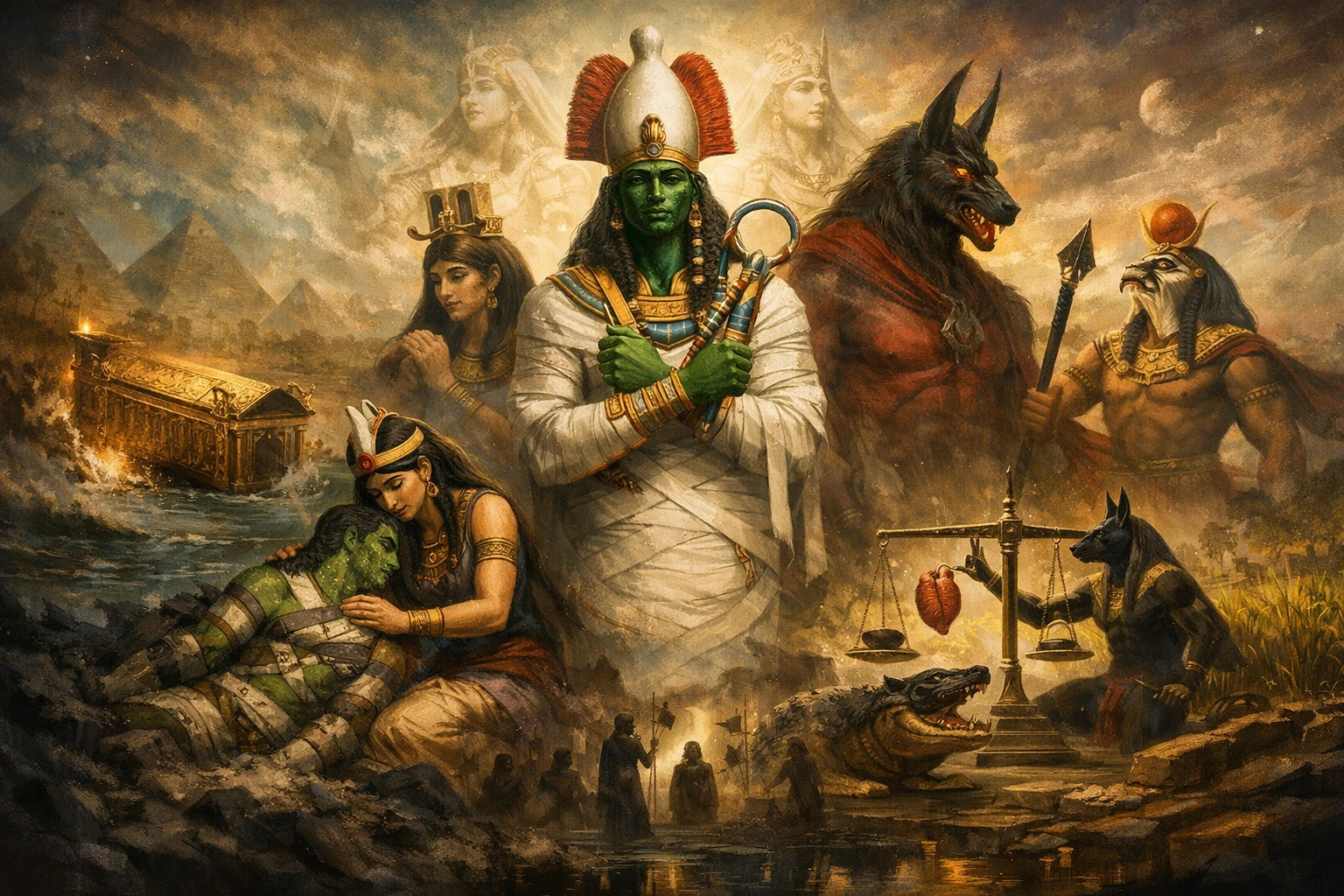
You’ll usually see Osiris in mummy wrappings, holding the crook and flail—icons of rule, not horror. The message is subtle: death is not chaos. Not if Osiris is in charge.
Symbols you’ll recognize quickly
- Green skin: regeneration, growth, return of life.
- Mummy form: preservation, continuity, ritual order.
- Crook + flail: kingship, protection, authority.
The Divine Family Tree
Osiris is part of a tightly wound divine family: born to Geb (earth) and Nut (sky), with siblings Isis, Set, and Nephthys.
If you’re reading with students (or just want clarity), here’s the easiest way to remember the roles:
- Osiris: order, rightful rule, renewal, the dead.
- Isis: devotion, protection, powerful restoration magic.
- Set: storms, the desert, disruption—chaos pushing against order.
- Nephthys: support in mourning and protection, often beside Isis.
This matters because the Osiris myth is a family story first—and a cosmic story second.
The Golden Reign — Why People Loved Him
Before the tragedy, the Osiris myth often frames him as a “good king.” Some tellings describe him teaching people agriculture and law—basically transforming Egypt from raw survival into civilization.
That’s why the betrayal stings: Set doesn’t overthrow a tyrant. He targets a ruler the people actually want.
A quick word on “maat”
“Maat” is one of the keys to Egyptian mythology. It’s truth, balance, right order—the feeling that the universe is aligned.
Osiris represents that alignment.
Set attacks it.
So when Osiris falls, it’s not just one death. It’s the fear that the world can slide back into chaos.
The Trap — Set’s Jealousy and the Famous Chest
Here’s where the Osiris myth turns into a thriller.
Set hosts a banquet and unveils a beautifully made chest (or box/coffin) as a “gift.” The rule is simple: whoever fits perfectly inside gets to keep it.
Everyone tries. No one fits.
Then Osiris lies down—and the chest snaps shut. Set and his allies seal it and send it away, effectively killing him.
This chest episode is especially famous in later retellings (including Greek-era accounts that shaped modern versions). The important point for readers: myths have layers. Egyptian sources can be fragmentary; later writers often narrate more smoothly.
But the emotional truth stays consistent:
- Osiris trusts.
- Set exploits trust.
- The world pays the price.
Isis’s Search — The Most Human Part of the Myth
If Osiris is the symbol, Isis is the engine.
She searches.
She mourns.
She refuses to accept that betrayal gets the final word.
Many tellings describe her retrieving Osiris’s body—only for Set to strike again by dismembering it and scattering the pieces.
The “14 pieces… or 42?” question (and why it’s not a problem)
You’ll often hear “fourteen pieces.” Britannica repeats the Plutarch-style version with 14.
But other traditions connect the dismembered parts to Egypt’s provinces (nomes), which can raise the number as high as 42 in later developments.
So which is “right”?
In mythology, sometimes the honest answer is: both are real in their own contexts.
For students: treat it like different editions of a story.
For educators: it’s a perfect moment to teach how oral/ritual traditions evolve.
Resurrection, But Not a Return
Isis gathers what she can, reassembles Osiris, and restores him through ritual power—often described with linen wrappings and the return of breath.
Here’s the twist most quick summaries miss:
Osiris doesn’t come back to sit on the same throne and rule the same way.
Instead, he becomes the ruler of the underworld—the lord of the Duat, the one who holds the afterlife together with judgment and order.
That transformation is the heart of the Osiris myth:
- He is murdered by chaos.
- He is reassembled by devotion.
- He becomes the structure that chaos can’t break again.
The Succession — Horus, Legitimacy, and Justice
Osiris’s story doesn’t end with resurrection. It continues through succession.
Horus—often described as Osiris’s son with Isis—becomes the rightful claimant to the throne and the force that challenges Set’s takeover.
Some versions stage this conflict as violence; others emphasize judgment by a divine tribunal. Either way, it’s not just an action sequence.
It’s a political idea:
- Legitimate rule matters.
- Chaos can seize power, but it cannot justify power.
- Order must be restored—not because it’s “nice,” but because it’s necessary.
For modern readers, this is why the Osiris myth remains so readable. It’s not abstract theology. It’s an argument about what makes a world livable.
Osiris as Judge — Weighing of the Heart
Now we reach the part that made Osiris feel personal to everyday people: judgment.
In the classic image, the heart is weighed against the feather of Ma’at (truth and right order). If the heart is light, the soul can pass on toward a blessed afterlife often described as the Field of Reeds.
If not, the soul faces obliteration—often personified by a devouring figure (Ammit).
Two key takeaways for readers:
- This isn’t “random fate.” It’s moral accountability.
- Osiris isn’t just scary—he’s stabilizing. He makes the afterlife make sense.
That’s why he became so beloved: Osiris turns the unknown into a system with rules.
Why Osiris Still Works on the Modern Mind
People don’t keep retelling myths for thousands of years unless the story solves something.
The Osiris myth solves several human problems at once:
- Grief: love doesn’t stop at the edge of loss.
- Injustice: betrayal can win a moment, not the meaning.
- Fear of death: death isn’t the end of order—order can be reborn.
And there’s a quieter, modern lesson too:
Osiris doesn’t “undo” what happened.
He builds a new role from it.
That’s resilience without denial.
If you’re reading as a parent, this is a gentle way to frame the myth:
- You can acknowledge hard things.
- You can still create safety and justice afterward.
If you’re reading as a student or educator, this is the myth’s staying power:
-
It’s theology, yes—but also psychology, politics, and ethics.
Conclusion
The Osiris myth begins with a god-king, a jealous brother, and a trap that seems final.
But it ends with something stranger—and stronger:
a new kind of victory.
Osiris becomes the judge who holds the Egyptian afterlife together, Isis becomes the symbol of devotion that rebuilds what was shattered, and Horus becomes the answer to the question every society asks: who deserves to rule?
And that’s why Osiris remains beloved. Not because he avoided death.
Because he transformed it.