The Enigmatic Teke Teke: Japan’s Terrifying Urban Legend (And Why It Won’t Let Go)
Introduction
You know that moment when you’re walking at night and you hear something behind you—too rhythmic to be wind, too close to be imagination?
Now picture this: the sound gets faster when you speed up. It copies you. Like it’s testing you.
And then you realize the sound isn’t footsteps.
It’s scraping.
Before we even say her name, that’s the trick of the Teke Teke urban legend: it makes you feel chased while you’re still pretending you’re safe.
Who (or What) Is Teke Teke?
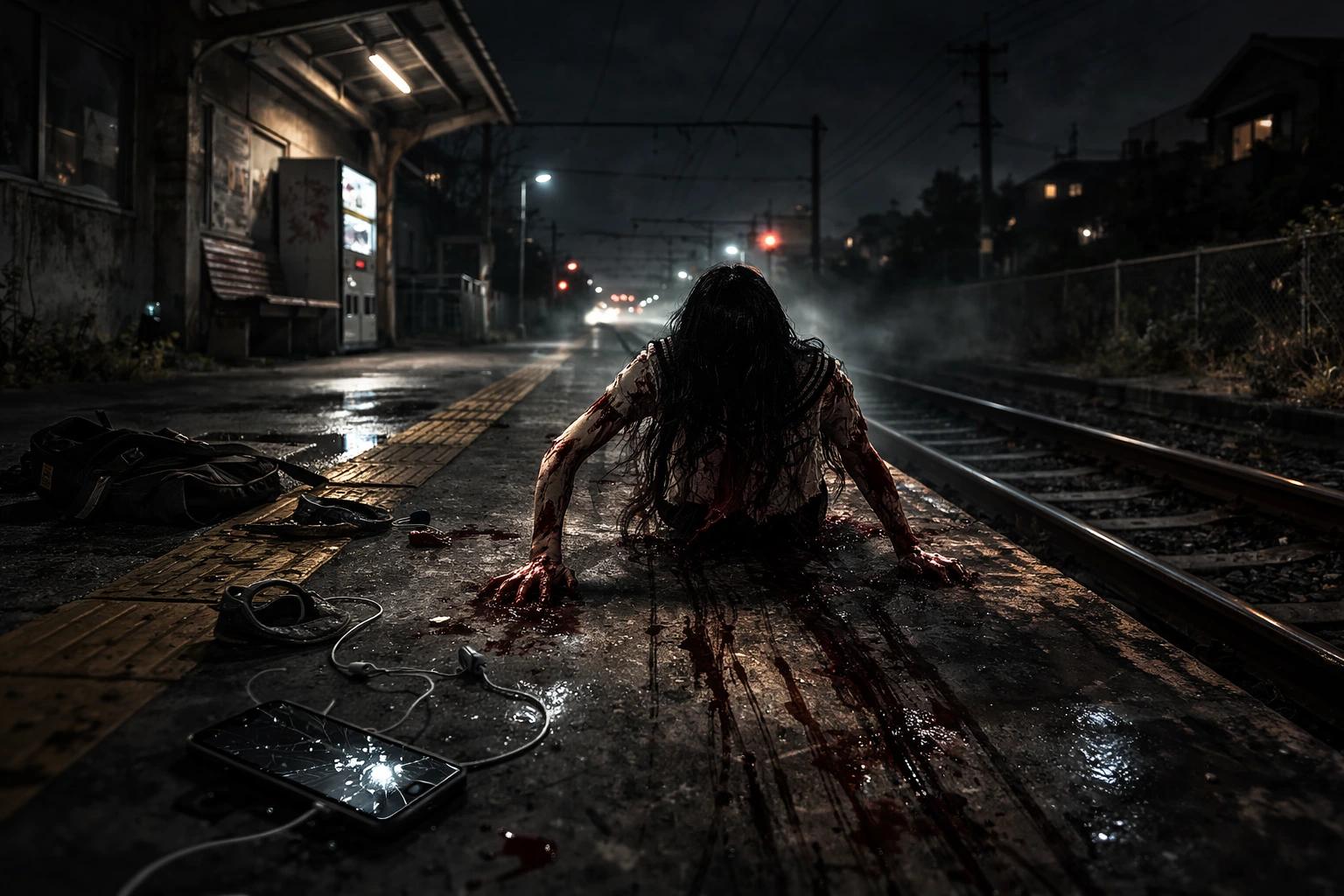
At its simplest, Teke Teke is a Japanese urban legend about a vengeful spirit—often described as a schoolgirl or young woman—whose body was cut in half by a train, leaving her to move with only her upper body.
She doesn’t walk.
She pulls herself forward with her hands or elbows.
And the sound that gives her the name—“teke…teke”—is the scrape of her movement across the ground.
The core legend in one chilling minute
Most retellings keep the same spine of terror:
- She appears late at night, often near train stations or empty streets.
- You hear the scraping before you see her.
- If you look back—or if she notices you—she chases.
- She’s impossibly fast for someone missing half a body.
- If she catches you, she kills in a way that mirrors her own fate.
Why the “teke…teke” sound matters
Monsters that roar are loud and obvious.
Teke Teke is worse because she announces herself the way real danger does: subtle, repeating, getting closer.
That sound turns the legend into a mini horror film you can’t unhear once it’s in your head.
The Origin Story: Tracks, Trauma, and a Split-Second Horror
The origin varies by version, but the gravitational center is consistent: railway tracks and a violent separation between “before” and “after.”
Wikipedia’s summary captures the most widely repeated core: she was split in half by a train, and returns as an onryō—a vengeful spirit—roaming urban spaces and stations at night.
The train-track motif (and why it’s so common)
Train stations have a built-in horror logic:
- They’re transitional spaces—no one belongs there for long.
- They’re loud, fast, and indifferent.
- One mistake becomes irreversible.
Urban legends love places where life can change instantly, because that’s what fear is: a sudden flip from normal to nightmare.
Onryō energy: vengeance as unfinished pain
Many retellings categorize Teke Teke as an onryō, the archetype of a wronged spirit that can’t move on.
Even if you don’t “believe,” this framing matters because it explains why the story sticks:
Teke Teke isn’t evil for fun.
She’s trapped.
The legend turns trauma into a creature—one that repeats its ending forever, and drags other people into the repetition.
The Encounter Rules: The Chase, the Question, the No-Win Feeling
Every great urban legend has rules, even when it pretends it doesn’t.
With Teke Teke, the “rule” is psychological:
If you hear it, you’ll want to confirm it.
If you confirm it, you’ve already lost.
Why “don’t look back” is a universal fear trigger
“Don’t look back” shows up in folklore worldwide because it attacks something human:
We would rather see danger than imagine it.
But the legend flips that instinct—curiosity becomes the trap.
And if you do look, the story insists the consequence is immediate.
That’s the nightmare fuel: no time to negotiate.
Kashima Reiko overlap (what’s shared, what differs)
Online and modern retellings often blend Teke Teke with a related figure: Kashima Reiko, another “missing legs” spirit who appears in certain versions with a question-and-answer ritual.
In Kashima Reiko stories (as documented in long-form legend profiles), the spirit may ask a sequence of questions—often about her legs, who told you, and her name—with “wrong answers” leading to violent punishment.
Here’s the useful takeaway for readers:
- Teke Teke is usually a chase legend (sound → sight → sprint).
- Kashima Reiko is often a ritual legend (questions → “correct” responses → survival).
They overlap because urban legends mutate the way rumors do: they borrow the scariest parts from each other and fuse.
What the Legend Is Really Teaching
The surface story is gore and speed.
The deeper story is human behavior.
Safety story: why “alone at night near tracks” shows up
JapanTravel’s broad overview of Japanese urban legends describes Teke Teke as a malicious spirit haunting urban areas and train stations at night—an implicit warning: night + isolation + risky infrastructure equals danger.
That’s folklore doing what it has always done:
It turns “please be careful” into something unforgettable.
Because people forget advice.
They don’t forget a scraping sound behind them.
Bullying/neglect themes and modern morality echoes
Some versions lean into cruelty—people mocking someone, abandoning someone, failing to help.
Even when the details differ, the emotional logic stays:
If suffering is ignored, it returns.
Not as a lesson.
As a haunting.
Trauma loop: repeating the moment you can’t escape
This is why Teke Teke feels different from a random monster:
She doesn’t have a “goal.”
She has a memory.
The legend imagines trauma as motion:
- always forward,
- always repeating,
- never resolving.
That’s why she’s fast. That’s why she doesn’t stop.
She’s not chasing you as you.
She’s chasing the world that didn’t save her.
Why Teke Teke Thrives in Modern Horror
If the legend were only about violence, it wouldn’t last.
It lasts because it’s portable.
You can tell it in a classroom whisper.
You can post it online.
You can adapt it into a scene with one sound effect and a shadow.
Urban legends as “shareable nightmares”
A good urban legend has:
- a hook (scraping sound),
- a setting (station, street, late night),
- a villain (half-body spirit),
- a consequence (she catches you),
- a repeatable ending (tell it again).
That structure is basically made for the internet.
Pop culture echoes (film/manga/anime energy)
Even when people haven’t heard the name “Teke Teke,” they’ve seen the influence: crawling figures, impossible speed, the horror of being pursued in a place that should be ordinary.
The legend sits comfortably beside other Japanese horror staples because it shares a core theme:
The everyday world is thin.
And something can slip through.
Why half-seen monsters are scarier than gore
Teke Teke is terrifying not because you see everything.
But because you imagine the rest.
The mind fills in:
- the sound under your feet,
- the sudden glance back,
- the shape you can’t explain.
That’s also why the legend survives across versions.
You don’t need perfect consistency when the fear is doing the heavy lifting.
If You’re Reading This at Night…
Let’s make this useful, not just spooky.
A respectful way to enjoy horror folklore
Folklore often borrows from real-world fears (like accidents near tracks). Enjoying the story doesn’t require treating tragedy lightly.
A good approach is to hold two truths at once:
- As a legend, it’s fiction that teaches through fear.
- As a motif, it echoes real dangers and real grief.
Parents / students / educators: how to talk about it safely
For parents
- Tell it in daylight first.
- Ask what part felt scariest—sound, chase, or unfairness.
- End with grounding: “Legends are stories; safety rules are real.”
For students
- Compare two versions and circle what changed (weapon, questions, setting).
- Notice what didn’t change (sound, speed, tracks, consequence).
For educators
- Use it as a folklore lens: motifs, urban anxieties, modern rumor spread.
- Discuss why stations and transit become “haunted spaces” in stories.
And if you ever do find yourself alone at night near a station…
Maybe don’t sprint.
Just… don’t add a scraping sound to your imagination.
Conclusion
The Teke Teke urban legend endures because it’s not only frightening—it’s efficient.
A sound.
A glance.
A chase.
A consequence.
But underneath the horror is something more human: a story about danger, neglect, and how trauma gets retold until someone finally listens.
If you heard “teke…teke” behind you, you’d run.
But if you heard a person in pain, would you stop?
That question is why the legend won’t let go.