Jesus and Hinduism: The Surprising Similarities—And the Important Differences
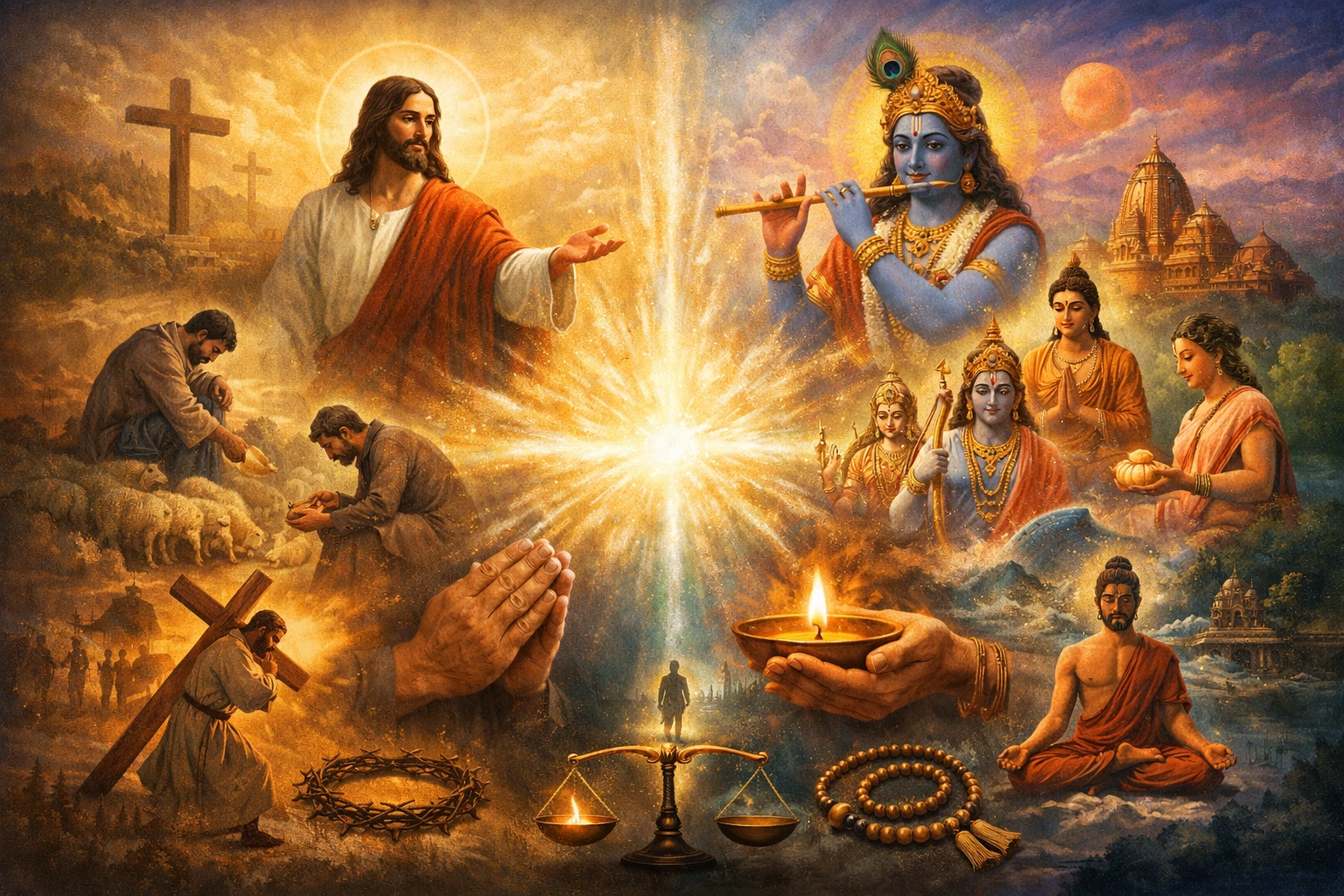
Introduction
Something strange happens when people compare religions.
They start by looking for what’s different… and accidentally uncover what feels like a shared fingerprint.
You might notice it in the language of “God coming close,” in stories of divine compassion, or in the way devotion reshapes a life from the inside out. That’s where many readers first stumble into the topic of Jesus Hinduism similarities—and realize the comparison is more nuanced than a quick “same vs different.”
The “Hidden Bridge” People Notice First: Incarnation and Avatar
When people search for Jesus Hinduism similarities, the first comparison is almost always this:
- Christians speak of incarnation—God taking human nature in Jesus.
- Many Hindus speak of avatar—a divine “descent” into the world, often linked with Vishnu.
At a glance, it feels like the same idea in two vocabularies.
What Christians mean by “incarnation”
In Christianity, incarnation is tied to a specific historical person—Jesus of Nazareth—and a claim of unique divine identity and mission. It’s not presented as a repeating cycle of divine appearances.
What Hindus mean by “avatar” and why Vishnu “descends”
In many Hindu traditions (especially Vaishnava ones), Vishnu is described as descending in forms associated with protecting dharma and restoring balance. The popular “ten avatars” framework is often called the Dashavatara.
Britannica summarizes the idea in a straightforward way: avatars descend to empower good, resist evil, and restore balance.
Where the analogy helps—and where it breaks
Where it helps:
- Both traditions take seriously the idea that the divine is not distant.
- Both hold that moral disorder matters, and the divine responds.
Where it breaks:
- The concepts don’t match perfectly in how often, why, and in what theological framework the “descent” happens.
- Many scholars caution that using “avatar = incarnation” too casually can blur important differences.
A safe way to phrase it (especially for students) is:
“There’s a meaningful analogy between incarnation and avatar, but they are not identical doctrines.”
That one sentence protects accuracy and respect.
Love That Moves the Heart: Jesus’ Teachings and Bhakti Devotion
If incarnation/avatar is the headline, love is the heartbeat.
Christianity centers love of God and love of neighbour as a lived ethic. Many Hindu paths, especially bhakti, also emphasize a deeply personal relationship with the divine—expressed through prayer, song, service, remembrance, and surrender.
Love of God and love of neighbour (Christian frame)
Jesus’ teaching tradition repeatedly returns to compassion, humility, forgiveness, and love that shows up in action—not just belief.
Bhakti as a path (bhakti yoga) and what devotion looks like
In Hinduism, bhakti is often described as devotion and loving orientation to the divine, and the Bhagavad Gita is frequently cited for presenting bhakti as a path (bhakti yoga) alongside other paths.
What’s important for readers: bhakti isn’t “one Hindu thing.” It’s a family of devotional approaches found across regions and communities.
Practical overlap: prayer, song, service, surrender
This is where Jesus Hinduism similarities becomes practical instead of abstract:
- Both traditions value devotion that changes character.
- Both emphasize inner transformation, not just outward ritual.
- Both encourage humility as strength, not weakness.
[Middle sign-up prompt] Want clearer, kinder explanations for students and families? Visit Navora Press
Sacrifice, Selflessness, and the Ego
Another strong bridge is ethical: self-giving love.
Christians view Jesus’ crucifixion as a central sign of sacrificial love and redemption. Hindu texts and traditions also explore selflessness—often framed as acting without ego-attachment and offering one’s actions to the divine.
To compare this responsibly, avoid claiming the events are “the same.” Instead, compare the values each tradition elevates:
- humility
- service
- compassion
- discipline
- surrender of ego
A “shared ethic” students can write about safely
If you’re writing a school essay, it’s safer to say:
- “Both traditions praise selflessness,”
rather than
- “Both traditions teach the same salvation story.”
That small shift keeps your comparison accurate and respectful.
Karma, Sin, Forgiveness, and Moral Consequences
This section is where many comparisons go off the rails.
People notice that both religions care about moral consequences. Then they assume karma = sin.
It’s not that simple.
Karma as moral causality (not just “fate”)
In Hindu thought, karma is commonly explained as a moral law of cause and effect: actions have consequences, shaping experience across time.
A key point: karma is not always “instant punishment.” It’s more like moral causality working through life in complex ways.
Sin, grace, and forgiveness (why frameworks differ)
In Christian teaching, sin is often described as a rupture in relationship with God, and forgiveness is tied to grace, repentance, and divine mercy.
Some Christian educational sources explicitly contrast this with karma, arguing they function differently as systems of moral accounting and redemption.
How to compare without mixing categories
Here’s a clean comparison that avoids confusion:
- Similarity: Both traditions insist morality matters and choices shape destiny.
- Difference: They explain how moral consequence and restoration work in distinct ways.
That’s the kind of balanced framing readers searching Jesus Hinduism similarities are actually looking for.
Salvation, Moksha, and the Soul’s Journey
Both religions are ultimately trying to answer a human question:
“What is a life for—and where does it lead?”
Christian salvation (overview)
Christianity speaks of salvation in relation to God’s grace and reconciliation, with eternal life as a promised outcome.
Samsara and moksha (overview)
Many Hindu traditions speak of the soul’s journey through samsara (cycle of birth and death) and the goal of moksha (liberation). Summaries of samsara often emphasize that the atman is enduring while conditions and embodiments change, with karma shaping future circumstances.
Same longing, different maps
A helpful way to hold both truths:
- The longing for union with the divine is recognizable across both.
- The map (cosmology, metaphysics, and soteriology) differs.
If you keep that distinction, your comparison stays strong.
“Jesus as Yogi”: A Modern Hindu Interpretation
Many people have heard claims like: “Jesus went to India,” or “Jesus learned yoga,” or “Jesus was really a yogi.”
Some of those claims are speculative or tied to modern myths. But there is a serious, documented idea worth understanding:
Why some modern Hindu thinkers framed Jesus this way
Scholarly work describes how modern Hindu figures—especially in the context of colonialism, interfaith engagement, and global modernity—sometimes interpreted Jesus through categories familiar to Hindu audiences, including the lens of a spiritually perfected teacher or “yogi-like” figure.
What this interpretation does and doesn’t claim
It can claim:
-
Jesus’ life shows spiritual discipline, compassion, and inner authority that resonates cross-culturally.
It does not automatically claim:
- Christianity and Hinduism are identical, or
- Jesus “belongs” to one tradition more than the other.
For readers exploring Jesus Hinduism similarities, this section matters because it explains why the comparison appears so often today.
A Student-Friendly Comparison Toolkit
If you’re a student, parent, or educator, here’s a practical way to compare without disrespect.
Mini-Glossary (plain language)
- Avatar: a divine “descent,” often associated with Vishnu restoring dharma.
- Dashavatara: a popular listing of ten Vishnu avatars.
- Bhakti: devotion; a path of love-oriented spirituality.
- Karma: moral cause-and-effect across time.
- Moksha: liberation from the cycle of suffering/birth-death.
Do’s and don’ts for respectful interfaith writing
Do:
- Compare themes (love, sacrifice, moral life) before comparing doctrines.
- Use “similarity” and “analogy” more than “same.”
- Cite one trusted reference for definitions (like Britannica).
Don’t:
- Claim “Jesus = Krishna” or “Christianity is just Hinduism rewritten.”
- Reduce Hinduism to “polytheism” without explaining diversity.
- Treat karma as a copy of sin, or moksha as a copy of heaven.
Quick paragraph template (for essays)
“Scholars note that Christians describe Jesus through incarnation, while many Hindu traditions describe divine descents through the concept of avatar. The comparison is useful as an analogy because both emphasize divine compassion and moral renewal, but the doctrines differ in frequency, cosmology, and salvation frameworks. Therefore, the similarities are meaningful at the level of theme, even when the theological systems remain distinct.”
Conclusion
The most interesting thing about Jesus Hinduism similarities is not the argument that “everything is the same.”
It’s the opposite.
The real discovery is that two very different traditions can share recognizable spiritual themes—love, devotion, selflessness, moral seriousness—while still telling their stories in distinct ways.
When you compare with care, you don’t erase differences. You learn to describe them honestly, without fear—and without forcing one tradition to fit inside the other.