Are the Nazca Lines Hindu? The Truth Behind the Peru “Mandala” Mystery
Introduction
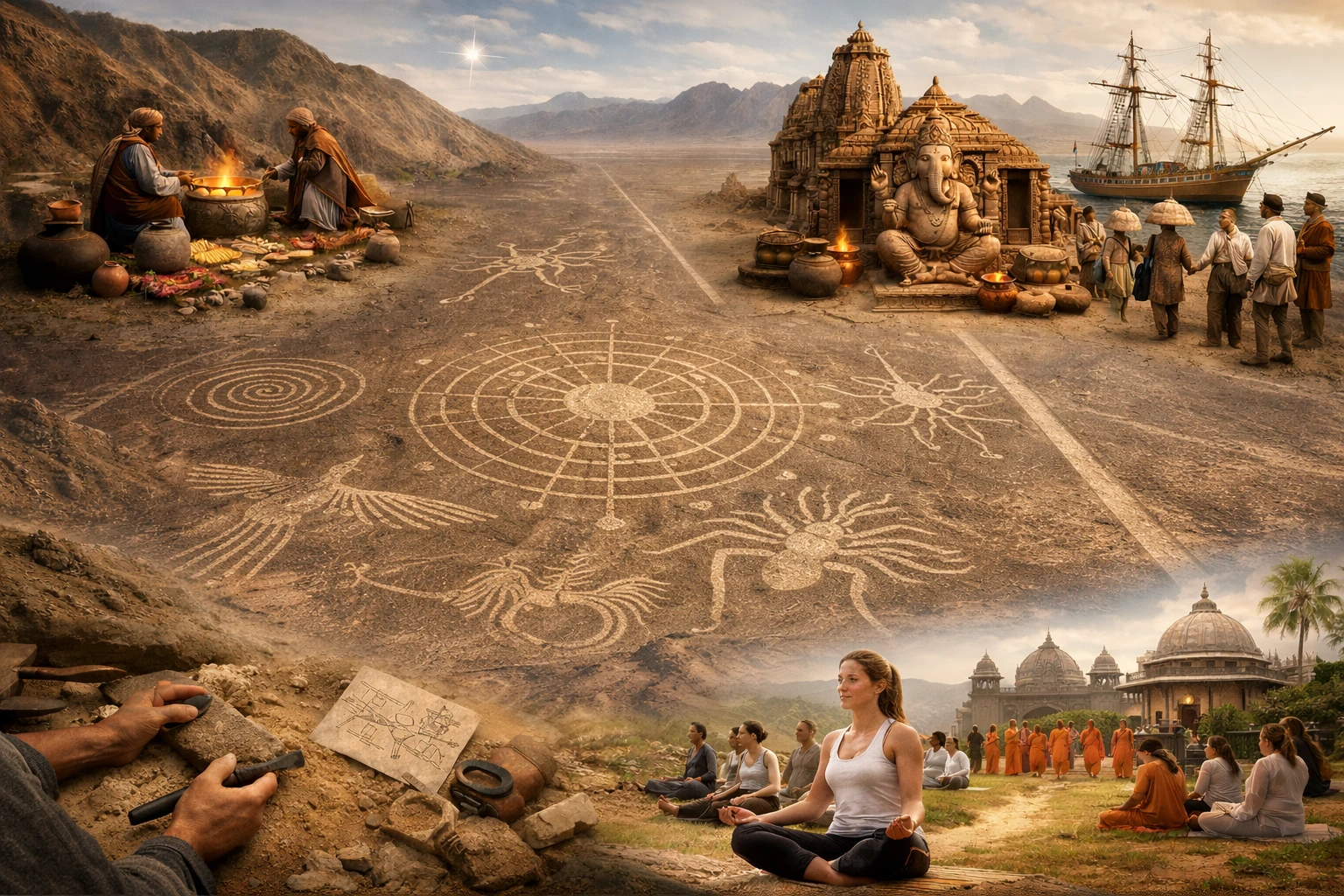
You’re looking at an aerial photo of Peru’s Nazca desert… and something strange happens.
Your brain clicks.
A curve becomes a symbol.
An oval becomes a sacred form.
A long, straight line feels like a deliberate message—meant for someone who “knows.”
And suddenly the question isn’t “What are the Nazca Lines?”
It’s: What if this is connected to Hinduism?
If you’ve ever felt that spark of recognition, you’re not alone. And you’re not “wrong” for wondering.
The “Mandala” You Think You Saw
Let’s start with the honest part: some Nazca shapes do look like things we recognize.
Ovals, circles, radiating lines, symmetric geometry—these forms feel “symbolic” because humans have used them symbolically for thousands of years.
But here’s the hidden twist:
Recognition isn’t evidence. It’s a brain feature.
Pattern-recognition vs historical proof
Humans are wired to find meaning fast. In psychology, this tendency is often described as pareidolia: seeing faces in clouds, animals in constellations, or symbols in random forms.
That doesn’t mean the Nazca Lines are random. They aren’t.
It means this: a shape that resembles a mandala doesn’t automatically prove mandalas were exported to Peru.
Why circles and straight lines appear everywhere
Circles and lines are “universal tools” for:
- marking space for gatherings and rituals
- creating processional routes
- making large designs using rope-and-stake geometry
- signaling directions or boundaries
So yes—an oval can feel spiritual. It can also be practical, ceremonial, or both.
What the Nazca Lines Actually Are
The Nazca Lines are geoglyphs—giant ground drawings made by removing darker surface stones to expose lighter soil beneath. They are generally dated to roughly 500 BCE to 500 CE on the Nazca and nearby pampas.
UNESCO describes the Nazca/Palpa geoglyphs as drawings of living creatures, stylized plants, imaginary beings, and long geometric figures created in that period.
They’re massive. Many are best appreciated from the air, though some are visible from surrounding foothills.
So the right starting question isn’t “Which religion owns these shapes?”
It’s: What did the Nazca people themselves likely use them for?
The Most Credible Nazca Lines Theories
Scholars don’t claim a single perfect answer. But modern research increasingly clusters around one strong idea:
Water, fertility, and ritual pathways
National Geographic’s reporting highlights research arguing that many lines and trapezoids connect to ritual activity linked to water and fertility—especially important in a desert environment. It quotes archaeologists Johan Reinhard and Anthony Aveni, who connect straight lines and trapezoids to water-related ritual practices rather than literal “water maps.”
That’s a major point:
“Related to water” doesn’t mean “used to find water.”
It often means “used to ask for water.”
This interpretation also fits a broader Andean pattern: ceremonies, offerings, and sacred landscapes tied to agriculture and rain.
Astronomy claims—what holds up, what doesn’t
Earlier researchers proposed astronomical or calendrical uses. Many explainers still include those ideas, but they’re frequently presented today as debated rather than settled.
The safest, most evidence-aligned stance is:
- astronomy may explain some alignments
- it likely does not explain the entire complex
Why “aliens” and hyper-diffusion don’t meet evidence standards
Popular culture loves the “runways for UFOs” narrative. Scholarly summaries typically classify it as speculation without archaeological support.
The same caution applies to “Hindu explorers did this” arguments unless they come with:
- datable inscriptions
- material trade evidence
- unmistakable cultural artifacts in context
- credible historical documentation
Which brings us to the biggest confusion in many blog debates.
The “Trident of Peru” and Why It’s Different
Many discussions mix two separate things:
- Nazca Lines (Nazca desert plateau)
- Paracas Candelabra (Paracas Peninsula near Pisco Bay)
The Paracas Candelabra is a large geoglyph sometimes called the “Trident.” Wikipedia notes pottery nearby dated around 200 BCE, associated with Paracas culture.
It’s visually striking. It can resemble a trident.
But resemblance still isn’t proof of Hindu origin.
A trident-like form can appear as:
- a botanical motif
- a directional marker
- a religious symbol within Andean systems
- a maritime landmark
Even modern travel/history sources often present multiple hypotheses rather than a single confirmed meaning.
Key takeaway: The Candelabra is culturally and geographically related to the region’s ancient peoples—but it is not a “smoking gun” for Hinduism.
Is There Evidence Nazca Was Hindu?
Let’s be precise and respectful.
What evidence would be required
To seriously claim the Nazca Lines are part of Hinduism, we’d need at least one of these:
- Sanskrit (or related) inscriptions in secure archaeological context
- Hindu iconography with datable artifacts (temples, sculptures, ritual objects) in Nazca layers
- genetic/settlement evidence of ancient South Asian migration to that region in that period
- documented historical contact routes with material trade trails
What we actually have (and what we don’t)
What we do have, from authoritative summaries:
- strong evidence the geoglyphs were made by local Andean cultures in that era
- credible theories pointing to ritual activity tied to water/fertility in a desert ecology
- ongoing discoveries expanding the catalog, showing the tradition is local and complex over time
What we don’t have (in mainstream archaeological references):
-
confirmed Hindu textual or material signatures in Nazca geoglyph context
So the most responsible answer is:
No—there is currently no credible archaeological consensus that the Nazca Lines are part of Hinduism.
That doesn’t insult Hinduism. It protects history from being rewritten by visual coincidences.
How Hinduism Really Reached Latin America
Here’s where the story becomes genuinely fascinating—because Hinduism did reach parts of the Americas in well-documented ways.
1) Indentured labor migration (19th to early 20th century)
Large Hindu communities formed in places like Guyana and Suriname, primarily through descendants of Indian indentured laborers.
These communities preserved festivals, temples, and practices over generations—creating deep, living Hindu cultures in the region.
2) Later migration for business and professional life (mid-20th century onward)
Some South American countries saw smaller waves of Indian migration later. For example, summaries of Hinduism in South America note a small Indian community in Peru emerging in the 1960s and later.
So if your question is “How did Hinduism reach Latin America?” the strongest answer is:
- migration + diaspora communities
- not ancient geoglyph authorship
3) Modern spiritual movements and local interest
Across Latin America, yoga, Vedanta-inspired groups, and ISKCON centers have also played a role in modern Hindu practice and interest.
A Credibility Checklist for Big Claims
If you’re a student, parent, or educator, this checklist helps you evaluate dramatic “hidden history” theories without shutting curiosity down.
1) Timeline test
-
Nazca geoglyphs: roughly 500 BCE–500 CE
If a claim requires a 10,000+ year leap or vague “ancient global civilization,” be cautious.
2) Context test
A symbol is only meaningful if it appears with:
- matching artifacts
- matching rituals
- matching language evidence
- datable layers
3) Linguistics red flags
Sound-alike words (e.g., “Inti” and a Sanskrit term) are not proof of shared origin. In fact, “Inti” is tied to Andean language history, often discussed as a local or regional borrowing rather than an Indian import.
4) Single-symbol trap
If one shape (oval, trident, monkey) is doing all the proof work, the argument is weak.
5) Best-source rule
Prefer:
- UNESCO site documentation
- major archaeological syntheses and reputable explainers quoting domain experts
Conclusion
The Nazca Lines feel like a message because they were likely made for meaning—ritual meaning, landscape meaning, community meaning.
But meaning is not the same as a Hindu origin story.
What the strongest evidence suggests is beautifully human:
- people living in a harsh desert
- building sacred space on a monumental scale
- connecting ceremony, survival, and awe in the landscape
And the story of Hinduism in Latin America is also real—just later, and better documented:
-
diaspora, migration, community-building, and cultural continuity