Are Egyptian Gods the Same as Hindu Gods? Similarities, Symbols, and the Real Story
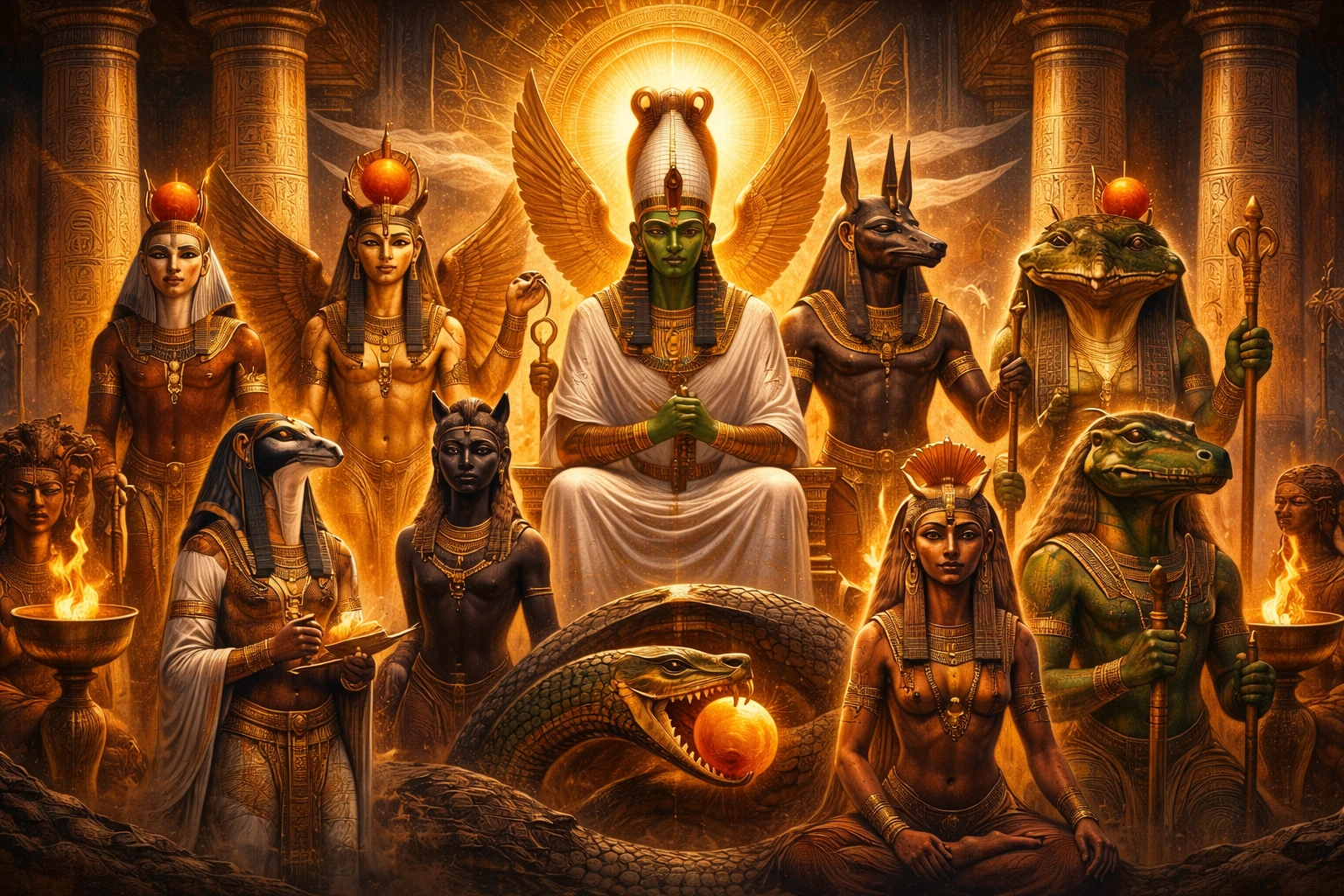
Introduction
You notice it in one second.
A looped cross in a museum looks oddly familiar.
A serpent “swallows the sun” in a story from another continent.
A god judges the dead, and suddenly you’re thinking of karma.
And then the thought lands like a secret you weren’t supposed to hear:
What if Egyptian gods are actually our Hindu gods—just wearing different names?
Before we answer, let’s do something smarter than jumping straight to “yes” or “no.” Let’s map the similarities, test what they can prove, and keep the wonder intact without losing the truth.
The “Same Gods” Question
Why it feels true
When two cultures describe:
- a moral universe,
- a powerful sun deity,
- a path after death,
- and symbols of protection and life,
our brain does what it’s built to do: pattern-match.
That doesn’t mean the connection is fake. It means the connection might be human.
Across civilizations, people asked the same hard questions:
- Why do good people suffer?
- What happens after death?
- Who controls the sky, the river, the harvest, the storm?
- How do we live so life doesn’t fall apart?
When questions rhyme, myths rhyme too.
Similarity isn’t proof of sameness
Here’s the key idea that most SERP pages skip:
Resemblance can come from three different causes:
- Shared human experience (death, fear, nature, power, family)
- Cultural contact (trade, travel, translation, borrowing)
- Shared origin (common ancestry of a tradition)
Most online comparisons jump straight to #3.
A careful comparison checks #1 and #2 first.
A Quick Timeline Check
Why “Hinduism began in X BCE” is tricky
It’s tempting to put religions on a single start date. But “Hinduism” is a wide river, fed by many streams: Vedic ritual traditions, philosophical schools, local deities, temple movements, bhakti poetry, and more.
So instead of claiming one exact birth year, it’s safer to say:
-
Hindu traditions develop over long periods, with early Vedic literature and later expansions across centuries.
That framing protects you from overconfident date claims—and makes your argument stronger.
What we can say about ancient Egypt’s religious record
For Egypt, we do have a deep, long religious record tied to dynasties, temples, and funerary texts. But even there, beliefs evolved over time (Old Kingdom → Middle Kingdom → New Kingdom, and beyond).
Bottom line: both worlds are ancient and layered. A fair comparison compares themes and functions, not just names.
Afterlife: Duat vs Lokas
This is where the similarities feel the most intense—because the emotional problem is universal:
If life ends, does meaning end too?
The Egyptian afterlife in one clear storyline
In many Egyptian accounts, the dead face judgment in a divine court:
- The deceased comes before Osiris.
- There is a moral evaluation tied to Ma’at (truth, balance, justice).
- The “weighing of the heart” compares the heart to Ma’at’s feather.
- Traditions describe Forty-Two assessors/judges connected to this process.
If the person is “in balance,” they continue toward a blessed afterlife (often described as an ideal field-like paradise). If not, the journey ends in destruction of the self/soul, rather than eternal comfort.
This is not random fantasy. It’s a moral system: your life has consequences.
The Hindu parallel readers recognize
In Hindu thought, the soul’s journey is also morally shaped. Karma creates consequences. Yama appears in many narratives as a judge-like figure. Rebirth logic explains why outcomes don’t always happen immediately.
Different schools explain details differently, but the shared spine is familiar:
- Actions matter.
- The soul’s journey continues.
- There is moral order, even when life seems unfair.
What this similarity can mean
This is the first “aha” moment:
A moral afterlife is not rare because cultures copied it—
it’s common because humans need moral meaning when facing death.
So yes, the parallels are real.
But they don’t automatically mean “same gods.”
Symbols: Ankh, Shivling, and the Eye
Symbols are where comparisons go viral—because a symbol hits you instantly.
Ankh vs Shivling: similar silhouette, different function
The ankh is a famous Egyptian symbol associated with life and often with life-after-death meanings, shown in the hands of gods and linked to vitality and enduring existence.
That’s why people compare it to the Shivling, which is deeply sacred in Shaiva traditions and is tied to creation-energy, presence, and devotion.
But here’s the careful distinction:
- The ankh is primarily a symbol-sign in Egyptian iconography meaning “life.”
- The Shivling is a ritual object of worship with layered theology across texts, regions, and lineages.
A similar outline is interesting—but function matters more than shape.
Eye of Horus vs “third eye”
People also map the Eye of Horus onto Shiva’s “third eye.”
The Eye of Horus is widely associated with protection, healing, and wholeness in Egyptian symbolism. Some modern comparisons link it to “inner vision,” but it’s not literally the same concept as the Hindu third eye.
So what’s the honest take?
- Both traditions use “eye” symbolism to express power beyond ordinary sight.
- But each symbol lives inside a different story-world.
Sun-Swallowing Myths: Apep and Rahu
This is one of the most cinematic parallels.
Apep and the Egyptian sun drama
In Egyptian myth, a chaos-serpent (often called Apep/Apophis) battles the solar order associated with Ra. Many popular retellings describe the serpent as a great enemy of the sun’s journey.
Rahu and the eclipse memory
In Hindu mythic tradition, Rahu is associated with the swallowing of the sun and moon—often tied to explaining eclipses through a mythic lens.
This is the second “aha” moment:
Eclipses are terrifying if you don’t have astronomy.
So cultures create stories that make the fear understandable.
Different regions, same sky problem, similar narrative solution.
So… Is Shiva “Ruling Egypt”?
If we define “same god” as “same name and same myth,” then no.
But if we define “same god” as “same human need expressed in divine form,” then the answer becomes more subtle.
Shiva, across many Hindu traditions, represents huge ideas:
- transformation,
- dissolution and renewal,
- power over fear,
- the breaking of illusion.
Egyptian religion also holds huge ideas:
- cosmic balance (Ma’at),
- life-force and continuation,
- divine kingship,
- the victory of order over chaos.
So here’s the strongest statement you can responsibly make:
Egyptian mythology and Hindu mythology sometimes point at similar truths—without being identical systems.
That keeps the wonder and protects the facts.
How to Compare Mythologies Without Fighting
If you’re a parent, student, or educator, this is the part that saves conversations.
A simple 3-step method
- Theme: What human problem is the myth solving? (Death, justice, nature, power)
- Role: What job does the deity do in that system? (Sun order, judgment, protection)
- Symbol: What visual shorthand carries the idea? (Eye, serpent, feather, river)
If the theme matches but the role differs, it’s probably parallel evolution.
If the role matches and there’s evidence of contact, it might be influence.
If names, roles, rituals, and texts align strongly, then you can discuss shared origin—but that’s the hardest claim and needs the strongest proof.
The trap to avoid
The internet loves this line: “Your god is my god.”
It sounds unifying, but it can also erase uniqueness—especially for people who hold these traditions as living faiths, not museum stories.
A healthier line is:
“Our ancestors asked similar questions—and answered with breathtaking imagination.”
Conclusion
So, are Egyptian gods our Hindu gods?
If you mean identical deities with the same historical identity, there’s no solid basis to claim that. The similarities online are often built on symbol-shapes and role-matching, which are intriguing but not decisive.
If you mean shared human themes—life, death, moral order, cosmic balance—expressed through divine stories, then yes, the resemblance is real, and it’s worth studying.
And maybe that’s the real treasure:
not proving sameness, but discovering how far human meaning can travel—without any map.