Is Hecate Really Kali? The Hidden Truth Behind “Greek Mythology Came From Hinduism”
Introduction
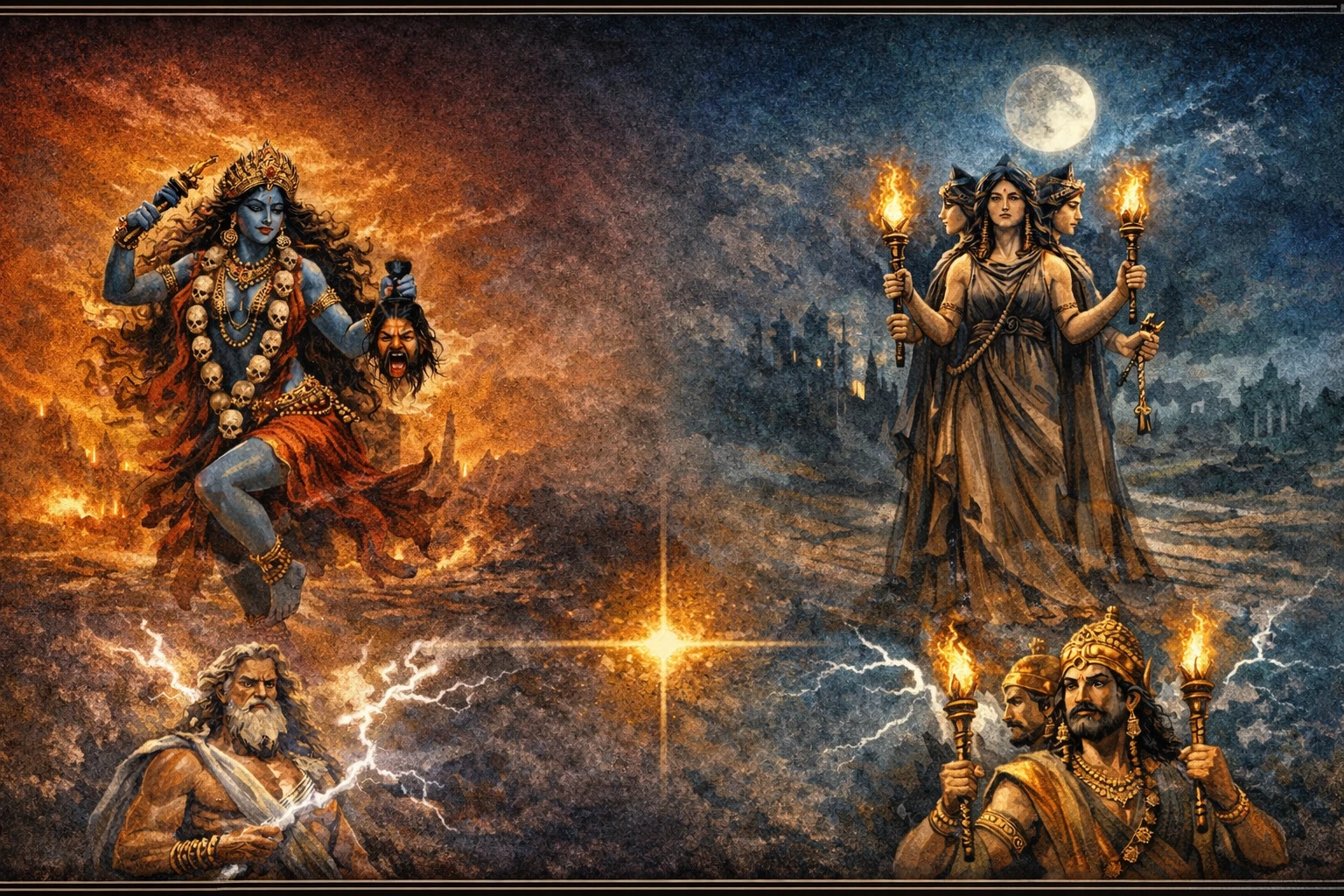
Something strange happens whenever people read about Hecate at a crossroads—torches raised, keys in hand, a night goddess who feels both protective and terrifying. If you’ve also met Kali in Hindu mythology—dark, fierce, dancing on the edge of creation and destruction—you may get the same unsettling thought:
What if they’re the same goddess wearing two masks?
Before we answer, here’s the twist: the most convincing evidence isn’t in the scary parts (blood, black, snakes). It’s hidden in something much older and quieter—how ancient humans everywhere tried to name the same invisible forces.
Why Kali and Hecate feel “too similar”?
When someone asks “Is Hecate Kali?”, they’re usually noticing a pattern:
- Both are linked to death and transformation.
- Both appear in dark, liminal spaces (night, graveyards, cremation grounds, thresholds).
- Both are connected to power that can protect or terrify.
- Both have devotees today who speak about witchcraft or tantric practice.
That’s a real emotional experience—and it deserves a real answer. But first, three quick traps that make the internet more confident than the evidence:
- Trap 1: Symbols aren’t fingerprints. Black, snakes, keys, blood appear in many cultures.
- Trap 2: Modern labels rewrite ancient gods. “Wiccan Hecate” isn’t identical to “Classical Greek Hecate.”
- Trap 3: Cherry-picking hides differences. Similarity lists rarely explain what doesn’t match.
Let’s meet each goddess on her own ground first.
Who Kali is in Hindu mythology?
Kali is often introduced as destruction—but that’s only half the story.
In many Hindu traditions, Kali represents time, truth, and the fierce force that cuts illusion away. Her iconography can be frightening because she doesn’t flatter the human ego. She shows what life contains: endings, impermanence, and the power of renewal.
One widely told myth involves the demon Raktabīja, whose blood creates more demons every time it touches the ground. Kali stops the multiplying horror by drinking the blood before it falls—an image that’s shocking on purpose, because it dramatizes a deeper idea: some problems can’t be solved gently.
In other tellings, Kali emerges through Parvati/Durga’s fierce energy to defeat Daruka, and Shiva intervenes to calm her overwhelming momentum after battle. The point isn’t “evil magic.” The point is uncontained power—the kind that must be integrated, not suppressed.
So when people call Kali a “Tantric goddess,” they’re pointing to a tradition that sees her as Shakti—active spiritual energy—capable of both terrifying confrontation and liberating insight.
Who Hecate is in Greek mythology ?
Hecate is often described as a “witchcraft goddess,” but in Greek religion she was also something extremely practical:
A guardian of thresholds.
Britannica notes that Hecate was closely associated with magic and spells, and that pillars (Hecataea) stood at crossroads and doorways, likely as protection against harmful spirits.
That protective function matters because it explains her symbols:
- Torches: not just spooky props—light that guides and reveals.
- Keys: authority over gates, entry, and passage.
- Crossroads: places of decision, danger, and “between-ness.”
Hecate also becomes strongly linked with liminal rites—the edges of life: birth, transition, death, and journeys to the underworld. Over time (especially in later Greco-Roman and magical texts), she becomes even more associated with ghosts, night, and esoteric practice—one reason modern readers meet her first as “dark.”
And yes: she is famously depicted in triple form. But “three” doesn’t automatically mean the modern “maiden-mother-crone” framework. In many contexts, the triple form emphasizes her presence facing multiple directions at a crossroads, or her ability to operate across boundaries.
The similarities that are real:
Here’s where the Kali Hecate comparison becomes genuinely interesting—because some similarities are not random.
1) Liminal power: where ordinary rules weaken
Kali is linked to cremation grounds and the edge of fear; Hecate is linked to doorways and crossroads. Different landscapes, same psychological territory: the places where you feel the world is bigger than your plans.
2) Protective fear: the “terrible” goddess as guardian
In many mythologies, the figure that looks frightening is the one keeping chaos out. Hecate’s crossroads shrines suggest a protective role against harmful forces.
Kali’s terrifying imagery often points to her refusal to let evil multiply (Raktabīja) or to let illusion survive.
3) Shared symbols don’t prove shared identity
Black, snakes, blood, night—these motifs appear across cultures because they are universal human languages for danger, power, death, and the unknown.
So the similarities are real. But what do they prove?
They prove that humans pattern-match the mysteries of life. They do not prove that Kali and Hecate are historically the same goddess.
Did Greek mythology come from Hinduism?
This is the bigger claim inside the blog topic: Has Greek mythology come from Hinduism?
The evidence points to a more careful answer:
Shared “family resemblance” (Indo-European inheritance)
Greek and early Indo-Aryan traditions are often discussed as part of a broader Indo-European family of languages and myth patterns. Comparative reconstructions of Proto-Indo-European mythology highlight recurring motifs like a sky-father figure, divine twins, and a thunder/serpent-slayer pattern—motifs that can echo across Greek and Vedic worlds without requiring direct borrowing.
This is why a rigorous explanation of similarities often begins with shared roots, not “one copied the other.” A widely referenced explanation in a moderated historical forum puts it bluntly: the systems are “sisters” descended from an older Indo-European continuum, not simple derivatives.
Historical contact (real, but not a blank check)
There was historical Greek presence and interaction in parts of South Asia (Indo-Greek kingdoms, diplomacy, trade). But contact alone doesn’t mean wholesale religious import. It means some exchange was possible—especially in art, philosophy, and local cult practice—while still leaving each tradition distinct.
Bottom line: “Greek mythology came from Hinduism” is usually too strong. “They share ancient patterns, and later cultures interacted” is closer to the evidence.
Popular parallels like Zeus–Indra
People love comparisons because they’re a fast way to learn. They can help—as long as we label them correctly.
Zeus and Indra (a useful parallel, not a proof)
Britannica describes Indra as a major early deity associated with the thunderbolt, rain, and heroic battle (including slaying the dragon Vritra).
So when readers compare Zeus and Indra, they’re noticing a recognizable “storm-king” role. That can be a meaningful functional parallel.
But a functional parallel is not the same as:
- same name,
- same origin story,
- same theology,
- or same worship practice.
Yama and Hades (helpful for “role,” risky for worldview)
Comparing underworld rulers can help a student remember who governs death. But Greek afterlife concepts and Hindu cyclical rebirth frameworks operate differently—so the comparison can become misleading if it implies the same moral logic.
A good rule for students and educators:
-
Compare roles first (what do they do?)
-
Then compare worldviews (what does “death” mean in that system?)
So is Kali Hecate?
Here’s the careful answer:
No—Kali and Hecate are not “the same goddess” in a historical, textual, or cultic sense.
They emerge from different religious worlds, with different narratives, rituals, and theological meanings.
But here’s the part most articles miss:
They can still be compared—because they occupy similar “mythic jobs” in the human imagination.
Both stand at the edges: the places where fear becomes wisdom, and endings become beginnings.
If you want to explore comparative mythology without flattening either tradition, start with sources that describe each goddess in context (for example, Hecate’s crossroads/torches role in Greek religion).
If you’re building your own reading list and want more grounded myth explainers, you’ll find curated learning paths at Navora Press.
Conclusion: Keep the wonder, upgrade the evidence
The temptation is to solve the mystery by declaring a single identity: Kali Hecate—case closed.
But the richer truth is more interesting: myths don’t need to be identical to be connected. Some similarities come from shared ancient patterns; others come from universal symbols humans use to speak about death, power, and transformation.
So instead of “Greek mythology came from Hinduism,” try this:
Greek and Hindu mythology sometimes rhyme—because human beings rhyme.